A quality garage floor coating transforms a stained, dusty concrete slab into a durable, attractive surface that resists chemicals, hot tires, road salt, and years of abuse. But the market is crowded with options — epoxy, polyurea, polyaspartic, concrete sealer, and various hybrid formulas — each with different performance characteristics, application requirements, and price points.
Part of our Epoxy, Concrete & Garage Floors guide — explore the full guide →
This guide breaks down the four main types of garage floor coating, compares them head-to-head on the factors that matter most for garages, and helps you decide between a DIY kit and a professional installation.
- Four Types of Garage Floor Coating
- Head-to-Head Comparison
- Epoxy Garage Floor Coating
- Polyurea Coating
- Polyaspartic Coating
- Concrete Sealer
- Cost Comparison
- DIY Kits vs Professional Installation
- Application Process Overview
- Frequently Asked Questions
- What is the best garage floor coating for hot tire pickup?
- How long does garage floor epoxy last?
- Can I apply garage floor coating over old epoxy?
- Is garage floor coating slippery when wet?
- How long before I can park on a new garage floor coating?
- Do I need to seal my garage floor before coating?
- What is the cheapest way to coat a garage floor?

If you’re running out of room even with a clean garage floor, a backyard shed takes the overflow — seasonal gear, tools, lawn equipment. And if you’re parking outside while the garage doubles as a workshop, a carport keeps your car covered without needing a second garage.
We may earn a commission when you purchase through our links.
Four Types of Garage Floor Coating
Each garage floor coating type uses different chemistry, which determines how it performs in real-world garage conditions — temperature swings, hot tire pickup, chemical spills, and UV exposure.
Epoxy is the most well-known option. It is a two-part system (resin + hardener) that creates a thick, hard coating with excellent chemical resistance. Garage floor epoxy has been the standard for decades, and the majority of DIY kits sold at hardware stores are epoxy-based.
Polyurea is a flexible, fast-curing coating with superior impact resistance and temperature tolerance. It bonds aggressively and is far more flexible than epoxy, making it resistant to cracking from concrete movement and thermal cycling.
Polyaspartic is a type of aliphatic polyurea with enhanced UV stability and clarity. It cures fast (often same-day return-to-service), does not yellow, and is commonly used as a topcoat over epoxy or as a standalone full-system coating.
Concrete sealer is the simplest option — a penetrating or film-forming product that protects the concrete without building up a thick coating. Sealers are the most affordable option but offer the least protection and aesthetic enhancement.
Head-to-Head Comparison
| Factor | Epoxy | Polyurea | Polyaspartic | Concrete Sealer |
|---|---|---|---|---|
| Durability | Very good | Excellent | Excellent | Moderate |
| Chemical resistance | Excellent | Excellent | Very good | Low to moderate |
| Hot tire resistance | Moderate (can peel) | Excellent | Excellent | N/A (no film) |
| UV stability | Poor (yellows) | Good | Excellent (no yellowing) | Varies by type |
| Flexibility / crack bridging | Low (rigid) | High | Moderate to high | N/A |
| Cure time (full use) | 5 – 7 days | 24 hours | 24 hours | 24 – 48 hours |
| Application temperature | 50°F – 90°F | 0°F – 100°F+ | 35°F – 100°F+ | 40°F – 90°F |
| DIY friendly? | Yes (most common DIY) | No (fast cure = pro only) | Possible (advanced DIY) | Yes (easiest) |
| Installed cost / sq ft | $3 – $7 (DIY) / $5 – $10 (pro) | $6 – $12 (pro only) | $5 – $10 (pro) | $0.50 – $2 (DIY) |
| Lifespan | 5 – 10 years | 15 – 20+ years | 15 – 20+ years | 2 – 5 years |
Epoxy Garage Floor Coating
Epoxy coatings have been the go-to garage floor coating for decades. The two-part formula (Part A resin + Part B hardener) creates a chemical reaction that produces a thick, rigid, glass-like surface with outstanding chemical resistance. Gasoline, oil, brake fluid, and antifreeze wipe up without staining.
Strengths:
- Excellent chemical and stain resistance — the best option for garages where automotive fluids are common
- Thick build (10 to 20 mils per coat) hides minor concrete imperfections
- Widely available as affordable DIY kits ($100 to $300 for a 2-car garage)
- Decorative options include color flake chips, metallic pigments, and quartz broadcast
- Strong adhesion to properly prepared concrete
Weaknesses:
- Hot tire pickup is epoxy’s biggest problem. Hot tires from summer driving soften the epoxy surface, and when the tires cool, they can bond to and peel the coating. This is especially common with water-based and low-solids epoxy kits.
- UV yellowing. Epoxy is not UV-stable. In garages with windows or frequently open doors, clear epoxy yellows and white epoxy turns amber over time.
- Long cure time. Full chemical cure takes 5 to 7 days. Light foot traffic is possible in 24 hours, but vehicles should stay off for at least 72 hours (a week is better).
- Rigid and brittle. Epoxy does not flex. If the concrete slab shifts or cracks, the epoxy cracks with it.
For a detailed breakdown, see our garage floor epoxy guide and our comparison of epoxy vs polyurethane floor coatings.
Polyurea Coating
Polyurea is the premium option for garage floor coating. It is a two-component, spray-applied coating with exceptional flexibility, rapid cure time, and broad temperature tolerance. Most professional garage floor coating companies (e.g., Penntek, Polyaspartic, ArmorPoxy commercial lines) use polyurea or polyurea/polyaspartic hybrid systems.
Strengths:
- Extremely flexible — bridges hairline cracks and handles concrete expansion/contraction
- Cures in hours, not days — garage can be used within 24 hours
- Works in extreme temperatures: can be applied in freezing conditions where epoxy cannot
- Outstanding hot tire resistance — no peeling or lifting
- Impact-resistant: dropped tools and heavy equipment do not crack the coating
- 15 to 20+ year lifespan with minimal maintenance
Weaknesses:
- Fast cure time makes it extremely difficult for DIY — pot life can be under 10 minutes
- Requires professional spray equipment for proper application
- Higher cost: $6 to $12 per square foot installed
- Surface preparation is critical — any moisture or contaminants cause adhesion failure
Polyaspartic Coating
Polyaspartic is a specific type of aliphatic polyurea that offers a balance between epoxy’s DIY accessibility and polyurea’s performance. Many professional installers use polyaspartic as a topcoat over an epoxy base coat, combining epoxy’s chemical resistance with polyaspartic’s UV stability and flexibility.
Strengths:
- UV-stable: will not yellow, even in garages with significant sunlight exposure
- Fast cure: walk-on in 4 to 6 hours, vehicle traffic in 24 hours
- Excellent clarity — makes decorative flake and metallic floors look their best
- Better flexibility than epoxy, good hot tire resistance
- Can be applied as a full system (base + top) or as a topcoat over epoxy
Weaknesses:
- Chemical resistance is slightly lower than pure epoxy — motor oil and battery acid should still be wiped promptly
- Fast cure can be a challenge for DIY installers working alone in large garages
- More expensive than epoxy kits
Concrete Sealer
Concrete sealers are the entry-level option for garage floor coating. They protect the concrete from moisture penetration, dusting, and light staining without creating the thick, glossy film of epoxy or polyurea.
Penetrating sealers (silane, siloxane, lithium silicate) soak into the concrete and react chemically to block moisture from below. They do not change the appearance of the floor. Ideal for garages where you want protection without a coated look.
Film-forming sealers (acrylic, polyurethane) create a thin surface film that adds a slight sheen and moderate stain resistance. They are easier to apply than epoxy but wear much faster — especially under vehicle traffic.
| Sealer Type | Appearance | Stain Protection | Durability | Cost (per sq ft) |
|---|---|---|---|---|
| Penetrating (silane/siloxane) | Natural (unchanged) | Good (moisture + salt) | 3 – 5 years | $0.15 – $0.50 |
| Lithium silicate densifier | Natural (slight hardening) | Moderate | 5 – 10 years | $0.15 – $0.40 |
| Acrylic film-forming | Low to high gloss | Moderate | 1 – 3 years | $0.20 – $0.60 |
| Polyurethane film-forming | Satin to high gloss | Good | 2 – 5 years | $0.30 – $0.75 |
Sealers are best for homeowners on a tight budget, garages used primarily for storage (not daily vehicle parking), or as a temporary measure before a full coating job. For a garage flooring overhaul, a full coating system is worth the investment.
Cost Comparison
| Coating Type | DIY Material Cost (2-car garage, ~450 sq ft) | Professional Installed Cost | Lifespan | Cost Per Year |
|---|---|---|---|---|
| Concrete sealer | $75 – $200 | $200 – $500 | 2 – 5 years | $40 – $100 |
| Epoxy (DIY kit) | $100 – $350 | $2,500 – $4,500 | 5 – 10 years | $20 – $70 (DIY) |
| Polyaspartic (full system) | $300 – $600 | $2,500 – $5,000 | 15 – 20 years | $20 – $40 (DIY) |
| Polyurea (professional) | N/A (pro only) | $3,000 – $6,000 | 15 – 20+ years | $150 – $300 |
When evaluated on a cost-per-year basis, the premium coatings (polyurea, polyaspartic) are often the best value. A $300 DIY epoxy kit that lasts 5 years costs $60/year; a $5,000 professional polyurea job that lasts 20 years costs $250/year but requires zero reapplication effort.
DIY Kits vs Professional Installation
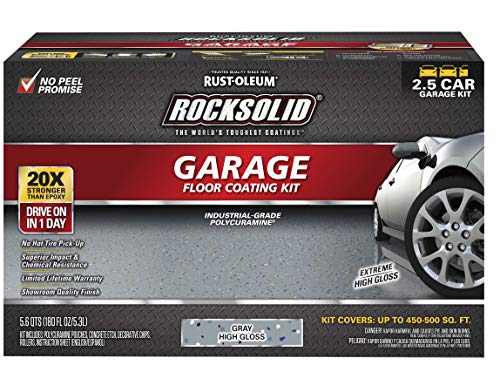
DIY is viable for epoxy and concrete sealer. Hardware-store epoxy kits (Rust-Oleum RockSolid, EpoxyShield) include everything you need: etching solution or grinding pad, epoxy base coat, decorative flakes, and a clear topcoat. Cost: $100 to $350 for a 2-car garage. The process takes a full weekend and the garage is out of service for 5 to 7 days.
Professional installation is recommended for polyurea and polyaspartic. These products cure too fast for amateur application — pot life is measured in minutes, not hours. Professionals use industrial grinders to prepare the concrete (far superior to acid etching), spray-applied coatings for even coverage, and broadcast decorative media at professional density. Results are measurably better than DIY.
The surface preparation gap is the real difference. Professional installers diamond-grind the concrete surface, which removes old coatings, opens pores for adhesion, and creates a consistent profile. DIY kits typically rely on acid etching, which is less effective and less consistent. Poor surface prep is the number-one cause of garage floor coating failure regardless of the coating type.
Application Process Overview
Step 1: Empty and clean the garage. Remove everything — vehicles, shelving, storage bins. Sweep and degrease the floor with a concrete cleaner/degreaser. Oil stains must be treated specifically with a poultice or degreaser — coatings will not adhere over oil-saturated concrete.
Step 2: Prepare the surface. Diamond grinding (professional) or acid etching (DIY). The concrete must have an open-pore texture that feels like medium sandpaper. A smooth, sealed surface will cause the coating to peel.
Step 3: Repair cracks and damage. Fill cracks with epoxy crack filler or polyurea joint filler. Level any uneven areas with patching compound. Let repairs cure fully before coating.
Step 4: Apply the coating system. Follow the specific product instructions for mixing ratios, pot life, and application technique. Most systems go down in 2 to 3 coats: primer/base coat, optional decorative flake broadcast, and a clear topcoat.
Step 5: Cure. Keep the garage closed and temperature-stable during curing. Epoxy: 5 to 7 days for full vehicle traffic. Polyurea/polyaspartic: 24 hours for vehicle traffic.
Frequently Asked Questions
What is the best garage floor coating for hot tire pickup?
Polyurea and polyaspartic coatings offer the best hot tire resistance. They remain flexible at high temperatures, preventing the bonding and peeling that plagues epoxy coatings. If you choose epoxy, apply a polyaspartic topcoat — it provides a heat-resistant barrier between the tires and the epoxy layer.
How long does garage floor epoxy last?
DIY epoxy kits typically last 3 to 5 years with regular vehicle traffic. Professional-grade epoxy with a polyaspartic topcoat lasts 7 to 10 years. Polyurea and full polyaspartic systems last 15 to 20+ years. Lifespan depends heavily on surface preparation quality.
Can I apply garage floor coating over old epoxy?
Sometimes. The old epoxy must be fully bonded (no peeling or flaking) and the surface must be mechanically abraded (sanded or ground) to create a profile for the new coating. If the old epoxy is failing, it must be fully removed before recoating. A bonding test on a small area is recommended before coating the entire floor.
Is garage floor coating slippery when wet?
Glossy coatings can be slippery when wet. Most professional installers add anti-slip aggregate (aluminum oxide grit or polymer beads) to the topcoat for traction. Decorative flake broadcast also adds texture that improves grip. Ask your installer about slip resistance, or choose a textured finish if traction is a concern.
How long before I can park on a new garage floor coating?
Epoxy: 5 to 7 days minimum for vehicle traffic (24 hours for foot traffic). Polyurea and polyaspartic: 24 hours for vehicle traffic. Always follow the specific product’s cure time recommendations — parking too early is one of the most common causes of coating failure.
Do I need to seal my garage floor before coating?
No — the coating itself is the seal. In fact, applying a penetrating sealer before a coating can prevent adhesion. The concrete surface must be clean, porous, and unsealed for coatings to bond properly. If your concrete was previously sealed, the sealer must be removed by grinding before coating.
What is the cheapest way to coat a garage floor?
A penetrating concrete sealer ($75 to $200 for a 2-car garage, DIY) is the cheapest option. It protects against moisture and dusting but does not provide the thick, glossy finish of a full coating. The next cheapest is a DIY epoxy kit ($100 to $350), which provides a more durable and visually impressive result.