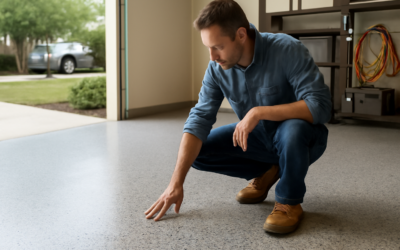
Bare concrete garage floors stain, dust, crack, and look worse every year. The right coating transforms that gray slab into a durable, chemical-resistant surface that cleans up with a hose and actually looks good. Understanding your garage floor coating options before committing saves you from the common trap of buying a cheap big-box kit that peels within a year. Each coating type has a specific strength — the key is matching it to your budget, climate, and how hard you use your garage.
Part of our Epoxy, Concrete & Garage Floors guide — explore the full guide →
Epoxy Coatings
Two-part epoxy is the most widely used garage floor coating and for good reason. It bonds chemically to concrete, builds a thick mil layer that fills minor imperfections, and resists oil, brake fluid, gasoline, and road salt far better than any paint.
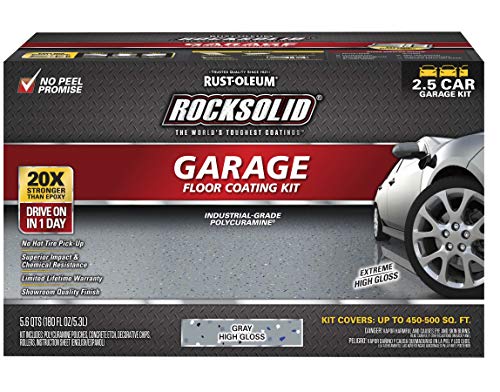
Water-based epoxy kits (like Rust-Oleum EpoxyShield) cost $70-$120 for a one-car garage and are the most DIY-friendly option. They go down with a roller, cure in 24 hours for foot traffic, and 72 hours for vehicles. The downside is thickness — these kits lay down 3-5 mils compared to 10-20 mils for professional-grade products. Expect 2-4 years of good performance in an actively used garage.
100% solids epoxy is what professional installers use. It contains no solvents or water, so what goes down stays down at full thickness — typically 10-15 mils per coat. Two coats produce a surface that lasts 10-20 years. Material cost runs $200-$400 for a two-car garage, plus $1,500-$3,000 if you hire a pro to apply it. Working time is limited to about 30-45 minutes before the mixed epoxy begins to gel, making this a challenging DIY project for beginners.

If you’re running out of room even with a clean garage floor, a backyard shed takes the overflow — seasonal gear, tools, lawn equipment. And if you’re parking outside while the garage doubles as a workshop, a carport keeps your car covered without needing a second garage.
We may earn a commission when you purchase through our links.
Polyurea and Polyaspartic Coatings
Polyurea and polyaspartic coatings are the newer, higher-performance alternative to epoxy. They cure faster, tolerate wider temperature ranges during application, and resist UV yellowing that plagues clear epoxy topcoats.
A polyaspartic system can be applied and driven on within 24 hours — some single-day systems are ready for vehicles in 8-10 hours. That speed matters in cold climates where a two-car garage cannot sit empty for three days. Polyaspartic coatings also stay flexible, making them more resistant to hot tire pickup — that annoying problem where warm tires pull up epoxy.
The trade-off is cost. Professional polyurea or polyaspartic installation runs $3-$7 per sq ft for a full system with primer, base coat, flake broadcast, and clear topcoat. A 500 sq ft two-car garage lands between $1,500-$3,500. DIY polyaspartic kits exist (ArmorPoxy and Penntek offer them) but the fast cure time leaves little room for error.
Concrete Paint
Latex or acrylic concrete paint is the simplest and cheapest option at $0.10-$0.25 per sq ft in material cost. A gallon of Behr Premium Porch and Patio Floor Paint covers about 400 sq ft and costs $30-$35. Roll it on with a standard 3/8-inch nap roller.
Paint sits on top of the concrete surface rather than bonding into it chemically. That distinction matters — paint is vulnerable to peeling, especially when moisture migrates up through the slab. In a garage that sees light use (storage, occasional parking, no heavy workshop activity), quality concrete paint lasts 2-3 years before needing a refresh coat. For working garages with vehicle traffic and chemical exposure, paint is a temporary solution at best.
Surface Preparation
Every coating manufacturer agrees on one thing: prep determines performance. No coating bonds to dirty, sealed, or poorly profiled concrete.
- Clean: Degrease the entire floor with a concrete cleaner or TSP solution. Scrub oil stains with a stiff brush
- Moisture test: Tape a 2 x 2 ft piece of plastic sheeting to the slab for 24 hours. If moisture collects underneath, you have a vapor transmission issue that must be addressed with a moisture-mitigating primer before coating
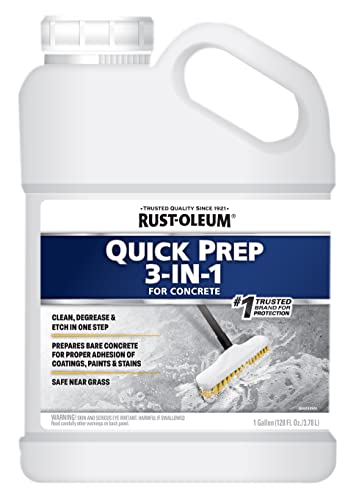
- Profile: The concrete surface needs a texture similar to 120-grit sandpaper for coatings to grip. Acid etching with muriatic acid solution is the budget method ($15-$25 in chemicals). Diamond grinding with a rented floor grinder ($150-$250 per day) produces a more uniform profile and is the professional standard
- Repair: Fill cracks wider than a hairline with an epoxy crack filler. Patch spalled areas with a concrete resurfacer and let cure fully before coating
Decorative Flake and Finish Options
Vinyl color flakes broadcast into wet base coat add grip, hide imperfections, and give the floor a professional showroom appearance. Full-flake coverage (where flakes completely hide the base color) is the most popular look for residential garages. Quarter-flake and half-flake broadcasts create a speckled pattern that uses less material.
Color choices range from standard gray-and-white blends to custom mixes with metallic, earth tone, or high-contrast chips. A 25 lb box of color flakes covers about 250 sq ft at full broadcast and costs $40-$80 depending on the brand and blend.
Cost Comparison at a Glance
- Concrete paint (DIY): $50-$120 for a two-car garage, lasts 1-3 years
- Water-based epoxy kit (DIY): $120-$250, lasts 2-5 years
- 100% solids epoxy (professional): $1,500-$3,000, lasts 10-20 years
- Polyurea/polyaspartic (professional): $1,500-$3,500, lasts 15-20+ years
Price per square foot ranges from as low as $0.10 for paint to $7.00 for a premium polyaspartic system. The professional coatings cost more upfront but their lifespan often makes them cheaper on a per-year basis. A $3,000 polyaspartic floor that lasts 20 years costs $150 per year — while a $150 epoxy kit reapplied every 3 years costs roughly $50 per year but demands repeated labor and downtime.