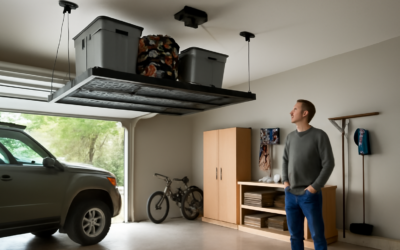
Ceiling racks are the cheapest storage in a garage — and the least used, because nobody enjoys hauling 60-pound totes up a ladder over their head. A garage storage lift system motorized removes the ladder from the equation entirely: a platform or hoist descends to waist height at the press of a button or remote, gets loaded on the ground, and carries 200 to 600 pounds back up to the ceiling. Prices run from about $200 for a motorized hoist to $1,500-plus for premium platform systems, which is real money against a $150 static rack — but for heavy bins, kayaks, rooftop tents, and anyone whose knees have opinions about ladders, it is one of the most-used gadgets a garage can own. Here is how the systems differ, which models lead the market, and what installation actually requires.
How Motorized Storage Lifts Work
All of these systems share the same anatomy: a steel platform, rack, or cradle suspended on aircraft-grade cables or straps, driven by an electric winch-style motor mounted to ceiling structure. The motor spools the cables through pulleys at the platform corners so the load rises level, and travel is controlled by a wall switch, wired pendant, or RF remote — better units add smartphone control. Two safety mechanisms matter and should be non-negotiable on your shortlist: automatic load-holding brakes (usually a worm-gear drive that cannot back-drive, so a power failure cannot drop the load) and upper/lower limit switches that stop travel automatically. Lifting speed is deliberately slow, typically 4 to 8 feet per minute; a full cycle from ceiling to floor runs about a minute, which feels stately the first day and perfectly fine forever after.
Platform Lifts vs. Specialty Hoists
The market splits into two families. Platform lifts — a 4-by-4 to 4-by-8-foot deck that descends flat — are the general-purpose choice for totes, coolers, luggage, and holiday bins, with capacities from 200 to 600 pounds. Because the platform lands at waist height or floor level, loading requires no lifting at all; you slide bins on, press up, and the whole shelf disappears overhead. Specialty motorized hoists handle single awkward objects: kayak and canoe cradles, overhead racks for rooftop tents and cargo boxes (a category the overlanding boom has exploded), motorcycle and e-bike lifts, and jeep hard-top hoists. These run 100 to 300 pounds of capacity and use slings or cradles instead of a deck. Choose by cargo: households mostly storing bins want one large platform; a garage with a 150-pound rooftop tent, two kayaks, and a cargo box may be better served by two or three targeted hoists at $200 to $500 each.
The Models That Lead the Category
- Auxx-Lift (Auxx Lift 1600): The best-known platform name — 4-by-8 deck, 600-pound rating, remote control, roughly $1,200 to $1,600. Their 4-by-4 units run $800 to $1,000.
- SmarterHome/Garage Smart: A modular ecosystem of app-controlled lifts — platform lifter, bike lift, kayak lift, universal lifter — mostly $400 to $1,200 per unit, strong on smartphone integration.
- Racor PHL-1R Pro HeavyLift (crank) with motor kits: The budget path — a $200 to $300 4-by-4 cable platform, hand-cranked, that some owners pair with a drill adapter; true motorization is worth buying purpose-built instead.
- Partner brand electric hoists (VEVOR, Big Ass overhead hoists): Generic 440-to-880-pound electric hoists from $150 to $350 adapted for cargo boxes and tents — capable, but verify brake type and use load-rated hardware throughout.
- Loft-It and Versalift-style attic lifts: A different niche — motorized dumbwaiters that move loads through an attic hatch, $1,500 to $3,500, for houses whose bulk storage lives above the ceiling entirely.
Across all of them, judge on rated capacity with safety factor stated, brake design, cable gauge, warranty (2 years should be the floor), and replacement-parts availability — a lift is a 15-year appliance if parts exist.
Installation: Structure First, Motor Second
Every credible failure story in this category is an anchoring failure, not a motor failure. A 600-pound-rated platform loaded to spec hangs its weight plus dynamic loading from four to six ceiling points, and those points must land in framing — 2×6 or better joists, or trusses only with load spread across multiple members per the manufacturer’s truss kit. Lag bolts go into joist centers, never drywall anchors, never joist edges. Garages with roof trusses deserve special respect: trusses are engineered for defined loads, and heavy lifts may require a strongback or engineer sign-off, which some manufacturers document directly. Beyond structure, you need a 120V outlet at the ceiling ($150 to $300 for an electrician to add one), clearance from the garage door’s travel path — map the door fully open before choosing the spot — and 10 to 15 minutes of cable-leveling adjustment so the platform flies flat. DIY installation of a 4-by-4 platform is a solid half-day for two people; hired out, expect $300 to $600 in labor.
Costs and Whether the Motor Is Worth It
Stack the options honestly. Static ceiling rack: $130 to $250, ladder required every time. Hand-crank cable platform: $200 to $350, no ladder but tedious winding under load. Motorized platform: $800 to $1,600 installed for a name-brand unit. The motor premium buys frequency of use — that is the entire argument. Owners of static racks touch them twice a year; owners of motorized lifts cycle them weekly, because pressing a button costs nothing. If your ceiling storage is purely dead archives, save the money. If it holds camping gear, seasonal sports equipment, or anything a household actually rotates — or if the alternative is a 60-year-old shoulder pressing totes overhead — the garage storage lift system motorized pays for itself in use rate and avoided tweaked backs. It is also the only ceiling storage that people with ladders they cannot safely climb can use at all, which makes it a legitimate aging-in-place upgrade.
Sizing the System to Your Ceiling and Cargo
Measure before you shop, because ceiling height decides more than any spec sheet. A standard 8-foot garage ceiling leaves roughly 24 to 30 inches of storage depth above a parked SUV’s hood and less over the roof, so a platform there works best positioned over the hood zone or in a bay corner the cars do not occupy. Ten- and twelve-foot ceilings — common in newer construction — are where these systems truly shine, swallowing full-height shelving loads while keeping 7 feet of clear headroom. Check the garage door style too: high-lift and wall-mounted jackshaft openers free up the prime ceiling real estate that a standard center-rail opener and its track consume.
Then inventory the actual cargo by weight and shape. A dozen 27-gallon totes at 30 to 40 pounds each lands around 400 to 480 pounds — right at the ceiling of mid-range platforms, which argues for the 600-pound class with margin. A rooftop tent at 130 to 180 pounds needs less capacity but wants a wide-strap cradle and four-point lift so the tent stays dead level. Kayaks and paddleboards are light but long; their hoists need mounting points spread 6 to 10 feet apart along the hull line. Writing this list down before buying prevents the two classic mistakes: an undersized platform that fills on day one, and an oversized unit whose footprint conflicts with the door track discovered mid-installation.
Operating Rules That Keep It Safe
Treat the lift like the small crane it is. Respect the rating with margin — load to 70 or 80 percent, and weigh the awkward stuff once instead of guessing. Balance the platform, heaviest items centered, and strap anything tall. Never ride it, never let kids operate it (keep the remote off the fridge-magnet hook at toddler height), and stand clear of the footprint during travel. Twice a year, run the platform down and inspect cables for frays, check lag bolts for movement, and cycle the limit switches. Ten minutes of inspection per year is the entire maintenance budget for a system that, properly anchored, will still be ferrying holiday bins to the ceiling when the garage door opener has been replaced twice.