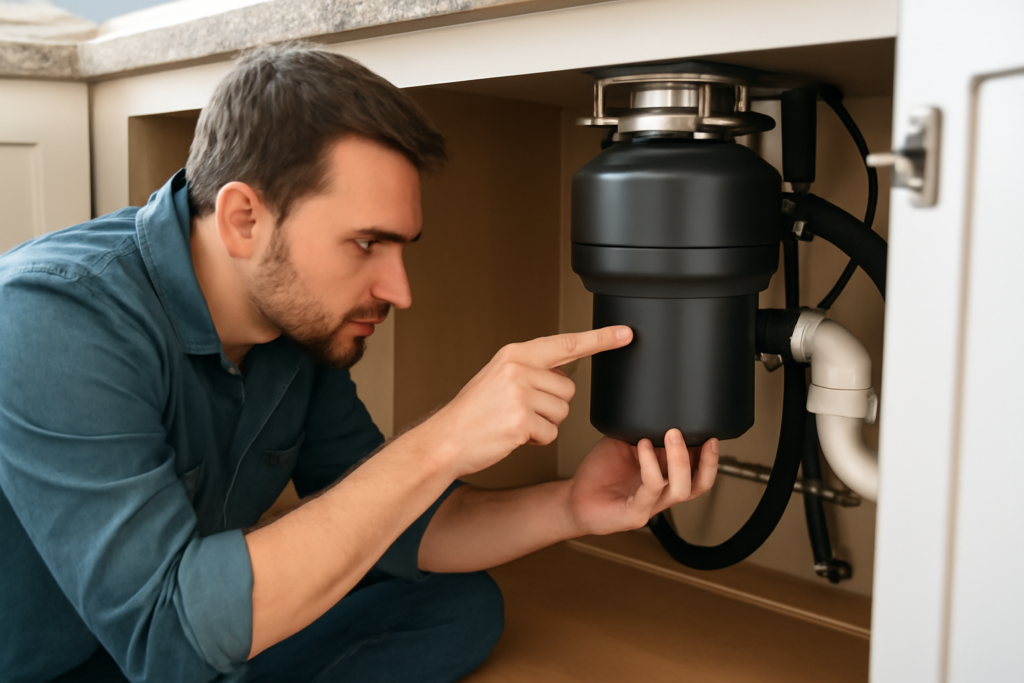
When you press that little red button under your disposal and it won’t stay in—or it stays in but the unit is still dead—the reset button is rarely the actual problem. Nine times out of ten, a garbage disposal reset button not working is a symptom telling you something upstream needs attention: a jam locking the motor, a tripped breaker, a loose wire, or a motor that has finally overheated one time too many. This guide walks through the causes in the order a technician would check them, so you can get the unit running again or know when it’s truly done.
- What the Reset Button Actually Does
- First, Rule Out a Jam
- Let the Motor Cool Down
- Check Power to the Unit
- Inspect the Wiring Connections
- Why the Reset Keeps Tripping Repeatedly
- Distinguishing a Reset Problem From a Switch or Outlet Problem
- Safety Rules You Should Never Break
- When the Motor Has Failed
- Getting Back Up and Running
What the Reset Button Actually Does
The reset button is a thermal overload protector. When the motor draws too much current—usually because it’s jammed or overheated—the internal breaker pops the button out to cut power and protect the windings from burning up. So a button that keeps popping out isn’t broken; it’s doing its job, warning you that the motor is straining.
Understanding this reframes the whole problem. You don’t fix the button—you fix whatever is making it trip. Push it back in and it holds only once the underlying overload is gone. That’s why forcing the button repeatedly gets you nowhere; you have to remove the cause first.
First, Rule Out a Jam
The most common reason the reset won’t hold is a jammed impeller. If you turned the disposal on and heard a hum before it went silent, a jam is almost certainly the cause. Always cut power before reaching anywhere near the chamber.
- Turn off the disposal switch and unplug the unit or flip its breaker off.
- Look into the chamber with a flashlight for bones, a utensil, or a fruit pit wedged against the grind ring.
- Insert the hex wrench that came with the disposal into the socket in the center of the unit’s underside.
- Rock the wrench firmly back and forth to free the flywheel; you’ll feel it break loose and spin.
- Remove any debris with tongs—never your fingers—then restore power and press the reset button.
No hex wrench on hand? Insert a wooden broom handle or a sturdy wooden spoon into the chamber, brace it against an impeller, and lever the flywheel back and forth. Once it turns freely, the reset will usually hold.
Let the Motor Cool Down
If you ran the disposal hard or it stalled under a heavy load, the motor may simply be too hot for the reset to hold. The thermal protector won’t allow a reset while the windings are overheated, so pressing the button immediately does nothing.
Give the unit 10 to 15 minutes to cool completely, then press the reset button firmly. You should feel and hear a distinct click as it seats. This single step—waiting instead of stabbing at the button—resolves a surprising number of “dead” disposals. If the motor keeps overheating on light loads, that points to a failing motor rather than a simple overload.
Check Power to the Unit
If the reset button holds but the disposal is still completely dead—no hum at all—the problem is upstream in the electrical supply. Work through the power chain methodically.
- Wall switch—confirm it’s on and that you’re flipping the right one; disposal and light switches are often side by side
- Circuit breaker—check the panel for a tripped breaker and reset it fully off, then on
- Outlet under the sink—many disposals plug into an outlet controlled by the switch; test that outlet with another device
- GFCI—if the disposal shares a GFCI outlet, its tripped reset can kill power; press the GFCI reset too
A dead outlet or tripped GFCI is a common overlooked culprit. If a lamp plugged into the same outlet also fails, the issue is the circuit, not the disposal.
Inspect the Wiring Connections
If power reaches the outlet but the disposal still won’t run and the reset won’t help, loose wiring may be to blame—especially on a unit that’s a few years old and has vibrated with every use. This step requires cutting power at the breaker, not just the switch.
With the breaker off, remove the electrical cover plate on the bottom of the disposal and check that the wire nuts are tight and the connections are clean and unburned. Look for a loose or blackened wire, which signals a bad connection that intermittently kills power. If you’re not comfortable working with wiring, this is the point to call an electrician—but a re-tightened wire nut has revived many disposals declared dead.
Why the Reset Keeps Tripping Repeatedly
Sometimes the reset button holds, the disposal runs, and then minutes or hours later it trips again. A reset that keeps popping is trying to tell you something, and ignoring it by repeatedly pressing it in only risks the motor. The most common cause of repeated tripping is a partial jam or a slightly bent impeller that lets the motor run under normal use but overloads it under any resistance.
Other repeat-trip causes include a failing motor whose windings are degrading and drawing excess current, a hardened buildup of grease and debris creating drag, or overloading the unit with too much food at once. Work through them in order: thoroughly clean and inspect the chamber, confirm nothing is lodged against the impellers, and try running only small amounts with plenty of cold water. If the reset trips even under light, clean operation, the motor is on its way out and no amount of resetting will fix it.
Distinguishing a Reset Problem From a Switch or Outlet Problem
A dead disposal isn’t always a reset issue, and diagnosing correctly saves you from replacing the wrong thing. The key clue is whether you hear a hum. If pressing the reset and flipping the switch produces a hum but no spinning, the motor has power and the problem is mechanical—a jam. If you get complete silence with no hum at all, the motor isn’t getting power, which points to the switch, breaker, outlet, GFCI, or wiring rather than the reset.
Test methodically. Plug a lamp or phone charger into the outlet under the sink to confirm it’s live. Check that the wall switch controlling the disposal actually works—people sometimes flip the wrong switch for months. Look for a tripped GFCI on a nearby outlet, since disposals often share that protected circuit. Only after confirming the unit is receiving power does a stuck reset button point to the disposal itself. This simple hum-or-silence test tells you immediately which direction to investigate.
Safety Rules You Should Never Break
Working on a disposal safely is non-negotiable, and a few rules protect your hands and prevent injury. The impellers can spin unexpectedly if power is restored, so treat the chamber as dangerous at all times.
- Always cut power at the switch and unplug the unit or flip its breaker before reaching in
- Never put your hand into the disposal—use tongs, pliers, or a wooden spoon to remove debris
- Free jams with a tool, either the hex wrench underneath or a wooden handle from above, not your fingers
- Let an overheated motor cool fully before resetting rather than forcing the button
- Call an electrician if you find scorched or loose wiring and aren’t confident working with it
These precautions take seconds and prevent the serious hand injuries that make disposals notorious. When in doubt, cut the power at the breaker, not just the wall switch, so there’s zero chance the motor energizes while your hand is anywhere near the opening.
When the Motor Has Failed
If you’ve cleared any jam, let the motor cool, confirmed solid power, and checked the wiring—and the reset still won’t hold or the unit stays silent—the motor itself has likely burned out. Disposals typically last 8 to 15 years, and a motor that overheats on the lightest load or hums without turning after the jam is cleared has reached the end.
At that point, replacement is the sensible move. A mid-grade half- or three-quarter-horsepower unit is affordable, and swapping one out is a manageable DIY job for anyone comfortable under the sink, since the mounting ring stays and only the motor unit twists off. Given the low cost of a new disposal versus a service call to repair an old motor, replacement almost always wins.
Getting Back Up and Running
To recap the sequence when your garbage disposal reset button not working has you stumped: cut power and clear any jam first, let the motor cool, then confirm the switch, breaker, outlet, and GFCI are all live, and finally check the wiring. Press the reset button firmly at each stage—it should click and stay. Most disposals come back to life somewhere in that checklist.
Going forward, prevent repeat trips by feeding the unit small batches with plenty of cold water and keeping bones, pits, and fibrous scraps out. A disposal that isn’t overloaded rarely trips its reset, and that little red button can go back to being something you forget exists.