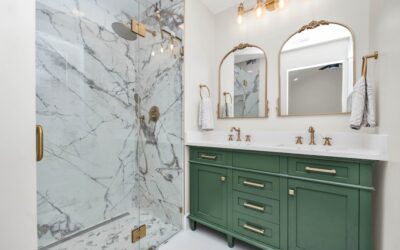
A shower door that fogs the room, drips onto the tile, or refuses to seal is doing more than annoying you, it is quietly rotting the subfloor at the threshold. A glass shower door replacement solves the leak, updates a dated bathroom faster than almost any other upgrade, and usually costs a fraction of a full remodel. Before you call a glazier, it helps to know what drives the price of a glass shower door replacement and which choices you will actually live with every morning.
Part of our Bathroom Remodeling & Flooring guide — explore the full guide →
Why a Glass Shower Door Replacement Pays Off
Old doors fail in predictable ways. Vinyl sweeps harden and crack, aluminum tracks corrode and trap mildew, and hinge screws loosen until the panel sags out of square. Once water escapes past a failed seal, it wicks into grout lines and drywall, and a $40 sweep you ignored becomes a $2,000 tile repair. Swapping the door also brightens the space; clear glass makes a small bathroom read larger than a frosted or framed enclosure ever will.
Framed, Semi-Frameless, and Frameless Options
The frame style you pick sets the tone and most of the budget.
- Framed: Aluminum surrounds every edge. It is the most affordable at roughly $300 to $700 installed, hides slightly uneven walls, and uses thinner 3/16-inch glass. The downside is more track to scrub.
- Semi-frameless: Frame on the perimeter but not the door edges. A middle path around $500 to $1,000 with a cleaner look.
- Frameless: Heavy 3/8-inch or 1/2-inch tempered glass held by minimal clips and hinges. The premium choice at $900 to $2,500 or more, easiest to clean, and the most modern.
Frameless glass weighs a lot, a single 3/8-inch panel can top 80 pounds, so the wall behind the hinges must hit solid blocking or well-anchored studs. That structural need is a big reason frameless installs cost more.
Glass Thickness, Coatings, and Safety
All shower glass sold in the US must be tempered so it crumbles into pebbles rather than shards if it breaks; look for the etched safety stamp in a bottom corner. Thickness affects both feel and price. Framed doors use 3/16-inch (5mm) glass, while frameless doors use 3/8-inch (10mm) or 1/2-inch (12mm) for rigidity.
Spend the extra $150 to $300 on a factory-applied hydrophobic coating such as those branded as ClearShield or Diamon-Fusion. These seal the microscopic pores in the glass so water sheets off, cutting hard-water spotting and the weekly squeegee battle by a noticeable margin. Skip the coating and you will be fighting mineral buildup within months, especially on well water.
Measuring for a Replacement Door
Precise numbers make or break a frameless order. Measure the opening width at the top, middle, and bottom, then use the smallest figure, because walls are rarely plumb. Check the height on both sides. Hold a level against the side walls to record how far out of plumb they run; a frameless installer needs that reading to spec the hinge shims.
For a standard 60-inch tub-to-shower conversion or a 32-by-32-inch corner stall, most suppliers stock pivot and sliding kits that fit without custom fabrication. Custom frameless panels, ordered to your exact out-of-plumb reality, add one to three weeks of lead time and a template visit.
What the Installation Involves
A pro replacement of a like-for-like framed door usually takes two to three hours. Frameless work runs longer because the glass must be dry-fit, marked, and the holes drilled into tile with a diamond bit before the panel ever goes up.
- Remove the old door, sweeps, and track, then scrape and clean the old silicone completely.
- Dry-fit the new frame or hinge plates and confirm level and plumb with shims.
- Drill anchor holes; in tile, go slow with a diamond bit and use plastic anchors rated for the glass weight.
- Set the glass, install hinges or rollers, and adjust for even reveals.
- Apply 100 percent silicone on the outside seams only, leaving the inside bottom open so any water inside can weep back into the pan.
That last detail trips up DIYers constantly. Sealing the interior bottom edge traps water against the threshold instead of draining it. Let the silicone cure a full 24 hours before the first shower.
DIY Versus Hiring a Glazier
A handy homeowner can install a framed or semi-frameless kit for the cost of the kit alone, usually $150 to $500 at a home center, saving the $200 to $500 labor charge. The tools are modest: a drill, a diamond hole bit, a level, a caulk gun, and painter’s tape. Frameless is a different animal. The heavy glass, the tile drilling, and the zero-tolerance fit make it worth paying a professional glazier, who also warranties the work if a panel ever cracks or a hinge fails.
Door Configurations for Your Space
The opening dictates the door style as much as taste does. A standard tub-shower combo usually takes a bypass (sliding) door on a bottom track, which needs no swing clearance, a smart choice for a tight bathroom where a hinged panel would hit the vanity or toilet. A walk-in stall can take a hinged (pivot) door, which feels more open but needs 24 to 30 inches of clear swing in front of it. For a curbless or oversized shower, a fixed panel with a hinged door, or a single fixed “splash panel” with no door at all, keeps water in while maximizing the open feel.
Neo-angle doors solve the corner-shower puzzle, fitting a five-sided enclosure into a room corner. They cost more because of the extra glass panels and the angled hardware. Whatever the layout, confirm the door swings out, or both ways on a frameless pivot, so it drains onto the shower floor rather than your bathroom tile, and so you can escape if you slip.
Threshold height plays into the choice too. A traditional shower curb stands about 2 to 4 inches tall to contain water, and a hinged or sliding door seals against it with a bottom sweep. If you are converting to a curbless, barrier-free shower for aging-in-place, the enclosure relies on a properly sloped floor pan (a minimum quarter-inch-per-foot pitch toward the drain) and a splash panel rather than a curb, so discuss the floor slope with your tile setter before ordering glass. Width matters for comfort as well: a walk-in opening should be at least 24 inches clear for easy entry, and 30 to 36 inches feels genuinely spacious. Undersize the opening and even the nicest glass makes the shower feel cramped every morning.
Hinges, handles, and clips are where a frameless enclosure earns its modern look, and the finish should tie into the rest of the bathroom. Match the shower hardware to the faucet and towel bars rather than to the door frame. Popular options run from polished chrome and brushed nickel to matte black and brushed gold, with black and gold carrying a $75 to $200 premium over standard chrome. Solid brass hardware under the plating lasts longest in a wet environment; cheaper pot-metal handles can pit within a few years of daily steam.
Pay attention to the handle style too. A back-to-back pull-and-knob on a heavy frameless door feels solid, while a towel-bar handle doubles as a place to hang a washcloth. On sliding doors, upgraded roller assemblies with sealed bearings glide far more smoothly and quietly than the basic plastic wheels that come on the cheapest kits.
Budgeting and Common Add-On Costs
The door quote is rarely the whole bill. Watch for these extras: a new curb or threshold if the old one is chipped, upgraded hardware finishes like matte black or brushed gold (add $75 to $200), and disposal of the old tempered panel, which many haulers charge to accept. If your tile is more than 20 years old, budget for possible repair around the anchor points where the drill can chip a glaze.
All in, expect $400 to $800 for a straightforward framed swap and $1,200 to $3,000 for a custom frameless enclosure. Get two or three quotes, confirm the glass is tempered and the thickness matches what you paid for, and ask specifically whether a protective coating is included. A well-chosen door should give you 15 to 20 years of clean, leak-free showers before you think about replacing it again.
Keeping that new glass looking new comes down to one simple habit: squeegee the panel after each shower to clear the water before mineral deposits can set. On hard water especially, that thirty-second wipe does more for the glass than any deep clean later, and it is why the optional hydrophobic coating pays for itself in saved scrubbing. Avoid abrasive pads and harsh acidic cleaners that can etch the glass or dull a protective coating; a soft cloth with a mild vinegar-and-water solution handles routine spotting. Check the silicone seams once a year and re-caulk any spot that has cracked or pulled away, since a failed bead is how water sneaks behind the tile and starts the very damage the new door was meant to prevent. A little routine care keeps a quality enclosure clear and leak-free for its full lifespan.