Bathrooms are where gold fixtures earn their keep, because a vanity faucet is jewelry — small, visible, and touched every day. A gold bathroom faucet can turn a builder-grade powder room into the best-looking six square feet in the house for under $300. But bathroom faucets come in three distinct mounting formats, and buying the wrong one for your sink’s hole pattern is the most common return in the category. Here is how the formats differ, which gold tones hold up in a humid room, and the models worth your money.
Part of our Bathroom Remodeling & Flooring guide — explore the full guide →
First, Count Your Holes
Before you fall for any faucet, look under or behind your sink. Vanity tops are drilled in standard patterns, and the faucet must match. Three holes spaced 8 inches or wider (center to center of the outer holes) means widespread. Three holes at 4 inches means centerset. A single hole means a single-handle or vessel-style faucet. You can cover a 4-inch pattern with a single-hole faucet plus deck plate, but you cannot stretch a centerset into widespread territory. Get this right and everything else is taste.
Widespread: The Upscale Standard
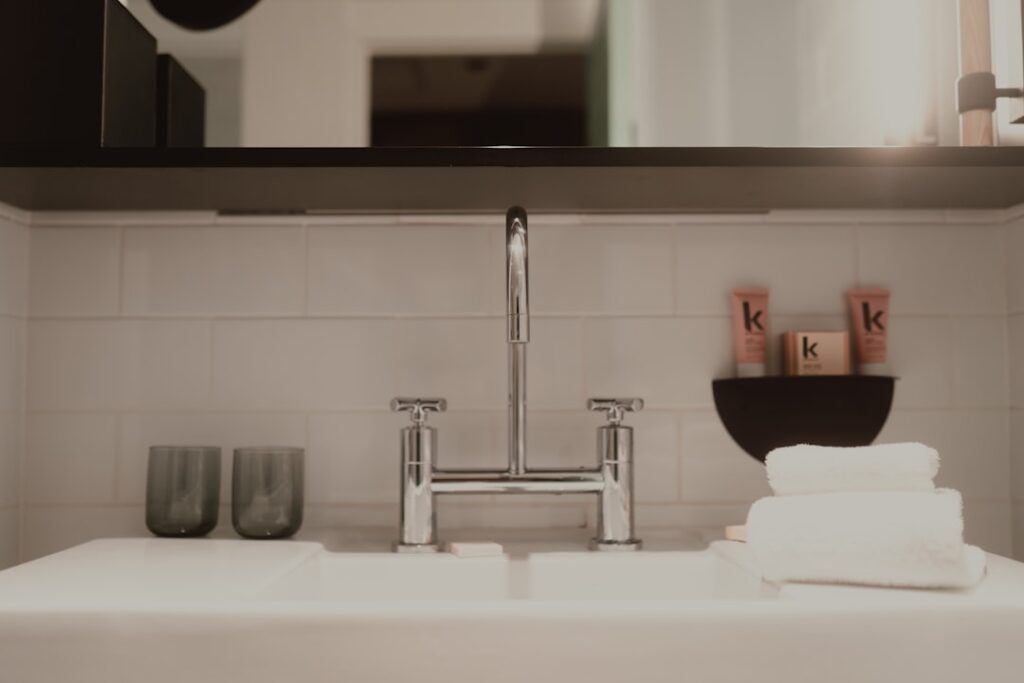
Widespread faucets use three separate pieces — spout, hot handle, cold handle — connected by flexible hoses under the deck. The spread-out layout looks custom and high-end, gives you room to clean around each piece, and is the default for master bath vanities. In gold, this is where the money shot lives: two cross handles and an arched spout in brushed gold against a marble top is the look filling every design feed.
Strong picks include the Delta Trinsic Widespread in Champagne Bronze ($350 to $450) with its slim cylindrical handles, the Kohler Purist Widespread in Vibrant Brushed Moderne Brass ($550 to $700) for minimalist rooms, and Kingston Brass’s Metropolitan ($220 to $300) if you want cross handles and solid brass construction without a boutique invoice. Installation is fussier than other formats — three assemblies and under-counter connections — so budget 2 hours DIY or about $200 for a plumber.
Centerset: Small-Bath Workhorse
Centerset faucets combine spout and handles on a single 4-inch base. They fit the drilled tops on nearly every stock vanity sold at big-box stores, install in 45 minutes, and cost the least. Gold options have exploded here as the finish went mainstream: the Moen Genta LX centerset in Brushed Gold runs $150 to $200, and Delta’s Foundations line gets you champagne bronze under $130. If you are refreshing a kids’ bath or a rental on a budget, a gold centerset plus a matching towel bar is the highest-impact $200 you can spend in the room.
Vessel and Single-Hole: The Statement Formats
Vessel faucets are tall single-hole units — usually 12 inches or more — built to clear the rim of an above-counter basin. Gold vessel faucets over a white ceramic or stone bowl are pure hotel-lobby drama. Check two numbers before buying: total height and spout reach. The spout must land near the center of the bowl, or you will get splash-over every time you wash your hands. The Kraus Ramus tall vessel in Brushed Gold ($120 to $170) is a proven budget option; Brizo’s Odin at the other extreme runs $600-plus.
Standard-height single-hole faucets suit undermount sinks with one drilled hole and give small vanities a clean, uncluttered deck. Wall-mount gold faucets exist too and look spectacular, but they require in-wall rough-in valves — a remodel decision, not a Saturday swap.
Which Gold Tone Works in a Bathroom
The same tone family from the kitchen applies here — brushed gold, champagne bronze, brushed brass, polished brass — but bathrooms tilt the math. Humidity and daily soap splatter make polished finishes higher-maintenance at a vanity than at a kitchen sink, so brushed and satin tones are the practical default. Champagne bronze flatters warm-white and cream bathrooms; cooler brushed gold suits gray and white-marble schemes. Whatever you choose, demand a PVD finish with a lifetime warranty — Delta, Moen, and Kohler all back theirs — because a vanity faucet gets handled 20-plus times a day.
Coordinate the whole room, not just the sink. Towel bars, the shower trim, mirror frame, and vanity lights should come from the same finish line or a deliberate two-tone plan (gold plumbing with black lighting is the current favorite). This is the same logic that governs the brushed nickel faucet — pick one metal to lead and let the second play accent. And if the gold is spreading beyond the bathroom, our gold kitchen faucet guide covers the pull-down and bridge formats that room calls for.
Carrying Gold Beyond the Vanity
A gold faucet floating alone in a chrome bathroom looks like a mistake, so plan the supporting cast before the first order. The critical partners are the tub filler and shower trim, because they sit in the same sightline as the vanity: Delta, Moen, Kohler, and Kingston Brass all offer matching Roman tub sets and shower kits within each collection, and buying them in one order from one production era avoids the subtle lot-to-lot tone drift that shows up when you add pieces two years later. Freestanding tub fillers in brushed gold — floor-mounted columns at $500 to $900 — are the category’s showpiece and worth the splurge in a master bath where the tub is visible from the door.
Accessories follow a simpler rule: towel bars, robe hooks, tissue holders, and drain trim should match the faucet line; the mirror frame, sconces, and cabinet pulls can either match or play the second metal. Two metals maximum per bathroom is the discipline that keeps a scheme intentional. One often-missed detail is the sink drain and pop-up — most faucets include a matching drain, but vessel sinks need a separately purchased grid or push-button drain in the same finish, and a chrome drain in a gold bowl undoes the whole effect for want of a $30 part. P-traps and supply stops below an open-console vanity deserve the same treatment; exposed chrome plumbing under a $400 gold widespread is the kind of miss a decorative trap kit fixes cheaply.
Costs, Warranties, and What to Avoid
Real-world pricing breaks down cleanly: $80 to $150 for a quality gold centerset, $200 to $500 for widespread, $120 to $600 for vessel depending on brand. Gold carries a finish premium of roughly 20 to 35 percent over chrome across every brand. Below about $70, be suspicious — that price usually means electroplated gold over zinc alloy, and those faucets pit and flake in humid bathrooms within two to three years.
Check three things in the listing: solid brass or stainless body (not “metal construction,” which means zinc), a ceramic disc cartridge, and a WaterSense label. WaterSense bathroom faucets flow 1.5 gallons per minute or less, save a family of four roughly 700 gallons a year, and are required by code in California and several other states.
Keeping Gold Looking Gold
Daily care is a rinse and a dry microfiber wipe — dried toothpaste and hard-water minerals are the real enemies, not the finish itself. Weekly, use warm water with a drop of dish soap. Never use abrasive powders, scrub pads, or bathroom cleaners containing bleach or ammonia on gold; even lifetime PVD finishes can haze under harsh chemistry, and the warranty will not cover cleaner damage. In hard-water areas, a spray of 50/50 white vinegar and water rinsed off within a minute handles mineral spotting safely.
Sample the tone against your tile and paint in daylight before committing, since gold shifts warmer under vanity bulbs than it looks in store lighting. Then match the format to your sink, insist on PVD, and buy the accessories from the same line on day one. Do that and a gold bathroom faucet will still look like the best decision in the room when the trend cycle comes back around.