Stand in the faucet aisle with a photo of your sink and you will discover the dirty secret of faucet shopping: “3 hole faucet” is not one product — it is three completely different faucet types that happen to fit the same sink. A 3 hole faucet setup simply means your sink deck or countertop has three drillings, and whether you need a 4-inch centerset, an 8-inch widespread, or a single-hole faucet with a deck plate depends entirely on one measurement you can take in ten seconds. This guide is the disambiguator: what 3-hole configurations are, how to measure yours, which faucet families fit, and how to convert in either direction. For deep dives on any single type, see the dedicated centerset, widespread, single-hole, and bridge faucet guides.
What a 3-Hole Sink Actually Is
Bathroom sinks and vanity tops ship pre-drilled in a few standard patterns: one hole, three holes at 4 inches, or three holes at 8 inches. In every three-hole pattern, the outer two holes carry the hot and cold supply (or the faucet’s mounting shanks) and the center hole serves the spout or a pop-up drain lift rod. The critical spec is the spread (also called “centers”): the distance between the centers of the two outer holes. American drilling standardized on exactly two spreads — 4 inches and 8 inches — decades ago, which is why faucet boxes shout “4-in. centerset” or “8-in. widespread.” Kitchen sinks use 3-hole (and 4-hole) drillings too, typically on 8-inch centers, but with a different logic covered below.
Measure Your Spread First
Before buying anything, measure center-to-center on the outer holes:
- Remove the old faucet, or measure from below if it’s still installed — hole centers are visible under the sink.
- Tape-measure from the middle of the left hole to the middle of the right hole. Easier method: measure edge-to-edge the same way (left edge of left hole to left edge of right hole) — it gives the identical number.
- 4 inches = centerset territory. 8 inches (occasionally 6-16 inches on older or custom tops) = widespread territory.
Hole diameter matters only at the extremes — standard drillings are 1-1/4 to 1-1/2 inches and virtually all faucets accommodate that range. The spread is the decision-maker.
Option 1: 4-Inch Centerset
A centerset faucet is a one-piece unit — spout and both handles share a single base — with mounting shanks 4 inches apart. It drops straight into a 4-inch three-hole sink with no extra parts. This is the workhorse of builder-grade bathrooms: compact, fast to install (30-45 minutes), and the cheapest category at roughly $40-150 (Delta Foundations ~$50, Moen Adler ~$60, up to Kohler and Delta mid-tier around $120). The tradeoffs are aesthetic: the connected base reads as entry-level, cleaning around the base collects grime, and style selection thins out at the high end. If your holes measure 4 inches, this is your default; single-handle centerset models (one lever on a 4-inch plate) fit the same drilling.
Option 2: 8-Inch Widespread
A widespread faucet is three separate pieces — spout, hot handle, cold handle — connected under the deck by supply hookups and a T. Because the parts are independent, most widespreads fit spreads from about 6 to 16 inches, with 8 inches the standard target. Visually this is the upgrade: each component stands alone on the counter, the look scales from traditional cross-handles to minimalist modern, and the category runs roughly $120-600+ (Delta Woodhurst ~$180, Moen Eva ~$220, Kohler Purist ~$400, and designer brands beyond). Installation is the price of elegance — under-deck linkages roughly double the install time versus a centerset. An 8-inch three-hole sink requires a widespread (or a bridge faucet, the vintage-style variant that connects hot and cold above deck — see the bridge guide); a 4-inch centerset physically cannot span it.
Option 3: Single-Hole Faucet + Deck Plate
The third path: install a single-hole faucet — one lever, one body, one hole needed — and cover the outer two holes with the escutcheon (deck plate) that most single-hole models include or offer as an accessory. The plate is a 4-inch oblong base that hides the flanking holes. This unlocks the huge modern single-hole category (vessel-height spouts, minimalist designs, $60-300 typical) for owners of 4-inch three-hole sinks. Two cautions: deck plates span 4-inch drillings only — an 8-inch spread leaves the plate comically short, so widespread sinks can’t take this shortcut; and check the box, because “optional deck plate included” is common (Delta, Moen, Kohler usually include one) but not universal.
Kitchen 3-Hole Logic Is Different
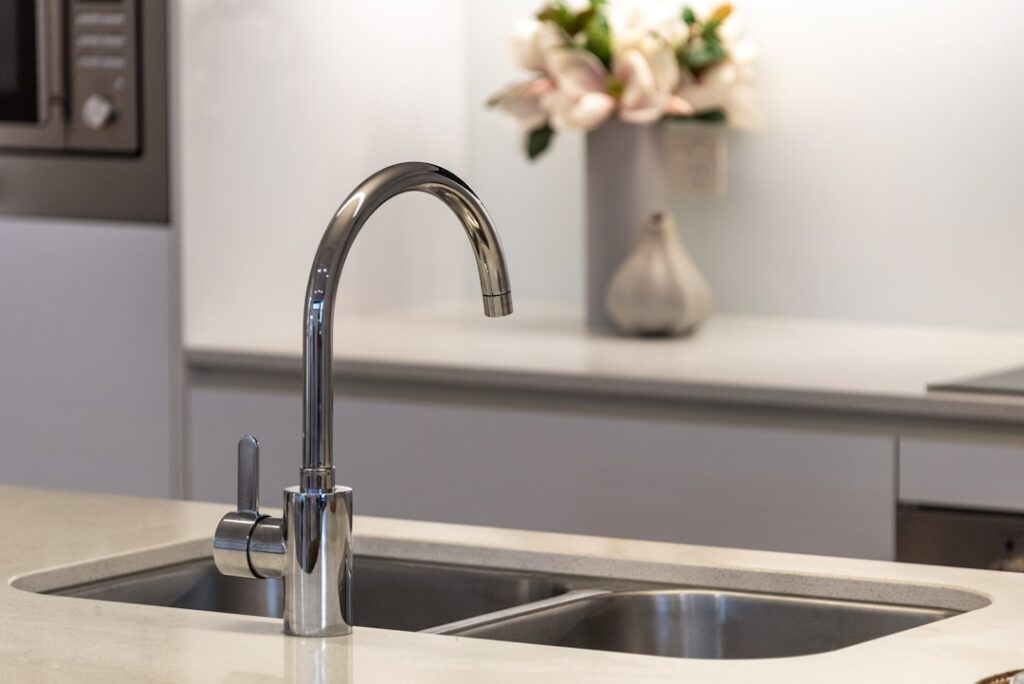
On kitchen sinks, the three holes rarely mean hot-spout-cold. The typical modern arrangement is a single-handle faucet in one hole plus accessories in the others: a side sprayer, soap dispenser, filtered-water tap, or air gap for a dishwasher. Kitchen faucets with pull-down sprayers are overwhelmingly single-hole designs, so a 3-hole kitchen sink usually gets: faucet in the center or left hole, soap dispenser in one flank, and either an accessory or a hole cover ($5-10 stainless cap) in the remainder — or a kitchen deck plate spanning all three (most pull-downs include one sized for 8-inch kitchen spreads). Two-handle kitchen faucets on 8-inch centers still exist (and kitchen bridge faucets use the same drilling), but they are now the minority. Measure the same way; kitchen spreads are almost always 8 inches when the holes are meant for a spanning faucet.
Converting in Either Direction
- 3-hole → single-hole look: deck plate, as above. Ten-dollar solution on 4-inch bathroom sinks; included plates on most kitchen pull-downs handle 8-inch kitchen drillings.
- Single-hole sink → 3-hole faucet: generally a no — you cannot un-drill porcelain, and adding holes to a finished vitreous china sink is a cracking risk not worth taking. Granite, quartz, and solid surface tops can be drilled in place with a diamond core bit ($150-300 by a fabricator), which is how people add widespreads or soap dispensers to stone.
- 4-inch → 8-inch or vice versa: not convertible on pre-drilled sinks; buy the faucet that matches, or replace the sink/top. So-called “mini-widespread” faucets (8-inch styling scaled to 4-inch drillings, e.g., Kingston Brass and Pfister models) fake the widespread look on 4-inch holes and are the one real crossover product.
Installation Notes Across All Three Types
Whichever configuration you land on, three-hole installs share a few realities worth knowing before the wrench comes out. Buy new supply lines with the faucet ($8-15 for a braided stainless pair) — reusing ten-year-old connectors on a new faucet is the classic false economy, since the rubber liners age regardless of the faucet above them. Plumber’s putty or the included gasket seals the base or deck plate against the sink; silicone works on stone where putty can stain. The pop-up drain assembly that ships with most bathroom faucets is the sleeper time-cost — budget as much time for the drain and its linkage as for the faucet body, and dry-fit the lift rod before final tightening. Finally, a basin wrench ($12-15) turns under-deck mounting nuts that fingers and standard wrenches cannot reach; on widespread installs it is close to mandatory. None of this is hard, but knowing it up front turns a frustrating evening into a 90-minute Saturday job.
The Buying Decision Tree
- Measure the spread. Everything follows from the number.
- 4 inches: choose on budget and style — centerset ($40-150, simplest), single-hole + deck plate ($60-300, most modern styles), or mini-widespread (widespread look, 4-inch fit).
- 8 inches: widespread or bridge faucet. Full stop. Budget $150+ and an afternoon, or one plumber-hour ($100-200).
- Kitchen 3-hole: single-handle pull-down + deck plate or accessories in the spare holes; match the plate to the spread.
- Replacing like-for-like? Same configuration is always the painless path — supplies and drain linkage land exactly where the old ones did.
Get the spread right and every 3 hole faucet decision collapses into a style-and-budget choice. Get it wrong and you own a faucet that hovers over holes it cannot reach — the single most common faucet return at every home center, and the easiest one to avoid.