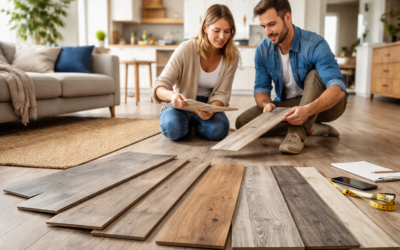
The vinyl flooring aisle is a marketing minefield. Every box brags about being “100 percent waterproof” and “built for lifetime use,” yet the actual performance gap between a $1.59 plank and a $4.49 plank is enormous. Good quality vinyl flooring comes down to four numbers: wear layer thickness, core type, total plank thickness, and finish technology. Get those right and a floor will outlast the homeowner. Get them wrong and you will be replacing a kitchen in five years.
- Wear Layer: The Number One Spec
- Core Type: SPC vs WPC vs Flexible LVP
- Total Thickness Matters Less Than You Think
- Finish Technology: Ceramic Bead and UV Cure
- Locking System Quality
- Brands That Consistently Hit Quality Marks
- Red Flags on Cheap Imports
- Pad and Underlayment Selection
- The Quick Buy Test
Wear Layer: The Number One Spec
The wear layer is a clear urethane coating that protects the printed design from scratches and stains. It is measured in mils, where 1 mil equals 1/1000 of an inch. This is the single most reliable predictor of how long a vinyl floor will look new.
- 6 mil: builder-grade, scratches in 1-2 years
- 12 mil: residential standard, 7-10 year aesthetic life
- 20 mil: pet and kid duty, 15-20 years
- 22-28 mil: light commercial, 20-25 years
Anything labeled “lifetime warranty” with under 12 mil wear layer is fiction. The fine print will exclude scratches, scuffs, and “general wear” — meaning the warranty only covers manufacturing defects, not the things that actually ruin floors.
Core Type: SPC vs WPC vs Flexible LVP
Stone Plastic Composite (SPC) is the modern premium standard. Limestone powder gives it dimensional stability across temperature swings and resistance to point-load denting from chair legs and heavy furniture. SPC tolerates 0 to 140 degrees Fahrenheit without expanding or contracting more than 1/16 inch per 10 feet.
Wood Plastic Composite (WPC) is softer and warmer underfoot but dents more easily under heavy furniture. It absorbs sound better, which is why some installers prefer it for second-floor bedrooms and home offices.
Flexible LVP (the original luxury vinyl) is the cheapest and least dimensionally stable. Avoid it for spaces with direct sunlight or radiant heat unless the box specifically says “rigid core.”
Total Thickness Matters Less Than You Think
A 5mm SPC plank with a 20 mil wear layer outperforms an 8mm WPC plank with a 12 mil wear layer. Marketing copy loves to lead with thickness because the number sounds bigger, but for vinyl, thickness is mostly about subfloor forgiveness, not durability.
A thicker core (6.5mm or 8mm) hides minor subfloor imperfections better. If your concrete slab has a few low spots or your plywood subfloor has visible seams, a thicker rigid plank will float over those without telegraphing flaws to the surface.
Finish Technology: Ceramic Bead and UV Cure
Premium vinyl uses a urethane wear layer infused with aluminum oxide or ceramic bead particles for scratch resistance. Look for callouts like “ceramic bead enhanced” or “aluminum oxide infused” on the spec sheet. These add 30 to 50 percent more abrasion resistance than plain urethane.
UV-cured finishes harden faster and bond more tightly than air-cured. The vast majority of brand-name product (Shaw, Mohawk, COREtec, Karndean) uses UV cure. Off-brand imports from random Amazon sellers often skip this step, which is why their floors haze and dull faster.
Locking System Quality
The locking edge is where cheap vinyl fails. Unilin Click and Valinge 5G are the two patented systems used by reputable brands, both rated for 1.5 to 2 million open-and-close cycles. Generic “drop and lock” systems, especially on no-name imports, can chip on the second installation if you ever pull the floor up.
Test the lock by snapping two planks together at the long edge. The seam should be invisible and the planks should feel rigid as a unit. If you see daylight or feel flex, the system is undersized for residential traffic.
Brands That Consistently Hit Quality Marks
COREtec Plus and Pro Plus, Shaw Floorte Plus, Mohawk SolidTech Plus, Karndean Korlok, and Mannington ADURA Max are reliably premium. Their entry-level products start around $3.50 per sq ft and run to $7 for the high end.
Big-box exclusives like LifeProof (Home Depot) and SmartCore (Lowe’s) are decent mid-tier picks at $2.99 to $4.49 per sq ft. Their value pricing reflects shorter wear layers and simpler locking systems, but the materials themselves are honest.
Red Flags on Cheap Imports
If a deal looks too good to be true, it is. Watch for these warning signs.
- Wear layer not specified, or listed only as “thick”
- “Waterproof” without a topical seal or click-edge sealant
- Heavy chemical smell out of the box (high VOC, often phthalates)
- Boxes with no batch numbers or factory codes
- Warranty period over 25 years on product priced under $1.50 per sq ft
Off-brand vinyl sold through marketplace sellers is the worst category. You have no recourse if it fails because the seller often vanishes within 18 months.
Pad and Underlayment Selection
Many premium vinyl planks include attached IXPE or cork underlayment. If yours does not, choose carefully. Closed-cell foam at 1.5mm to 2mm with a vapor barrier is the right pick for most concrete subfloors. Cork at 3mm gives the best sound dampening but adds about $0.65 per sq ft.
Avoid stacking underlayments. Some homeowners think more cushion is better, but multiple layers of soft underlayment exceed the lock joint’s tolerance and cause click failures within months. Stick to one layer at the manufacturer’s recommended thickness.
The Quick Buy Test
When evaluating any plank in person, run this five-minute check. Press a fingernail into the wear layer; quality material does not gouge. Bend a sample plank; it should flex without cracking the click edge. Rub the surface with a key; premium ceramic bead finishes barely show a mark. Sniff the box; healthy vinyl has a faint plastic odor, not a sharp chemical smell. If the plank passes all four, it qualifies as good quality vinyl flooring regardless of the brand on the box.
Prefer to explore on your own?
See how new flooring looks in your actual room in seconds — free, no signup.
Try the free Floor Studio →