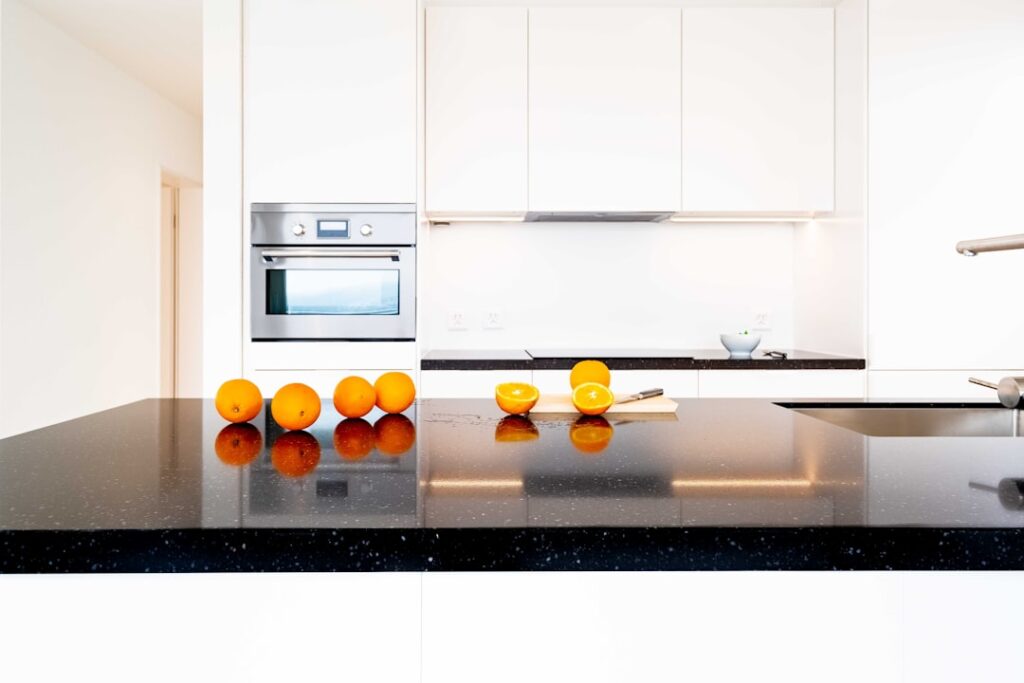
Homeowners obsess over granite color and finish, then get blindsided at the fabricator when they are asked to pick a slab thickness. Yet granite countertop thickness affects the price, the edge profile, the support your cabinets need, and even how the finished kitchen feels. Getting the granite countertop thickness right is one of the few countertop decisions that touches both your budget and your structure.
Part of our Countertops guide — explore the full guide →
The choice usually comes down to two standard options, 2 centimeters and 3 centimeters, with a few less common variations. Here is what each thickness means in practice and how to decide.
- Standard Granite Countertop Thickness Options
- 2cm Granite: Lighter and More Affordable
- 3cm Granite: The Standard for Kitchens
- Cost Difference Between Thicknesses
- How Thickness Affects Overhangs and Support
- Edge Profiles and How Thickness Changes Them
- Weight, Handling, and Cabinet Requirements
- Seams and Large Installations
- Thickness in Bathrooms Versus Kitchens
- Perceived Quality and Resale Impact
- Which Granite Countertop Thickness Should You Choose
Standard Granite Countertop Thickness Options
Granite slabs are sold in metric thicknesses, which is why you will hear centimeters instead of inches. The two mainstream choices are 2 cm, which is about 3/4 inch, and 3 cm, which is about 1 1/4 inch. A less common 1.2 cm (roughly 1/2 inch) exists mainly for backsplashes, prefabricated pieces, or laminated applications.
In the United States, 3 cm has become the default for kitchen countertops, while 2 cm shows up more in bathrooms, on a budget, or laminated at the edge to look thicker. Both are structurally sound when installed correctly, but they are handled and supported very differently.
2cm Granite: Lighter and More Affordable
At about 3/4 inch, 2 cm granite weighs roughly 12 to 13 pounds per square foot, noticeably less than its thicker cousin. That lower weight makes it easier to transport and install, and it puts less load on cabinets, which can matter in older homes or on wall-hung vanities.
The trade-off is support. Two-centimeter granite usually requires a plywood substrate underneath for strength, and overhangs beyond about 6 inches need brackets or corbels to prevent cracking. Because it looks thin on its own, fabricators often laminate a second strip along the front edge to build up a 4 cm or thicker appearance, which adds labor and cost that can erase the material savings.
3cm Granite: The Standard for Kitchens
Three-centimeter granite, about 1 1/4 inch, weighs roughly 18 to 19 pounds per square foot and is strong enough to install directly on cabinets without a plywood deck in most cases. Its thickness allows larger unsupported overhangs, typically up to about 10 inches, before brackets become necessary, which is why it is the go-to for eating bars and islands.
Because the slab is already substantial, the edge shows a solid piece of stone with no lamination seam, giving a cleaner, more premium look. Most edge profiles, from a simple eased edge to an ogee or bullnose, are designed with 3 cm in mind. If you want the countertop to read as high quality without extra fabrication tricks, 3 cm delivers it straight from the slab.
Cost Difference Between Thicknesses
Thicker stone uses more raw material, so 3 cm granite typically costs more per square foot than 2 cm. Expect a difference of roughly $5 to $15 per square foot depending on the color and supplier.
- 2 cm granite: often $35 to $60 per sq ft installed, but add edge lamination if you want a thick front.
- 3 cm granite: often $45 to $75 per sq ft installed, with no lamination needed.
- Plywood substrate for 2 cm: adds material and labor, commonly $3 to $8 per sq ft.
Once you factor in the plywood deck and edge lamination that 2 cm usually requires, the real-world price gap between the two often shrinks to almost nothing. For a full kitchen, many homeowners find 3 cm is the better value despite the higher sticker price per foot.
How Thickness Affects Overhangs and Support
Overhang is where thickness really earns its keep. For a standard countertop with a 1 1/2 inch overhang past the cabinet face, either thickness is fine. Problems start at breakfast bars and islands where the stone cantilevers out for seating.
As a rule of thumb, 3 cm granite can safely overhang about 10 inches unsupported; 2 cm granite is limited to roughly 6 inches. Beyond those limits you need steel brackets, corbels, or a support panel, or the stone can crack under weight, especially if someone leans or sits on the edge. If your design calls for a 12-inch or 15-inch seating overhang, plan for hidden steel plates regardless of thickness, and lean toward 3 cm for the extra margin.
Edge Profiles and How Thickness Changes Them
Your thickness choice directly shapes which edge profiles look right. On 3 cm granite, the full-depth edge showcases profiles beautifully. A simple eased or pencil-round edge looks clean and modern, a half-bullnose softens the front, and an ogee or dupont edge adds traditional detail with room to carve into the thicker stone.
On 2 cm granite, the thin front can look flimsy on its own, so fabricators typically laminate a second strip underneath to build a doubled edge, often called a built-up or mitered edge. This creates a chunky 4 cm appearance but adds labor cost, commonly $20 to $45 per linear foot, and introduces a glue seam that a skilled fabricator will hide well but a rushed one will not. If you love a dramatic thick edge, starting with 3 cm and mitering it can look even more substantial without a visible seam.
Weight, Handling, and Cabinet Requirements
Thickness translates directly into weight your cabinets must carry. A 3 cm slab at roughly 18 to 19 pounds per square foot means a modest 40-square-foot kitchen countertop weighs around 750 pounds before the sink and appliances. Standard stock and semi-custom cabinets handle this fine when properly leveled and shimmed, but very old or damaged cabinet boxes should be reinforced first.
Two-centimeter granite lightens that load by roughly a third, which is why it appears on wall-hung floating vanities and in second-floor baths where weight is a concern. The trade-off is that it almost always needs a continuous 3/4-inch plywood substrate glued to the cabinet tops for support, adding both material and labor. When you tally the plywood deck plus edge lamination, the handling advantage of 2 cm often comes with hidden costs that erase its lower per-foot price.
Seams and Large Installations
Slab size limits how much countertop you can install without a seam, and thickness plays a supporting role. Most granite slabs run about 9 to 10 feet long, so any run longer than that needs a seam regardless of thickness. Thicker 3 cm stone gives fabricators more material to work with at the seam, generally producing a stronger, less visible joint.
Plan seam locations before fabrication. Good fabricators place seams away from high-stress points and often at a sink, where the cutout reduces the span. On 2 cm installations, the plywood substrate becomes even more important at seams to keep the two pieces perfectly coplanar. Ask to see a seam sample and confirm the fabricator uses a color-matched epoxy and a seam-setting tool rather than eyeballing it.
Thickness in Bathrooms Versus Kitchens
The right thickness can differ room to room. In a kitchen, where counters take heavy daily use, hot pans, and the weight of small appliances, 3 cm is the practical standard for its strength and clean solid edge. Kitchen islands with seating overhangs make the case even stronger, since the thicker stone cantilevers farther before needing support.
Bathrooms are more forgiving. A vanity top sees lighter use, spans shorter distances, and rarely has a large overhang, so 2 cm granite is perfectly adequate and can save money. It is also easier to handle up a flight of stairs and puts less strain on a wall-mounted vanity. Many homeowners choose 3 cm in the kitchen and 2 cm in the baths, matching the thickness to how hard each surface will work rather than defaulting to one for the whole house.
Perceived Quality and Resale Impact
Thickness quietly signals quality to buyers and guests. A solid 3 cm edge reads as substantial and high-end, which is why it dominates in kitchens shown to sell. A thin 2 cm edge, unless built up with lamination, can look economical even when the granite itself is beautiful, and some buyers notice.
If you are remodeling with resale in mind, 3 cm in the kitchen is the safer choice for perceived value, especially on a visible island. For a rental property or a tight budget where the goal is a clean, functional surface, 2 cm with a tidy edge delivers granite’s durability at a lower cost. Think about who will use and see the counter, and how long you plan to keep the home, when you weigh the small price difference against the impression thickness makes.
Which Granite Countertop Thickness Should You Choose
For most kitchens, 3 cm is the smart default: stronger, cleaner-looking, larger overhangs, and often a comparable installed price once you add up 2 cm’s extras. It is what fabricators recommend and what buyers expect to see.
Choose 2 cm when weight is a genuine concern, such as on a wall-mounted vanity, when you are working to a tight budget on a bathroom or small area, or when your design specifically wants a thin, minimalist profile. Just confirm your fabricator will add the plywood support and, if you want a chunky edge, budget for lamination.
Whatever thickness you pick, ask to see the actual slab, confirm the overhang plan for any seating area, and get the substrate and edge treatment spelled out in writing. Granite lasts decades, so the half hour you spend understanding thickness now pays off every time you lean on that counter for the next 30 years.