
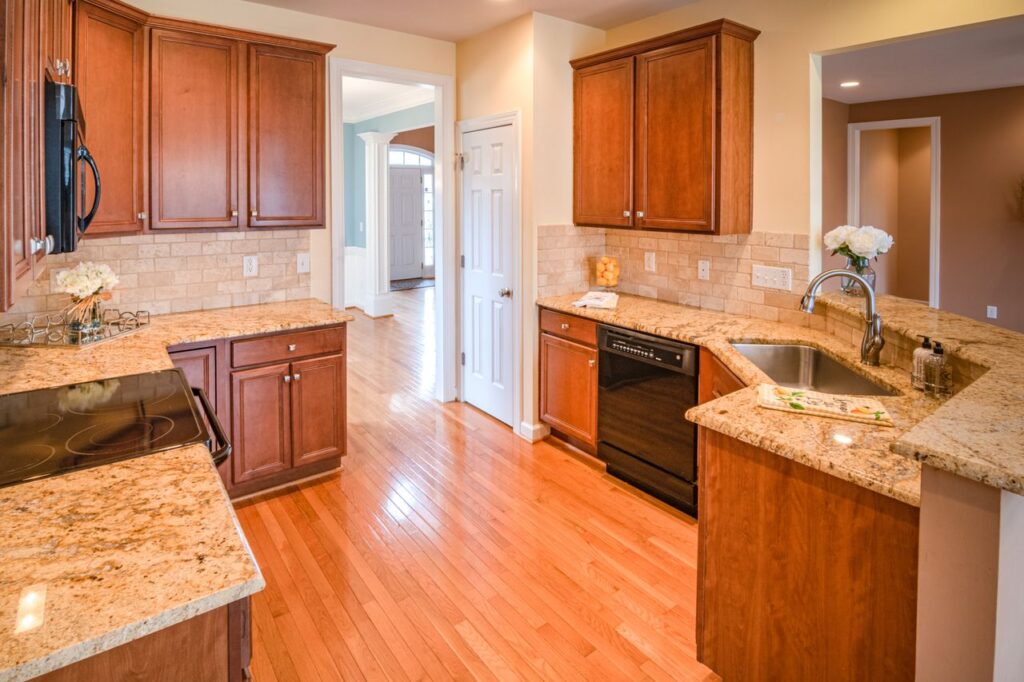
Granite usually gets specified for countertops, but laid across a floor it turns an entryway or great room into something genuinely impressive. Before you fall for that look, you need the real numbers, because granite flooring cost covers far more than the stone itself. Material, installation labor, sealing, and subfloor reinforcement all stack up, and granite floors run notably higher than the tile or vinyl most homeowners price against. Here is what the finished project actually costs.
Part of our Countertops guide — explore the full guide →
- Granite Flooring Price Per Square Foot
- Installation Labor Costs
- The Costs People Forget
- A Real Room Cost Example
- What Drives Granite Flooring Cost Up or Down
- Is Granite Flooring Worth the Cost?
- How to Save on Granite Flooring
- Granite Tile vs Slab: Cost and Look
- Maintenance Costs Over Time
- Granite Flooring vs Porcelain Alternatives
Granite Flooring Price Per Square Foot
Material price swings with format and grade. Granite floor tile is cheaper and easier to install than full slabs, but slabs deliver the dramatic, near-seamless look.
- Granite floor tile (12×12 or 18×18) — $5 to $15 per sq ft for the tile.
- Premium and exotic granite tile — $15 to $25 per sq ft.
- Granite slab flooring — $20 to $50 per sq ft, fabricated and cut to size.
Color and origin drive the spread. Common blacks and grays sit at the low end, while rare blues and reds with dramatic movement command the top.
Installation Labor Costs
Granite is heavy and unforgiving, so labor is a real line item. Professional tile installers charge $7 to $15 per square foot to set granite floor tile, including thinset, spacers, and grouting.
Slab flooring costs more to install — often $15 to $25 per square foot in labor — because the pieces are massive, must be fabricated precisely, and require multiple workers to handle safely. Cutting around cabinets, thresholds, and odd angles adds time and money.
The Costs People Forget
The sticker price hides several necessary extras. Build these into your budget from the start:
- Sealing — granite needs sealing on install and every 1 to 2 years; sealer runs $30 to $60 per bottle plus labor.
- Subfloor reinforcement — granite is heavy, and weak floor framing may need bracing, especially upstairs.
- Old floor removal — $1 to $3 per sq ft.
- Underlayment — cement board or an uncoupling membrane at $1 to $2.50 per sq ft to prevent cracking.
- Edge polishing and transitions — for exposed slab edges and thresholds.
A Real Room Cost Example
Picture a 200-square-foot entry and hallway in mid-grade granite tile. Tile at $10 with 10 percent waste is roughly $2,200. Installation at $11 adds $2,200. Cement-board underlayment is about $350, old-floor removal $400, and initial sealing $150.
That brings the total to around $5,300, or about $26 per square foot installed. Switch to slab granite and the same room can climb past $9,000 once fabrication and heavier labor are added.
What Drives Granite Flooring Cost Up or Down
Several factors move your final number. Stone rarity is the biggest: a common Absolute Black tile is a fraction of an exotic Blue Bahia. Tile versus slab is the next lever, with slabs roughly doubling the project cost.
Room complexity matters too. A simple square room with few cuts installs cheaply per foot; a space full of curves, columns, and thresholds drives labor up fast. Finally, polished granite costs more than honed or flamed finishes because of the extra fabrication.
Is Granite Flooring Worth the Cost?
For high-impact, high-traffic spaces, granite earns its premium. It is extraordinarily hard, resists scratches and heat, and can last the life of the house without ever needing replacement, which spreads that $26-per-square-foot cost across 50-plus years.
The downsides are real: it is cold and hard underfoot, slippery when wet unless honed or textured, and the upfront cost dwarfs porcelain that mimics the look for a third of the price. If budget is tight, granite-look porcelain at $4 to $9 installed delivers most of the drama for far less.
How to Save on Granite Flooring
You can trim the total without cheapening the result. Choose granite tile over slab, pick a common color, and limit the stone to a feature area like a foyer rather than the whole floor. Buy remnant tiles or close-out lots from a fabricator, and handle your own demolition.
Get at least three itemized bids that separate stone, labor, underlayment, and sealing so you can compare honestly. Done thoughtfully, granite flooring cost becomes a planned investment in a surface that will still look striking decades from now.
Granite Tile vs Slab: Cost and Look
The single biggest cost decision is tile versus slab. Granite tile, usually 12-by-12 or 18-by-18 inches, installs like any other tile with thinset and grout lines, keeping both material and labor in a manageable range. Slab flooring uses large fabricated pieces with minimal seams for a seamless, monolithic look that reads as far more luxurious — and costs roughly double once fabrication and heavier labor are added.
For most homeowners, tile delivers most of the granite beauty at a fraction of the slab price. Slabs make sense in showpiece spaces — a grand foyer or a hotel-style bathroom — where the seamless effect justifies the premium. If budget is the priority, tile is almost always the smarter call.
Maintenance Costs Over Time
Granite’s upfront price is only part of the picture; ongoing care adds modest but real cost. The stone needs resealing every one to two years to resist staining, which runs $30 to $60 in sealer per application plus a few hours of labor if you hire it out. Skipping this lets liquids penetrate and stain, which is far costlier to remedy.
The upside is that granite rarely needs anything beyond sealing and routine cleaning. It does not wear out, fade, or need refinishing the way wood does, so across 50 years the lifetime cost stays low despite the high entry price. Clean it with pH-neutral stone cleaner rather than acidic products, which can dull the polish over time.
Granite Flooring vs Porcelain Alternatives
Before committing to real granite, weigh granite-look porcelain. Modern porcelain prints capture stone veining convincingly and install at $4 to $9 per square foot — roughly a third of natural granite’s cost. Porcelain is also waterproof, never needs sealing, and is less slippery when wet, which matters in bathrooms and entries.
What porcelain cannot fully replicate is the depth and authenticity of real stone underfoot, especially in slab form. If you want genuine granite for its uniqueness and prestige, the premium is justified; if you mainly want the look and durability for less money and upkeep, porcelain is the practical winner. Knowing the full granite flooring cost — material, labor, prep, and lifelong sealing — lets you make that call with clear eyes.
Prefer to explore on your own?
See how new flooring looks in your actual room in seconds — free, no signup.
Try the free Floor Studio →

