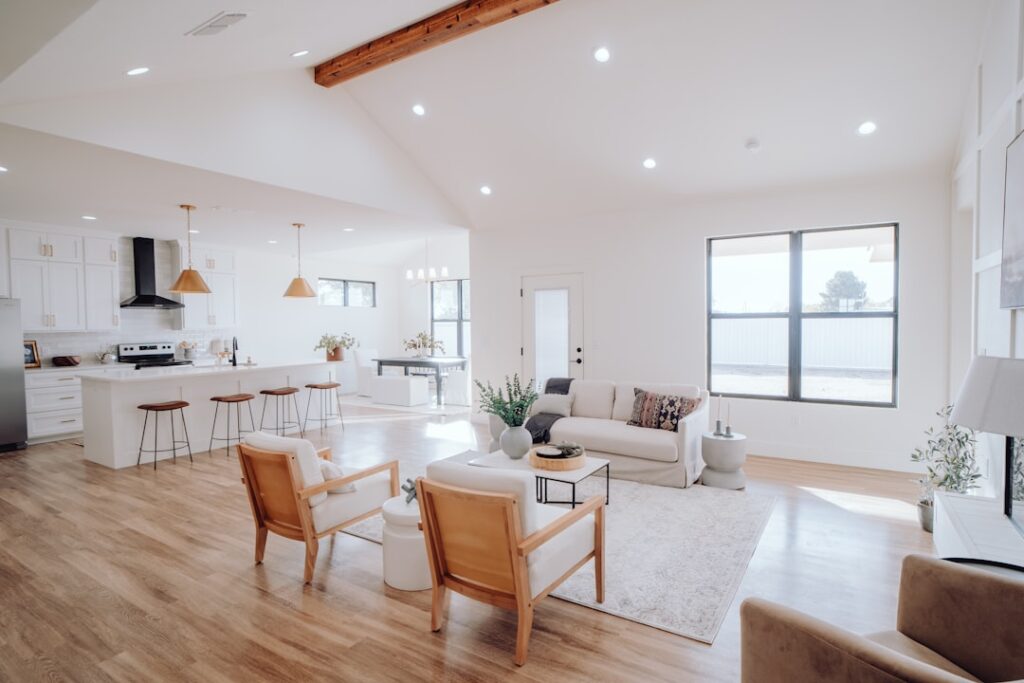
Indoor air inside a typical American home runs two to five times more polluted than outdoor air, according to EPA studies, and flooring is one of the biggest contributors. Greenguard Gold certified flooring caps the volatile organic compounds the product can emit at levels safe enough for hospitals, daycare centers, and schools — a standard meaningfully stricter than the base CARB Phase 2 formaldehyde rule. For households with asthma, allergy, or chemical sensitivity, the Gold seal is often the deciding factor between two otherwise identical planks.
- What the Greenguard Gold Standard Actually Tests
- Which Flooring Categories Carry It
- Pricing Premium Over Standard Product
- Where It Matters Most
- Reading the Spec Sheet Like a Pro
- The Adhesive Question
- Brand Spotlight: Mohawk SolidTech and COREtec
- Maximizing Air Quality During Install
- Who Should Insist on Greenguard Gold
What the Greenguard Gold Standard Actually Tests
UL Solutions administers the Greenguard program. Gold-level certification applies UL 2818 chamber-test protocols that measure emissions of more than 360 individual VOCs plus total VOCs, total aldehydes, and formaldehyde across 14 days. To earn the seal a product must keep formaldehyde under 7.3 micrograms per cubic meter and total VOCs under 220 micrograms per cubic meter — limits derived from the California Department of Public Health Section 01350 specification used in LEED v4.1.
That is roughly half the threshold of the standard Greenguard mark, which is why “Gold” matters when the buyer cares about children, pregnancy, or autoimmune conditions.
Which Flooring Categories Carry It
Greenguard Gold is most common in resilient, laminate, and engineered wood. Solid hardwood rarely needs it because raw wood emits negligible VOCs once finishes cure, though prefinished products do qualify when the topcoats are tested.
- Luxury vinyl plank (LVP and SPC) — COREtec, Shaw Floorte, Mohawk SolidTech, Karndean Korlok
- Laminate — Mohawk RevWood, Pergo Extreme, Quick-Step
- Engineered hardwood — Mohawk TecWood, Mannington engineered, Bruce Lock&Fold lines
- Carpet — Shaw Carpet ClearTouch, Mohawk EverStrand, Stainmaster PetProtect select styles
- Tile and stone — naturally low-VOC and often not pursued for certification, though adhesives and grouts have separate Gold listings
Pricing Premium Over Standard Product
For most major brands the Gold-certified line is not priced higher than the conventional equivalent — the brand simply pays the certification fee and uses the seal as a sales tool. Where premiums show up is at the budget end, where uncertified imports undercut by $0.40 to $0.90 per sq ft.
- Mid-grade LVP, certified: $2.99 to $4.49 per sq ft
- Mid-grade LVP, uncertified import: $1.69 to $2.79 per sq ft
- AC4 laminate, certified: $1.99 to $3.29 per sq ft
- Engineered oak, certified 4 mm wear layer: $4.49 to $7.99 per sq ft
On a 1,200 sq ft project, switching from a generic SPC to a Gold-certified COREtec or Mohawk product typically adds $1,500 to $2,400 to material cost.
Where It Matters Most
The certification has the biggest practical impact in tight, low-ventilation rooms — basement playrooms, master bedrooms, finished attics, and rooms where infants sleep. A new installation off-gasses most heavily in the first 14 to 30 days, exactly the window where children spend the most hours per day on the floor. Gold-certified product compresses that off-gas envelope and lowers the peak concentration.
For commercial applications, LEED v4.1 BD+C awards an EQ credit for floors meeting CDPH 01350, which matches Greenguard Gold criteria. Architects pursuing WELL Building Standard certification also default to Gold-listed products.
Reading the Spec Sheet Like a Pro
Not every product labeled “low VOC” is actually Greenguard Gold. Verify three things before buying.
- Check the UL SPOT database directly at spot.ul.com — search by brand and product name
- Confirm the certification covers the specific SKU and color you are buying, not just the product family
- Confirm the listing is current — certifications expire annually and must be renewed
Sales reps sometimes show a Gold logo on a brochure cover while the specific style on display is uncertified. The SPOT database is the only authoritative check.
The Adhesive Question
A Gold-certified plank installed with a non-certified glue defeats the purpose. If you are glue-down, specify a low-VOC adhesive such as Mapei Ultrabond ECO 373 or Bostik GreenForce — both carry their own Greenguard Gold listings and stay under 25 grams per liter VOC. Floating installations sidestep this issue, which is one reason click-lock LVP dominates the certified market.
Brand Spotlight: Mohawk SolidTech and COREtec
Mohawk’s SolidTech rigid-core line is one of the broadest Gold-certified offerings in the US, spanning 12 to 28 mil wear layers and prices from $2.49 to $4.99 per sq ft. Every SKU made in the Dalton, Georgia plant carries the seal. USFloors COREtec — the original WPC innovator now owned by Shaw — certifies its Pro, Pro Plus, and Plus Premium lines with 12, 20, and 30 mil wear layers and attached cork underlayment. Both brands publish full UL test reports on request, which puts them ahead of most imported competitors.
Maximizing Air Quality During Install
Even Greenguard Gold certified product off-gasses at peak levels during the first 14 days after install. Open windows on opposing sides of the home to create cross-ventilation. Run HVAC fans continuously for the first 72 hours. Avoid sleeping in the room with new flooring for the first 3 to 5 days when possible.
Adhesives, baseboards, and quarter-round trim contribute their own VOCs if not selected carefully. Specify low-VOC silicone or polyurethane caulks (GE Supreme, OSI Quad Max) and water-based primers and topcoats for trim painting. The whole-system approach matters more than any single product certification.
Who Should Insist on Greenguard Gold
Households with children under five, pregnant occupants, asthma or chemical sensitivity, or anyone replacing more than 800 sq ft of flooring in a tight building envelope should treat the certification as non-negotiable. The cost premium is modest, the third-party verification is robust, and the air quality benefit during the first 30 days of occupancy is measurable. For a vacation cabin or unfinished garage, the certification adds little practical value and the budget is better spent on durability features like a heavier wear layer.
Prefer to explore on your own?
See how new flooring looks in your actual room in seconds — free, no signup.
Try the free Floor Studio →