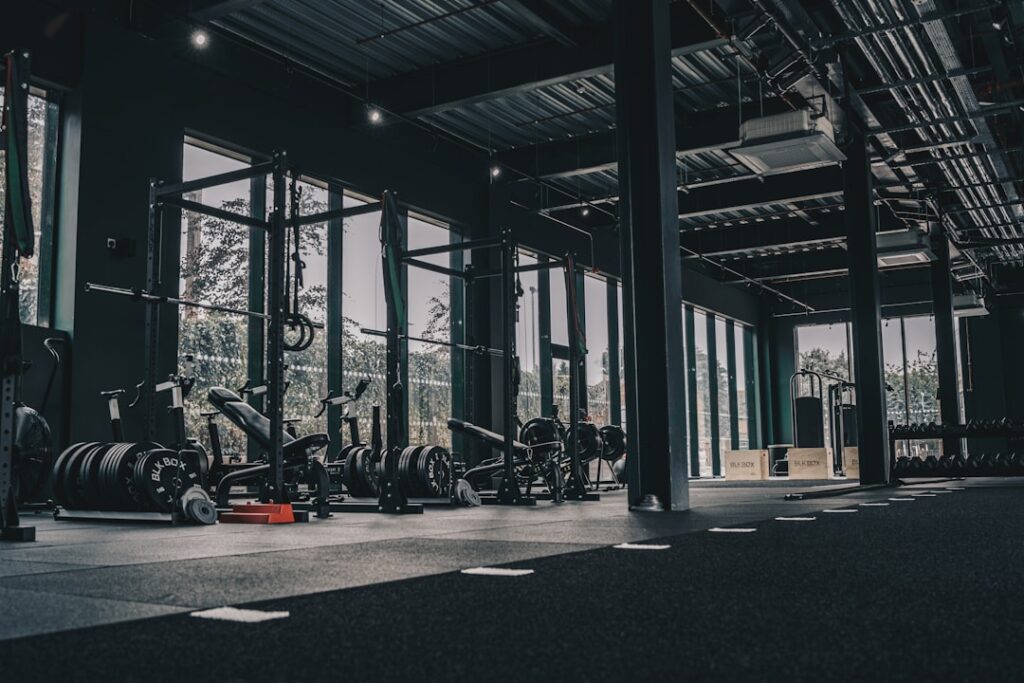
Solid black rubber gym flooring has a UV problem — the rubber off-gasses and fades to brown under skylights, then telegraphs every flake of chalk and footprint. Grey rubber flooring sidesteps both issues by using EPDM-blended granules in 70/30 or 90/10 grey-to-black ratios, which deliver a more neutral commercial look and hide dust between cleanings. Installed prices in 2026 land $3.99 to $14.99 per square foot depending on tile versus roll, thickness, and EPDM content, with most CrossFit gyms and corporate fitness centers spending $7 to $10 per square foot delivered.
How Grey Rubber Is Made
Most grey rubber flooring blends recycled SBR (styrene-butadiene rubber) granules from end-of-life truck tires with virgin EPDM color flecks pressed under heat and a polyurethane binder. The percentage of EPDM in the mix drives the color saturation and the UV stability — a 10% EPDM blend reads as charcoal grey with black speckles, while a 70% blend hits a true light grey that holds color under skylights for 15-plus years. Premium fusion-bonded products from Ecore (Endura), Mondo Sport, and Greatmats Pro Endurance use solid-color EPDM caps over recycled SBR cores for the most consistent grey tone.
Roll goods come in 4-foot widths up to 50 feet long and 3 mm to 12 mm thicknesses. Modular tiles ship in 24 x 24 inch interlocking squares from 8 mm to 20 mm.
Where Grey Rubber Wins
Commercial gyms with natural light prefer grey because skylights bake black rubber to dull brown in 3 to 5 years. The same goes for storefront-facing fitness studios where the floor is visible from the street. Veterinary clinics, daycares, and senior living common areas pick grey for the neutral institutional look that pairs with white walls and stainless steel cabinetry. Garage shops and home gyms in detached structures also lean grey because it doesn’t show every white dust speck the way black does.
Where grey doesn’t fit: heavy free-weight rooms with constant chalk use sometimes prefer black because the chalk dust contrasts visibly and signals a cleanup is overdue. Olympic platforms and competition spaces also tend to spec black for the same chalk-visibility reason.
Pros That Drive the Spec
- UV stability on EPDM-rich blends — holds tone for 15 to 20 years under skylights
- Sound dampening at IIC 50 to 70 depending on thickness
- Impact absorption rated to ASTM F1292 for fall heights of 4 to 7 feet on thicker SKUs
- Slip resistance at wet DCOF of 0.55 to 0.65 — exceeds ANSI A326.3 high-traction threshold
- 40% to 90% recycled content for LEED MR Credit 4 submittals
- Neutral grey base pairs with white, charcoal, or any accent EPDM fleck
- Custom color blending with 20-plus chip colors at 200 to 500 sq ft minimums
Cons You Should Plan For
Off-gassing is universal for the first 30 to 90 days. The smell ranges from mild burnt-tire to strong depending on EPDM content and binder system. Run HVAC at maximum air exchange for the first month after install, and avoid commissioning the space for occupants during the worst of the curing period. Premium fusion-bonded products from Ecore and Mondo off-gas significantly less but still need a couple of weeks of airflow.
Indentation under heavy point loads is the other complaint. A 600-pound dumbbell rack on small rubber feet can dent 8 mm rubber flooring within months. Use load spreaders under any furniture or equipment with concentrated load above 100 lbs per leg, and step up to 12 mm or 14 mm where dropped barbells and free weights live.
Match the Thickness to the Use Case
- 3 mm to 4 mm: light commercial, office break rooms, treadmill-only rooms — $3.99 to $5.49 per sq ft installed
- 5 mm to 6 mm: corporate fitness centers, hotel gyms, cardio-and-light-weights areas — $5.49 to $7.49
- 8 mm sheet: most full-service gym floors, free-weight zones, dumbbell racks — $6.99 to $9.49
- 10 mm to 12 mm: heavy free-weight gyms, university strength training, CrossFit boxes — $8.99 to $11.99
- 14 mm to 20 mm tiles: drop zones for bumper plates, Olympic platforms — $11.99 to $14.99-plus
Layer 4 x 6 foot lifting pads over thinner roll goods where dropped weights live — cheaper than installing thicker rubber across the entire space.
Cost Breakdown for a Typical Garage Gym
A 400 square foot two-car garage gym in 8 mm grey rubber roll runs roughly $2,800 in material plus $300 in adhesive and seam sealer, plus $800 in installer labor — about $3,900 turn-key. DIY the install with peel-and-stick interlocking tiles and the same project drops to roughly $2,400 in materials with no labor. Add a 6 x 8 foot 12 mm drop zone in front of the squat rack for another $400 in materials, and the floor handles dropped 405-pound deadlifts with no slab damage below.
Commercial installs scale similarly. A 5,000 square foot fitness center in 8 mm grey EPDM rubber roll lands $35,000 to $50,000 turn-key including adhesive, perimeter trim, and heat-welded seams.
Installation Reality Check
Roll goods install with full-spread urethane adhesive over a primed slab at 65°F to 85°F with under 75% RH and slab moisture under 4 lbs per 1,000 sq ft on calcium chloride. Seams are either butt-fit and chemically welded with the manufacturer’s seam sealer or heat-welded with a thermal rod after grooving. Both methods need a certified installer to keep manufacturer warranty intact.
Interlocking tile install is genuinely DIY-friendly — no adhesive on most products, just dry-fit the tongue-and-groove edges and use ramped reducer strips at the doorways. Stagger seams between rows, leave 1/4 inch expansion gap at the walls, and weigh down the perimeter tiles with the equipment going on top of them.
Cleaning and Maintenance
Sweep or vacuum daily in a commercial setting and weekly in a home gym. The smooth top surface of grey rubber traps dust between EPDM flecks where the standard broom misses it, so use a vacuum on hard-floor setting for the deepest clean. Damp-mop weekly with a pH-neutral cleaner mixed at 1 capful per gallon — never use acidic, ammonia, or solvent cleaners that attack the binder.
Avoid auto-scrubbers with rotary brushes — they pull EPDM flecks out of the surface over time. Soft-bristle counter-rotating brushes or microfiber pads on a low-RPM scrubber are the safe choice in commercial settings.
What to Confirm Before You Buy
Get the EPDM percentage in writing on the order. Anything below 10% EPDM will look mostly black with grey speckles, not the lighter grey most buyers picture from the showroom sample. Order a 6 x 6 inch sample of the exact color blend and confirm the tone matches your render. Verify the adhesive coverage and roller spec match what the manufacturer requires, because off-spec install voids the typical 15-year commercial warranty.
Grey rubber flooring stays the workhorse choice for any commercial space that combines impact, sound, slip safety, and a neutral institutional look. Spec the EPDM percentage and thickness for your real use case, and the floor outlasts every other surface in the building.
Prefer to explore on your own?
See how new flooring looks in your actual room in seconds — free, no signup.
Try the free Floor Studio →