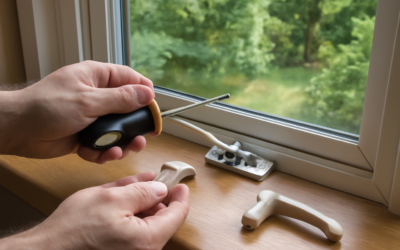
In an era when an 18V brushless cordless drill runs $199 and fits in a tool belt, the hand crank drill sounds like a museum piece. Plenty of serious woodworkers, antique restorers, and careful homeowners still reach for one first. Zero battery anxiety, near-perfect torque control, and the ability to feel the grain as you drill make these tools earn their place in a modern shop. The catch is knowing which type to buy and what it does best.
The Three Types Worth Owning
“Hand crank drill” covers a family of tools, not one tool. Each has a different job:
- Eggbeater drill: A compact two-gear drill with a side crank, sized for 1/4 inch and smaller bits. Classic Millers Falls No. 2 and Stanley Handyman designs.
- Breast drill: Larger, with a curved chest plate for pushing weight, driving bits up to 1/2 inch. Old framing and shipwright tool.
- Bit brace: The U-shaped crank drill for auger bits. Drives large holes through timber slowly and with enormous torque.
For most homeowners, the eggbeater handles fine work and the brace handles heavy timber. The breast drill is a specialized piece best suited to restoration and large boring tasks.
Why Use a Hand Crank Drill in 2026
There are five situations where a hand drill beats a cordless:
- Fine furniture work: No battery torque spikes, so you can feel exactly when to back off
- Antique restoration: Matches period work and avoids splintering fragile wood
- Musical instrument repair: Ultra-low-speed control for pilot holes in thin spruce or maple
- Power outages and off-grid projects: Always works
- Quiet work environments: Silent drilling for apartments, nurseries, studios
For driving screws into a deck, use a cordless. For pilot holes in a $200 walnut veneer you cannot afford to chip, use an eggbeater.
The Best New Hand Crank Drills
Only a few manufacturers still make quality new hand drills. Your best options:
- Schroder SH-41 Eggbeater Drill: German-made, hardened steel gears, $85 to $110
- Ji Zhi Hand Drill: Taiwanese, well-regarded budget option, $35 to $50
- Lee Valley Veritas Hand Drill: Premium eggbeater, brass fittings, $169
- Stanley H1220 Hand Drill: Entry-level, plastic handles, still works, $25 to $35
For bit braces, the Narex 10-inch brace ($85 to $110) is the best new option. Vintage Stanley, Millers Falls, and North Brothers braces from the 1920s to 1950s are often better than anything made today.
Buying Vintage: What to Look For
Old hand drills are usually better than new budget models. Haunt estate sales, flea markets, and eBay for these names:
- Millers Falls (No. 2 and No. 5 eggbeaters are benchmarks)
- Stanley (Handyman and Yankee series)
- Goodell-Pratt
- North Brothers (pre-1929, before Stanley bought them)
- Craftsman from the 1940s to 1960s
A vintage Millers Falls No. 2 in working condition typically sells for $30 to $60. Check that the gears mesh smoothly, the chuck jaws still center, and the crank handle is not cracked. Surface rust is normal. Broken gear teeth mean walk away.
Restoring an Old Hand Drill
Nearly any vintage drill can be brought back to working condition with basic tools and an evening. The process:
- Disassemble fully: mark orientation of gears with a sharpie before removing
- Soak rusted parts in Evapo-Rust (overnight, non-toxic) or 50/50 vinegar and water
- Scrub with a brass brush, not steel, to avoid scratching plated surfaces
- Polish wood handles with 320 grit sandpaper and a coat of boiled linseed oil
- Lubricate gears with white lithium grease or synthetic wheel bearing grease
- Reassemble and test with a 1/8 inch bit in pine
Total time: 2 to 4 hours. Budget under $20 in supplies. The satisfaction of bringing a 100-year-old tool back to productive use is a bonus not found in a battery pack.
How to Actually Use One
Technique matters more with hand tools than power tools. For an eggbeater:
- Grip the top knob with your off hand for downward pressure
- Turn the crank with your dominant hand at a steady 60 to 90 RPM
- Let the bit do the work; do not force it
- Back out every inch to clear chips on deep holes
- Use a starting awl or punch to prevent bit walk
For a bit brace, grip the handle firmly, lean your body weight over the pad, and sweep full circles rather than cranking in short arcs. Full rotations give even torque.
The Right Bits for Hand Drilling
Modern high-speed steel twist bits work in eggbeaters but are overkill. Better options:
- Lee Valley Brad-point bits: Perfect for wood, clean entry, $30 for a set
- Vintage auger bits for braces: Irwin, Russell Jennings, James Swan
- Snail-countersinks: Cut pilot hole and countersink in one pass
- Spoon bits: Traditional chairmaker bits for angled holes
A bit brace with a good set of Russell Jennings augers will bore holes a cordless drill cannot match for cleanness in hardwood.
Common Mistakes to Avoid
Three errors wreck hand drill work:
- Forcing the bit (breaks gears and bits)
- Cocking the drill off axis while turning (opens the hole to an oval)
- Using dull bits (dull twist bits in a hand drill just bind and strip)
Keep your bits sharp. A jeweler’s file, a small guide, and 10 minutes once a month keeps an eggbeater cutting like new.
When a Hand Drill Is Not the Right Tool
Do not try to drill 30 pilot holes in ledger boards with an eggbeater. Do not bore through steel with a brace. Do not expect to mix drywall mud or use a hole saw. Hand drills are precision instruments for carefully placed, finite holes in wood and the occasional thin plastic.
Final Word
A quality hand crank drill lives in a workshop the same way a block plane or a dovetail saw does. It is not a cordless replacement. It is a tool that does certain jobs better than any battery-powered alternative, and it will still be drilling perfectly clean holes when your lithium pack is in a recycling bin. For around $50 you can add one to your bench that your grandkids will inherit in working order.