A casement window that grinds, slips, or spins freely without moving the sash has a worn operator, and the fix is far cheaper than the window company wants you to believe. Casement window crank replacement runs $15 to $60 in parts and about an hour of work, yet window dealers routinely quote full sash or unit replacement when the only failed component is a $40 gearbox. I have swapped hundreds of these operators, and the entire skill is in identification — get the right part number and the wrench work is trivial.
Part of our Windows & Doors guide — explore the full guide →
Start by understanding what you are replacing. The crank handle turns a gear housing (the operator) screwed to the window frame at sill level; the operator drives one or two steel arms that push the sash open along a track. In a casement window crank replacement, you might need just the handle ($5-$12), the operator gearbox ($25-$60), or occasionally the hinge hardware everyone misdiagnoses as a crank problem. Diagnosing which comes first.
Diagnose: Handle, Operator, or Hinges
- Handle spins but the splined shaft beneath doesn’t turn: stripped handle splines — the cheapest fix. Pull the handle (set screw or friction fit) and inspect: rounded-out teeth inside the handle bore mean a $5-$12 universal replacement handle. Buy the multi-spline universal; it fits 11-tooth, 12-tooth, and most spline counts.
- Handle and shaft turn but the sash moves erratically or not at all: stripped gears inside the operator or a disconnected arm. Gearbox replacement.
- Crank works but the window is brutally hard to open, or sags: the operator is fine — the hinges are dry or worn, or the sash has dropped. Cranking through hinge resistance is precisely what kills operators, so fix hinges first or the new gearbox dies the same death. Silicone spray the hinge pivots and track, and check the adjustable hinge channel screws.
- Grinding but functional: open the cover and look: dried grease and grit are serviceable with cleaning and white lithium grease; visibly chewed zinc gear teeth are not.
Identify the Operator Before Buying Anything
Operator design varies by window brand and era, and “casement operator” covers a dozen incompatible geometries. The manufacturers to know:
- Truth Hardware: the OEM behind a huge share of the market — Pella, Marvin, Milgard, Hurd, and dozens more use Truth operators. Look for TRUTH cast into the arm or housing plus a part number like 30.10 or 15 series. The Truth “Encore” (dual-arm, dyad style) and “Entrygard” (single-arm with track shoe) families cover most windows since the mid-1980s.
- Andersen: makes its own operators, handed left/right, in distinct generations — the straight-arm and split-arm types on Perma-Shield casements (1966-1995) versus the Improved/E-Z series after. Andersen stamps the sash with a manufacture date; their parts line keys off it.
- Roto: a licensed geometry with a distinctive rounded housing, common on Canadian and vinyl windows.
- EntryGard clones and imports: generic operators from Prime-Line and Slide-Co mimic common patterns at $20-$35.
The reliable ID method: remove the operator first (next section), then match three things — the part number cast into it, the arm configuration (single arm, single arm with pivot shoe, or dual scissor arms), and the handing (stand inside; a right-hand window hinges on the right). Photograph it on a bench next to a tape measure. Suppliers like SWISCO, Blaine Window Hardware, and All About Doors match photos daily, and Truth numbers cross straight to stock at window-parts sites for $25-$60.
Removing the Old Operator
- Crank the sash to roughly 90 degrees open — arm access happens at full extension on most designs.
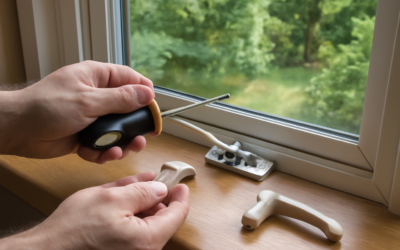
- Pull the handle: loosen the set screw (commonly 3/32 hex) or pry the friction cap and pull straight off.
- Remove the operator cover/trim: on wood windows, a screwed or snap-fit sill cover; on vinyl, the operator screws are usually exposed.
- Disconnect the arms: single-arm shoe types slide along a sash track to an access notch where the shoe pops out; dual-arm types disconnect at a pivot clip or by unscrewing the arm bracket from the sash. Stubborn shoes free up with a flat screwdriver twist at the notch.
- Unscrew the operator base — typically 3 or 4 screws down through the sill frame or horizontally through the jamb face — and wiggle it out. Note the shim washers if any; they set arm height and go back the same way.
- Support the sash: with arms disconnected, only hinges hold the window. Close and latch it, or clamp it, before walking away — a wind gust on a free sash bends hinges and worse.
Installing the New One
Installation reverses removal, with three details that matter. Set the new operator in place and start all screws before tightening any, so the housing can align to the arm geometry. Reconnect the arms with the sash at the same opening angle you disconnected at — forcing an arm to reach teaches you why the access notch exists. And before the cover goes back on, crank through the full range twice: the sash should pull snug against the weatherstrip at fully closed with the handle stopping firm, not mushy. If the sash closes loose, most operators allow slight repositioning in slotted holes; snug the closure before final torque.
Finish with lubrication that lasts: white lithium or silicone grease in the gear housing if it opened for service, silicone spray (never oil, which gums with dust) on the arm track, shoe, and hinge pivots. Two minutes of grease annually roughly triples operator life — worn dry gears are the number-one failure I see.
Sourcing Parts Without Frustration
- SWISCO, Blaine Window, All About Doors and Windows: photo-match services and deep Truth/Roto stock; typical operator $28-$55 shipped.
- Andersen parts direct or via dealers: operators $40-$80; have the window’s date stamp and glass etching info ready.
- Big-box aisles (Prime-Line): universal handles and a handful of common operators, $8-$35 — fine for handles, hit-or-miss for gearboxes.
- Discontinued patterns: some 1950s-60s operators are gone; the workaround is adapting a current Entrygard-pattern operator with a new sash bracket, a known conversion the specialty suppliers document, or salvage via eBay searches on the cast part number.
Ordering rules that prevent the wrong-part loop: match handing, match arm length within 1/2 inch (measure pivot to shoe center), and match the mounting footprint hole pattern, which you can verify against supplier dimension drawings before checkout.
Preventing the Next Stripped Operator
Operators strip because they get asked to do a hinge’s job. The habits that keep the new one alive: unlock the sash latches fully before cranking (cranking against an engaged lock is the fastest gear-killer there is), stop turning the instant the sash seats instead of adding a “make sure” quarter turn, and never crank through obvious resistance — investigate it. Paint is a repeat offender; a sash painted shut on the exterior face will strip a fresh operator in one enthusiastic session, so score painted edges with a utility knife after every exterior repaint.
Put the window on a two-minute annual schedule: silicone spray on hinge pivots and the operator track, a drop of white lithium at the arm’s pivot shoe, and a check that the hinge channel screws are tight. While you are there, inspect the weatherstrip — compressed or torn bulb gasket makes the sash need extra force to seal, which translates directly into gear load. Replacement bulb and leaf weatherstrip runs $10-$20 per window from the same suppliers that sold the operator, and swapping it is a pull-and-press job on most brands. A casement that closes with light fingertip pressure on the crank is a casement whose $40 gearbox lasts twenty years.
Cost, Time, and the Replace-the-Window Question
A realistic ledger for one window: $30-$60 operator, $8 universal handle if needed, one hour the first time and 25 minutes each after. A handyman charges $100-$180 per window; window companies quote $600-$1,500 to replace the sash or unit. Replacement genuinely wins only when the operator failure is a symptom — rotted sash corners, fogged double-pane glass, or bent hinges from years of forcing — stacking multiple failures on one opening. A sound window with a stripped gearbox deserves the $40 part every single time.
Keep the old operator in a labeled bag in the garage for a season. If anything about the new part’s geometry proves off, that reference casting answers every question the supplier will ask — and when the swap goes perfectly, which it usually does, toss the bag and enjoy a window that closes with two fingers again.