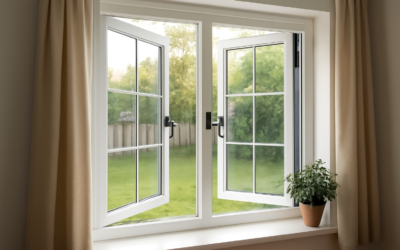
If you have ever wondered whats a casement window and why builders specify them for kitchens, bathrooms, and tight spaces over sinks, the short version is this: a casement window swings open on side-mounted hinges using a hand crank, opening fully to the outside like a door. That single design difference makes it the best-sealing, best-ventilating, and most security-friendly operable window on the market. It also brings tradeoffs that homeowners need to understand before swapping out double-hung sashes.
Part of our Windows & Doors guide — explore the full guide →
- How a Casement Window Works
- Casement vs Double-Hung: Real Performance Numbers
- When to Specify Casement
- Where Casement Falls Short
- Brand Spotlight: What Actually Lasts
- Installation Specs That Matter
- Energy Performance and U-Factor
- Hardware Options That Matter
- Cleaning the Exterior Glass
- Maintenance Schedule That Extends the Life
How a Casement Window Works
The sash hinges on either the left or right vertical edge of the frame and is operated by a folding crank handle at the bottom interior side. Turning the crank extends a steel arm that pushes the sash outward up to 90 degrees. A multi-point locking mechanism along the latch side of the sash pulls the window tight against weatherstripping when closed. That compression seal is why casement windows test out at the lowest air infiltration rates of any operable window style.
Casement vs Double-Hung: Real Performance Numbers
- Air infiltration: casement windows average 0.10 cubic feet per minute per square foot, double-hungs average 0.30. Three times tighter.
- Glass area: casement windows have no horizontal meeting rail, giving 10 to 15 percent more glass per square foot of opening.
- Ventilation: casement opens 100 percent of the sash area to outside air. Double-hung tops out at 50 percent (one sash open).
- Cost: casement runs 15 to 30 percent more than double-hung of the same size from the same manufacturer.
When to Specify Casement
Casement is the answer for any opening above a kitchen counter where reaching up to lift a heavy sash is awkward, in tight bathrooms where you want maximum air movement, on windward walls where you want to catch and scoop breezes into the house (the open sash acts like a vane), and in any second-story bedroom required to meet egress code with limited rough opening width. The minimum egress opening of 5.7 square feet with at least 24 inches clear height is easier to hit with a casement than with a double-hung.
Where Casement Falls Short
Casement windows swing outward, so they conflict with deck space, narrow walkways, and exterior screens (most use interior insect screens that get in the way of cleaning). They are vulnerable to wind damage if the crank is left engaged in a heavy gust. The mechanical hardware (crank, hinges, multi-point lock) is more failure-prone than a simple double-hung counterbalance. After 15 years, expect to replace at least one crank per window.
Brand Spotlight: What Actually Lasts
Andersen 400 Series casement windows at $580 to $980 each (depending on size) are the residential benchmark. Solid wood interior with fiberglass exterior cladding, Stratos low-E glass, and a 20-year glass seal warranty. Marvin Elevate casements run slightly higher at $720 to $1,200 each with extruded aluminum exterior and pine interior. For premium budgets, Pella Reserve and Sierra Pacific deliver paint-grade and stain-grade hardwood with even longer warranties.
Budget-friendly picks include the Pella 250 Series at $380 to $620 and the Andersen 100 Series Fibrex at $420 to $680. Both pass Energy Star certification and carry 10-year warranties. Skip no-name vinyl casements under $250; the cranks fail within 7 years and the seals leak within 12.
Installation Specs That Matter
A new construction casement installs into a stick-framed rough opening with a nailing fin. Rough opening dimensions are 1/2 inch wider and 1/2 inch taller than the window unit size. Shim the bottom on the hinge side first, plumb the jambs with a 4-foot level, and secure with 2.5-inch finish nails or installation screws through pre-drilled holes. Insulate the gap with low-expanding foam (Great Stuff for Windows and Doors, blue can) and flash the head and sides with Tyvek or 3M 8067 flashing tape.
Replacement casements are trickier than double-hungs because the swing radius requires the exterior opening to be unobstructed. If you have stucco, brick veneer, or fiber cement siding right up to the edge of the existing frame, allow extra trim work to make room for the new sash to operate freely.
Energy Performance and U-Factor
Energy Star certification requires a U-factor below 0.30 in the northern climate zone and a Solar Heat Gain Coefficient (SHGC) below 0.40 in the southern zone. Andersen 400 Series casements hit U-factor 0.27 with triple-pane glass and SHGC 0.27. Over a 20-year window life in a Minneapolis or Boston home, the energy savings from a casement upgrade over a leaky 30-year-old aluminum double-hung average $35 to $75 per window per year.
Hardware Options That Matter
Standard cranks fold flat against the window so blinds and shades clear them. Truth Hardware and Roto are the two dominant manufacturers; replacements run $25 to $65 per unit. For accessibility, motorized cranks with a wall switch are available from Truth at around $290 per window. Multi-point locks with three rolling cams are standard on premium brands; budget windows use a single latch and seal less tightly.
Cleaning the Exterior Glass
The biggest practical advantage of a casement: open the sash 90 degrees and you can reach the exterior glass from inside the room. No ladder, no extension squeegee, no calling a service. For homeowners in two-story houses, this alone justifies the price premium over double-hungs.
A casement window is the right choice when you want a tighter seal, more glass area, and easier cleaning. Specify a reputable brand, install it correctly, and it will outperform almost any other operable window style for the life of the house.
Maintenance Schedule That Extends the Life
Lubricate the crank gears and hinge points with white lithium grease once a year, typically in spring before heavy use begins. A $6 can of CRC White Lithium Grease handles 15 to 20 windows and keeps the operating hardware smooth for decades. Inspect the weatherstripping each fall before heating season; replace any compressed or torn sections with manufacturer-specific replacements (around $18 to $40 per window for a full kit).
Check the multi-point locks once a year by closing and locking each window then trying to push the sash open from outside. If there is any play in the seal, adjust the strike plates with a Phillips screwdriver. Clean the weep holes at the bottom of the exterior sill with a toothpick or a thin wire so drainage flows freely. These small habits, totaling roughly 90 minutes a year for a whole house of casements, prevent the warranty claims and replacement costs that plague neglected windows after the 15-year mark.