
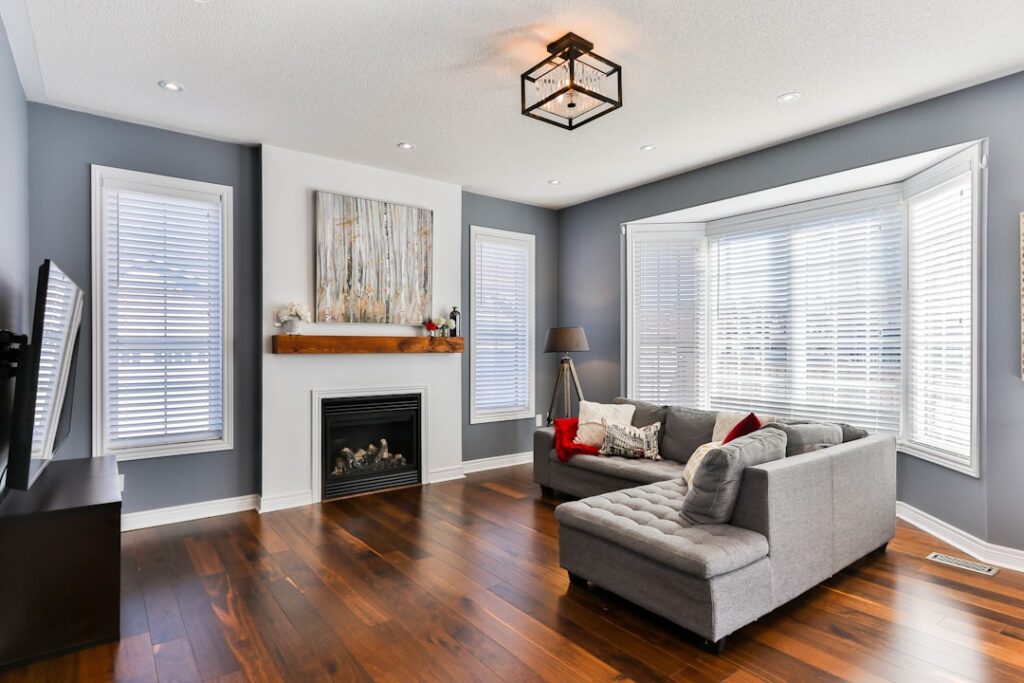
The phrase covers two related ideas: the hardwood that covers your subfloor, and the rugs and protective layers you put over hardwood to shield it. This guide treats hardwood floor covering in both senses, walking through solid versus engineered wood, the species and finishes that determine durability, and the rugs, mats, and finishes that protect a wood floor once it is installed. Whether you are choosing a new wood floor or trying to protect an existing one, understanding these layers helps you make decisions that look good and last.
Solid vs Engineered Hardwood
The first decision is the wood itself, and the two main categories behave differently.
Solid Hardwood
Milled from a single piece of wood, typically 3/4 inch thick, solid hardwood can be sanded and refinished many times over decades. It is the most authentic and longest-lived option, but it reacts to humidity, so it is best on or above grade in climate-controlled homes. Expect $8 to $15 per square foot installed.
Engineered Hardwood
Built from a real-wood veneer over a plywood or HDF core, engineered hardwood resists humidity-driven movement far better and can go over concrete slabs and in basements. Most can be refinished once or twice depending on veneer thickness. Typical installed cost is $6 to $12 per square foot.
Choosing a Wood Species
Species affects hardness, color, and price. Hardness is measured on the Janka scale, which predicts dent resistance.
- Red oak (Janka ~1,290): the American standard, affordable and easy to refinish.
- White oak (~1,360): slightly harder, with a trendier, less-pink tone.
- Hickory (~1,820): very hard, great for high-traffic homes with pets.
- Maple (~1,450): hard and light, with a subtle grain.
- Walnut (~1,010): softer but prized for its rich brown color.
For busy households, choose a harder species; for formal, lower-traffic rooms, softer woods like walnut are fine.
Finishes That Protect the Wood
The finish is the wood floor’s first line of defense, a clear protective covering over the wood itself. Common options include:
- Oil-based polyurethane: durable and warm-toned, but ambers over time and has strong fumes.
- Water-based polyurethane: clear, low-odor, fast-drying, and increasingly popular.
- Penetrating hardwax oil: a natural matte look that is easy to spot-repair but needs periodic reapplication.
- Aluminum-oxide factory finish: the toughest, found on prefinished engineered planks.
Prefinished floors arrive with a factory-cured finish and install faster, while site-finished floors allow custom colors and a perfectly smooth, seamless surface.
Protecting Hardwood With Rugs and Mats
Once wood is down, the right surface coverings preserve it. Area rugs do more than decorate; they shield high-traffic paths from wear and scratches. A few guidelines:
- Use a breathable rug pad: a felt-and-rubber pad protects the finish and prevents slipping, but avoid solid rubber-backed rugs that can trap moisture and discolor the wood.
- Place mats at entries: walk-off mats catch grit that scratches finish; most floor wear is abrasive grit ground in by foot traffic.
- Add felt pads under furniture: they prevent dents and scratches from chairs and tables.
- Rotate rugs periodically: so the floor under them ages evenly with the exposed areas, especially in sunny rooms.
Everyday Care and Maintenance
Hardwood is durable but not indestructible, and a simple routine keeps it looking new. Sweep or vacuum with a hard-floor setting regularly to remove grit. Damp-mop with a wood-specific cleaner, never a soaking-wet mop or steam, since standing water and steam can swell wood and cloud finishes. Wipe spills promptly. Keep indoor humidity between roughly 35 and 55 percent year-round to minimize seasonal expansion and contraction, using a humidifier in dry winters and a dehumidifier or AC in humid summers.
When to Refinish or Recoat
Wood floors can be renewed rather than replaced, a major advantage over vinyl and laminate. A light recoat, screening the surface and adding a fresh layer of finish, refreshes a dull floor every few years without sanding. A full sand-and-refinish removes deep scratches and lets you change color, and solid hardwood can take this many times across its life. Watch for graying, deep scratches reaching bare wood, or a finish that no longer beads water; these signal it is time to recoat or refinish before damage reaches the wood itself.
Subfloor and Installation Basics
A hardwood floor is only as good as what lies beneath it. The subfloor must be clean, dry, structurally sound, and flat to within about 3/16 inch over 10 feet before installation begins. Plywood and OSB subfloors accept nail-down solid hardwood well, while concrete slabs require either engineered planks glued down or a floating installation with a moisture barrier. Always run a moisture test on the subfloor; excess moisture is the leading cause of cupping and gaps later. Acclimate the wood in the room for several days to a week so it reaches equilibrium with your home’s humidity before it is fastened down. These prep steps are unglamorous but decisive in whether the finished floor stays flat and quiet.
Comparing Hardwood to Alternatives
It helps to weigh real wood against the look-alikes when budgeting. Luxury vinyl plank and laminate cost less and resist moisture better, but they cannot be sanded and refinished, so once the wear layer is gone, they must be replaced. Genuine hardwood costs more up front, $8 to $15 per square foot installed for solid, but it can be refinished multiple times and often adds resale value that vinyl and laminate do not. Engineered hardwood splits the difference, offering real-wood looks with better humidity tolerance and a lower price than solid. For homeowners who value longevity, authenticity, and the ability to renew the surface for decades, hardwood remains the benchmark the alternatives are designed to imitate.
The Bottom Line
Thinking about hardwood floor covering in both senses, the wood you install and the rugs and finishes that protect it, leads to better decisions and longer-lasting floors. Choose solid or engineered wood based on your climate and subfloor, pick a species hard enough for your traffic, protect the surface with quality rugs and felt pads, and maintain stable humidity with gentle cleaning. Treated this way, a hardwood floor can stay beautiful for generations and be refinished rather than replaced when it finally shows its age.
Prefer to explore on your own?
See how new flooring looks in your actual room in seconds — free, no signup.
Try the free Floor Studio →

