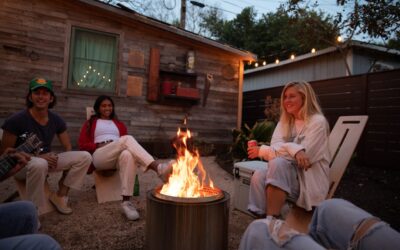
A propane fire table that hides the tank looks clean and uncluttered, but the box around that tank is doing more than hiding it. A hidden propane tank fire pit has to vent leaking gas, protect the hose and regulator, and let you reach the valve quickly. Get those details wrong and you trap propane in an enclosed cabinet right below an open flame.
Here is how the design works: a standard 20 lb propane cylinder sits upright inside the base of the table, a hose and regulator run up to the burner valve, and the enclosure has vent openings near the bottom (propane is heavier than air) plus a door large enough to swap tanks. Factory-built tables are designed and tested with these features. DIY enclosures are possible, but they must copy the same ventilation and access rules and follow the burner kit maker’s instructions.
- How a Hidden Propane Tank Fire Pit Is Built
- Ventilation: The Most Important Feature
- Hose and Regulator Routing
- Tank Door and Compartment Sizing
- DIY Enclosure Rules
- Tools and Materials for a Tank Change
- Step-by-Step: Installing or Swapping the Tank
- Fire, Gas and Carbon Monoxide Safety
- Troubleshooting
- Cost Ranges
- When to Call a Licensed Professional
- Frequently Asked Questions
The sections that follow explain how tank-inside tables are laid out, what to look for when shopping, the rules for building your own enclosure, and safe operation of any hidden propane tank fire pit.
How a Hidden Propane Tank Fire Pit Is Built
Every fire table with a propane tank inside shares the same basic parts.
- Tank compartment: a cabinet in the base sized for a standard 20 lb cylinder, which is about 12 inches in diameter and about 18 inches tall.
- Burner pan: a steel tray in the tabletop holding the burner and media such as lava rock or fire glass.
- Hose and regulator: connects the tank to the control valve. The regulator reduces tank pressure to what the burner needs.
- Control valve and igniter: usually a knob on the side of the table with push-button or spark ignition.
- Vent openings: slots or gaps in the base, especially low on the sides, that let any leaking propane escape.
- Access door: a hinged or removable panel for installing and changing the tank.
Rectangular fire pit tables with a propane tank inside often place the tank at one end of the base with the burner centered above, while square and round designs usually put the tank directly under the burner.
Ventilation: The Most Important Feature
Propane is heavier than air. A small leak will sink and pool in the bottom of an enclosed cabinet. That is why tank enclosures need vents low on the sides or in the floor of the compartment, and often higher openings as well so air can move through. The goal is that any leaked gas drains out rather than collecting under the burner.
Look for generous vent openings on at least two sides. Never block them with cushions, leaves, a cover pulled down tight while the burner is lit, or by pushing the table against a wall. Open or slatted base designs vent better than solid boxes. For DIY builds, follow the vent size and placement given by the burner kit or enclosure instructions; do not guess.
Hose and Regulator Routing
The hose should run from the tank up to the valve without kinks, sharp bends or contact with hot surfaces. Keep it away from the underside of the burner pan, which gets hot during use. Secure it with clips or brackets so it does not rub against metal edges.
The regulator should hang freely with its vent facing down so rain cannot enter. Check the hose each season for cracks, stiffness or abrasion, and replace it if you see any damage. Use only a hose and regulator assembly designed for your burner.
Tank Door and Compartment Sizing
A tank door must be large enough to lift a full cylinder in and out without tilting it into the hose or forcing the valve. A 20 lb tank full of propane weighs around 37 pounds, so awkward angles make it hard to handle. Look for:
- Interior height of at least 20 to 22 inches so the valve and regulator clear the top
- Interior width and depth of at least 14 to 16 inches
- A door opening wide enough to slide the tank straight in
- A level floor so the tank stays upright
- Easy reach to the tank valve so you can shut it off quickly
Tanks must always be stored upright. A tank on its side can release liquid propane through the valve.
DIY Enclosure Rules
Building your own hidden propane tank fire pit around a burner kit is a popular project, but the enclosure design is where most DIY mistakes happen. Follow these rules:
- Use a listed burner kit and follow its instructions for enclosure size, venting and clearances.
- Vent the tank compartment with openings low on at least two sides, sized per the kit instructions.
- Separate the tank from the burner. Keep the cylinder well below the burner pan and shield it from heat. Some designs use a separate side enclosure.
- Use non-combustible materials near the burner, such as masonry, concrete board or metal. Keep wood well away from hot surfaces.
- Allow easy access to the tank valve and all connections.
- Leak test every connection with soapy water before first use and after every tank change.
Never modify a burner, regulator or valve. If you want a natural gas line run to a table, or you want to convert a burner between fuels, that work belongs to a licensed gas professional and often requires a permit and a pressure or leak test.
Tools and Materials for a Tank Change
- Full 20 lb propane cylinder with an overfill protection valve
- Spray bottle of soapy water for leak testing
- Work gloves
- Soft brush to clear debris from the compartment
- Flashlight for checking the hose and regulator
Step-by-Step: Installing or Swapping the Tank
- Turn off the burner and let the table cool completely.
- Close the tank valve clockwise until snug.
- Unscrew the regulator from the old tank by hand and remove the cylinder, keeping it upright.
- Inspect the compartment; clear leaves, spiderwebs and debris from vents.
- Set the new tank upright and hand-tighten the regulator connection.
- Open the tank valve slowly and spray soapy water on every connection. Growing bubbles mean a leak; close the valve and fix or replace the part.
- Close the door, making sure it does not pinch the hose.
- Light the burner following the manual.
Fire, Gas and Carbon Monoxide Safety
Propane fire tables are for outdoor use only. Never use one in a garage, enclosed porch, sunroom or tent. Burning propane produces carbon monoxide, and in an enclosed space it can build to dangerous levels quickly. Keep the table in open air with clearances from walls, overhangs and railings as specified in the manual, and keep carbon monoxide alarms installed inside your home on every level and near sleeping areas.
If you smell gas, close the tank valve if it is safe to do so, move away, and call your propane supplier or the gas utility. Do not try to light the burner. Keep a fire extinguisher nearby, never leave a lit table unattended, and keep children and pets at a distance. Store spare tanks outdoors, upright, away from the fire table and any ignition source, never inside the house or garage.
Troubleshooting
Burner will not light: the tank valve may be closed or empty, the regulator may be in bypass mode (close the tank valve and control knob, wait, then reopen slowly), or media may cover the igniter.
Low flame: a nearly empty or cold tank, or a kinked hose.
Gas smell near the base: shut the valve, leak test with soapy water, and do not use the table until the leak is fixed.
Soot on media: too much media or a clogged burner; reduce media and have the burner serviced if needed.
Cost Ranges
Propane fire pit tables with hidden tank compartments range from a few hundred dollars for compact metal models to well over a thousand for large concrete, stone or wood-look designs. DIY burner kits with a pan and valve are sold separately, and the enclosure materials add to the cost. Hiring a gas professional to run a natural gas line typically costs several hundred dollars or more, depending on distance and local rates.
When to Call a Licensed Professional
Call a licensed gas professional for natural gas lines, fuel conversions, burner or valve repairs, and any persistent leak. Check local codes and HOA rules before installing a permanent fire table, since some areas regulate open flames and clearances. If you are building a masonry enclosure, a contractor can help ensure proper footing, ventilation and heat separation.
Frequently Asked Questions
Is it safe to keep a propane tank inside a fire table?
Yes, when the table is designed for it. The compartment must be well ventilated, the tank must stay upright, and every connection should be leak tested.
What size tank fits inside a fire pit table?
Most tank-inside tables are built for a standard 20 lb cylinder. Check the compartment dimensions before buying.
Why does the tank compartment need vents?
Propane is heavier than air, so leaking gas sinks. Low vents let it drain out instead of collecting under the burner.
Can I build my own hidden tank fire table?
Yes, with a listed burner kit and its enclosure instructions for venting, clearances and materials. Gas lines and fuel conversions need a licensed pro.
Can I use a propane fire table on a covered patio?
Only if the manufacturer permits it and required overhead clearances are met. Never use one in an enclosed space because of carbon monoxide.