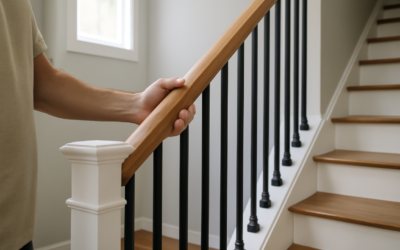
A handrail mounted even an inch too low or too high feels wrong the moment you grab it, and on stairs, that small detail affects real safety. So how high should a handrail be on stairs? Under the International Residential Code (IRC), the standard handrail height is between 34 and 38 inches, measured vertically from the leading edge of the stair tread (the nosing) to the top of the rail. That range is the baseline most US jurisdictions follow, but local codes can differ, so always confirm with your building department before you start. This guide walks through how to measure correctly, why the range exists, and the related rules that make a handrail truly safe.
Part of our Stairs & Stair Flooring guide — explore the full guide →
- The Standard Handrail Height
- How to Measure Handrail Height Correctly
- Why Local Code Always Wins
- When a Handrail Is Required
- Graspability and Grip Size
- Handrail Ends and Continuity
- Guardrails Versus Handrails
- Common Installation Mistakes
- Mounting the Handrail Securely
- Choosing a Handrail Material
- Stairs in Homes With Children or Seniors
- Final Thoughts
The Standard Handrail Height
The 34-to-38-inch range comes from decades of ergonomic and accessibility research. It places the rail at a height most adults can grip comfortably whether climbing or descending, which is when a handrail does its real work, catching a stumble before it becomes a fall. Mount it lower and tall users hunch awkwardly; mount it higher and shorter users lose leverage in a slip.
The critical detail is the measurement reference point. You do not measure from the floor or from the back of the tread. You measure vertically from the nosing, the front edge of each step, straight up to the top surface of the handrail. Because the rail runs parallel to the stair slope, that height stays consistent along the entire flight.
How to Measure Handrail Height Correctly
Accurate measurement is straightforward once you know the reference points. Follow these steps for each rail run.
- Identify the nosing on a representative step, usually one near the middle of the flight.
- Hold a level horizontally out from the nosing edge.
- Measure straight up from that point to the top of the installed or planned rail.
- Confirm the reading falls within 34 to 38 inches.
- Check several steps to ensure the rail stays parallel and consistent.
If you are installing new, snap a chalk line along the wall parallel to the stair slope at your target height before mounting brackets. This keeps the rail dead straight and saves rework.
Why Local Code Always Wins
The IRC is a model code, not law by itself. Your city, county, or state adopts and sometimes amends it. While 34 to 38 inches is the common residential range, some jurisdictions, commercial settings, or accessibility requirements under the ADA specify slightly different figures. Before any installation tied to a permit, inspection, or home sale, verify the exact requirement with your local building department. A quick phone call prevents a failed inspection and the cost of remounting an entire rail.
When a Handrail Is Required
Code does not require a handrail on every step. The trigger point is the number of risers in a continuous flight.
- Most codes require at least one handrail on stairs with four or more risers.
- The rail must run continuously the full length of the flight.
- It must be graspable along its entire length, with no sharp interruptions.
- Wider stairs or open both-side designs may require rails on both sides.
Graspability and Grip Size
Height alone does not make a handrail safe; you also have to be able to wrap your hand around it. Code addresses this with grip-size rules. A round handrail should have an outside diameter of roughly 1.25 to 2 inches, the range a hand can fully close around. Larger decorative rails must include a graspable secondary profile or finger recess. There must also be at least 1.5 inches of clearance between the rail and the wall so your knuckles clear the surface as your hand slides. A beautiful rail that your fingers cannot close around fails its one essential job.
Handrail Ends and Continuity
The ends of a handrail matter for both safety and code compliance. Open ends should return to the wall or terminate in a newel post rather than sticking out, where a sleeve, bag strap, or pocket can snag and cause a fall. The rail should also extend slightly beyond the top and bottom risers in many jurisdictions, giving you something to hold as you step onto the landing. Continuity is key: avoid gaps, abrupt height changes, or sections where the rail is interrupted mid-flight.
Guardrails Versus Handrails
Do not confuse the two. A handrail is the graspable rail you hold while using the stairs, set at 34 to 38 inches. A guardrail (or guard) is the barrier that prevents falls from an open side of a stair, landing, or elevated deck, and it is taller, typically a minimum of 36 inches in residential settings and often more for decks and balconies. On an open staircase you frequently need both: a guard to prevent falling off the side and a graspable handrail at the correct height for support.
Common Installation Mistakes
A few errors show up again and again. Mounting the rail to drywall alone instead of into studs or solid blocking leaves it unable to bear a real load. Setting brackets too far apart allows flex; space them no more than 4 feet apart and at every change in direction. Forgetting to keep the rail parallel to the slope produces a height that drifts out of range from top to bottom. And choosing a chunky decorative profile that no one can grip turns a safety feature into a liability.
Mounting the Handrail Securely
A handrail at the perfect height is useless if it pulls off the wall when someone grabs it during a fall. Secure mounting is non-negotiable. Brackets must anchor into wall studs or into solid blocking installed behind the drywall, never into drywall alone, which cannot hold the sudden load of a person catching themselves. Use brackets rated for handrail use and space them no more than 4 feet apart, plus one near each end of the run. On masonry or tile walls, use the appropriate anchors rated for the load. A properly mounted rail should not flex or shift when you lean your full weight on it.
Choosing a Handrail Material
Handrails come in several materials, and the choice affects both grip and durability. Wood is the most common in homes, warm to the touch and easy to shape into a graspable profile. Metal rails, including steel and aluminum, offer a sleek modern look and excellent strength, though they can feel cold. Composite and PVC rails resist weather and are popular for exterior stairs. Whatever you choose, make sure the cross-section meets the graspability rules, with a diameter your hand can fully close around, and finish wood smoothly so there are no splinters along the gripping surface.
Stairs in Homes With Children or Seniors
While code sets a single height range, households with young children or aging family members often benefit from extra consideration. Adding a second, lower handrail for children, mounted within their reach, can improve safety without removing the code-compliant adult rail. For seniors or anyone with mobility challenges, ensuring the rail extends fully to the top and bottom of the flight gives critical support during the riskiest transition onto the landing. These additions go beyond the minimum code, but they make stairs meaningfully safer for the people who use them most.
Final Thoughts
So, how high should a handrail be on stairs? Plan for 34 to 38 inches measured vertically from the stair nosing to the top of the rail, confirm the exact figure with your local code, and pair that height with a graspable profile, secure mounting into framing, and continuous coverage along the flight. Get those details right and your handrail will do exactly what it is meant to do: keep everyone who uses the stairs safe.