Walk down the hardwood aisle at Lumber Liquidators and you will see boxes labeled 5/16, 3/8, 1/2, 9/16, 5/8, and 3/4 inch. How thick is hardwood flooring matters more than most homeowners realize because thickness determines how many times you can refinish, how stable the floor is over the long term, and which subfloors and installation methods actually work. Solid hardwood ranges from 5/16 inch to 3/4 inch, while engineered runs from 3/8 inch to 3/4 inch with a wear-layer specification that matters more than the total dimension. This guide breaks down what each thickness gets you and where the meaningful differences lie.
- Solid Hardwood Thickness Options
- Engineered Hardwood Thickness Options
- Why Wear Layer Matters More Than Total Thickness
- Pros and Cons by Thickness
- How Thickness Affects Installation Method
- Subfloor Considerations
- Cost Comparison Across Thicknesses
- What Most Homeowners Should Choose
- Frequently Asked Questions
Solid Hardwood Thickness Options
Solid hardwood is milled from a single piece of wood. Total thickness equals the wear surface, which means every fraction of an inch matters for long-term refinishing potential.
- 5/16 inch: Thinnest solid product. Mostly parquet and budget strip flooring. Refinishes 1-2 times. $2-$5 per sq ft.
- 3/8 inch: Common for narrower strip floors. Refinishes 2-3 times. $3-$6 per sq ft.
- 1/2 inch: Less common, niche specialty product. Refinishes 3-4 times. $4-$7 per sq ft.
- 3/4 inch: Industry standard for residential solid hardwood. Refinishes 5-7 times. $5-$10 per sq ft.
Three-quarter inch is what most homeowners and contractors mean when they say solid hardwood. The thicker board provides better long-term refinishing capacity, fits standard subfloor heights when paired with normal underlayment, and accepts the 1-1/2 inch cleat fasteners that are industry standard for nail-down installation.
Engineered Hardwood Thickness Options
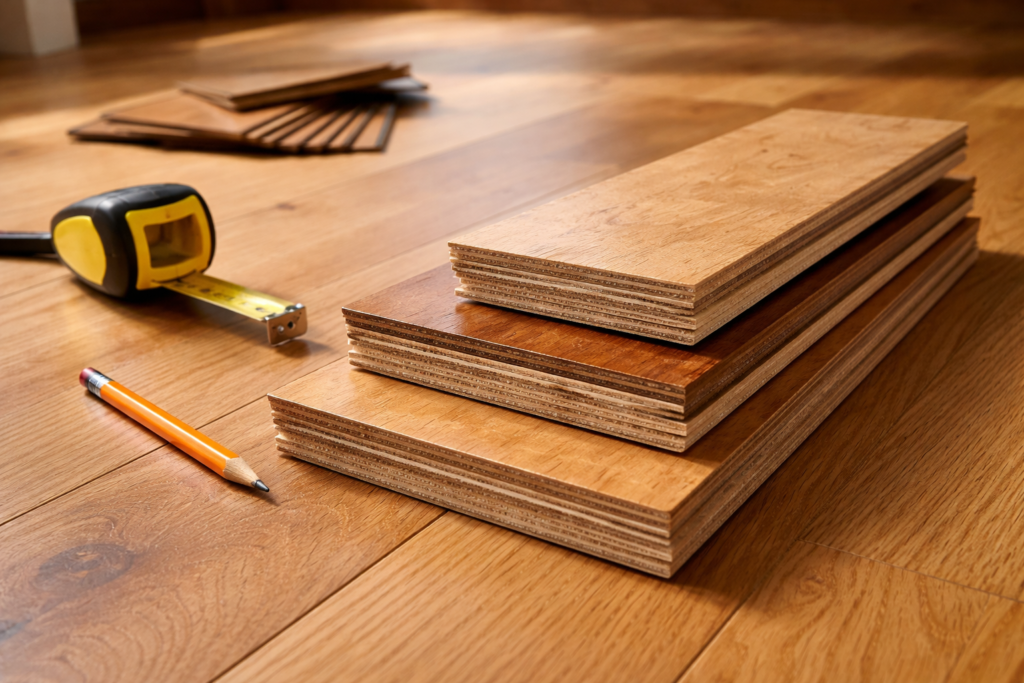
Engineered hardwood combines a real wood veneer (the wear layer) bonded to a plywood, HDF, or composite core. Total board thickness varies, but the wear-layer thickness determines refinishing potential.
- 3/8 inch total / 1mm wear layer: Budget engineered. Cannot be refinished, only buffed and recoated. $2-$4 per sq ft.
- 1/2 inch total / 2mm wear layer: Mid-grade engineered. Refinishes 1 time lightly. $3-$6 per sq ft.
- 9/16 inch total / 3mm wear layer: Common premium engineered. Refinishes 2 times. $5-$8 per sq ft.
- 5/8 inch total / 4mm wear layer: Premium engineered. Refinishes 2-3 times. $6-$10 per sq ft.
- 3/4 inch total / 4-6mm wear layer: Heritage-grade engineered. Refinishes 3-5 times. $8-$14 per sq ft.
Why Wear Layer Matters More Than Total Thickness
The wear layer is the slice of real hardwood you can sand down to refresh the floor. Each refinish removes 1/32 to 1/16 inch (roughly 0.8-1.5mm) of wood. A 1mm wear layer cannot survive a single sand-and-refinish cycle. A 4mm wear layer survives three full cycles.
Manufacturers sometimes market a thick total dimension while skimping on the wear layer. A 5/8 inch board with a 1mm wear layer offers the same long-term refinishability as a 3/8 inch board with a 1mm wear layer. Always read the spec sheet for wear-layer dimension, not just total thickness.
Pros and Cons by Thickness
Thinner Hardwood (5/16 to 1/2 inch)
Cheaper material cost, easier to handle and cut, fits in tight transitions to thinner adjoining floors. Drawbacks: limited refinishing capacity, less dimensional stability over wide planks, restricted installation methods (typically glue-down only for solid).
Standard Hardwood (5/8 to 3/4 inch)
Best balance of refinishing potential, structural rigidity, and installation flexibility. Works with all standard subfloor heights and accepts both nail-down and glue-down methods. The default choice for most residential installs.
Thicker than 3/4 inch
Rare in residential. Typically only seen in custom-milled wide plank or historic restoration where matching original 7/8 or 1 inch flooring is required. Premium pricing reflects custom milling.
How Thickness Affects Installation Method
Thickness dictates which installation methods work.
- 5/16 to 1/2 inch: Glue-down to slab or wood subfloor. Some 1/2 inch engineered floats with click joints.
- 9/16 to 5/8 inch: Floating, glue-down, or staple-down with engineered. Solid not common at this thickness.
- 3/4 inch solid: Nail-down with cleats over wood subfloor. Glue-down possible but less common.
- 3/4 inch engineered: All three methods (float, glue, nail) work depending on tongue-and-groove configuration.
Subfloor Considerations
Total floor system height matters when matching to adjacent rooms. A 3/4 inch solid hardwood with 1/4 inch underlayment plus 3/4 inch subfloor creates a 1-3/4 inch finished floor height. If the adjoining room has 1/2 inch tile over the same subfloor, you have a 1/4 inch height difference that needs a transition strip.
For renovations where you cannot raise the floor (usually because of stair tread heights or appliance clearances), 3/8 or 1/2 inch engineered keeps the total assembly thinner. New construction has more flexibility.
Cost Comparison Across Thicknesses
For 1,000 sq ft of mid-grade oak:
- 3/8 inch engineered, 1mm wear layer: $2,500-$4,000 material
- 1/2 inch engineered, 2mm wear layer: $3,500-$6,000 material
- 3/4 inch solid: $5,000-$10,000 material
- 5/8 inch engineered, 4mm wear layer: $6,000-$10,000 material
Installation labor adds $3-$6 per sq ft regardless of thickness, with site-finished solid commanding the higher end of the range.
What Most Homeowners Should Choose
For new construction or full renovation in a primary residence: 3/4 inch solid hardwood for long-term refinishing or 5/8 inch engineered with 4mm wear layer for slab installs and locations with humidity swings.
For starter homes, rentals, or short holds: 3/8 to 1/2 inch engineered with at least a 2mm wear layer.
For premium custom projects: 3/4 inch engineered with 4-6mm wear layer, which combines slab compatibility with multi-generation refinishing potential.
Frequently Asked Questions
Is thicker hardwood flooring better?
For solid wood, yes – 3/4 inch refinishes more times than thinner solid. For engineered, wear-layer thickness matters more than total board thickness.
How thick is engineered hardwood flooring?
Engineered hardwood ranges from 3/8 inch to 3/4 inch total thickness, with wear layers from 0.6mm to 6mm. The 5/8 inch total with 4mm wear layer is the premium standard.
What thickness of hardwood flooring is best for slab installation?
Engineered hardwood at 1/2 inch to 5/8 inch total thickness handles slab installs best. Solid 3/4 inch is not recommended over concrete due to moisture and movement issues.
Can thin hardwood be refinished?
5/16 inch solid refinishes once or twice. Engineered with a 1mm wear layer cannot be sanded but can be screened and recoated to refresh the finish.
Prefer to explore on your own?
See how new flooring looks in your actual room in seconds — free, no signup.
Try the free Floor Studio →