
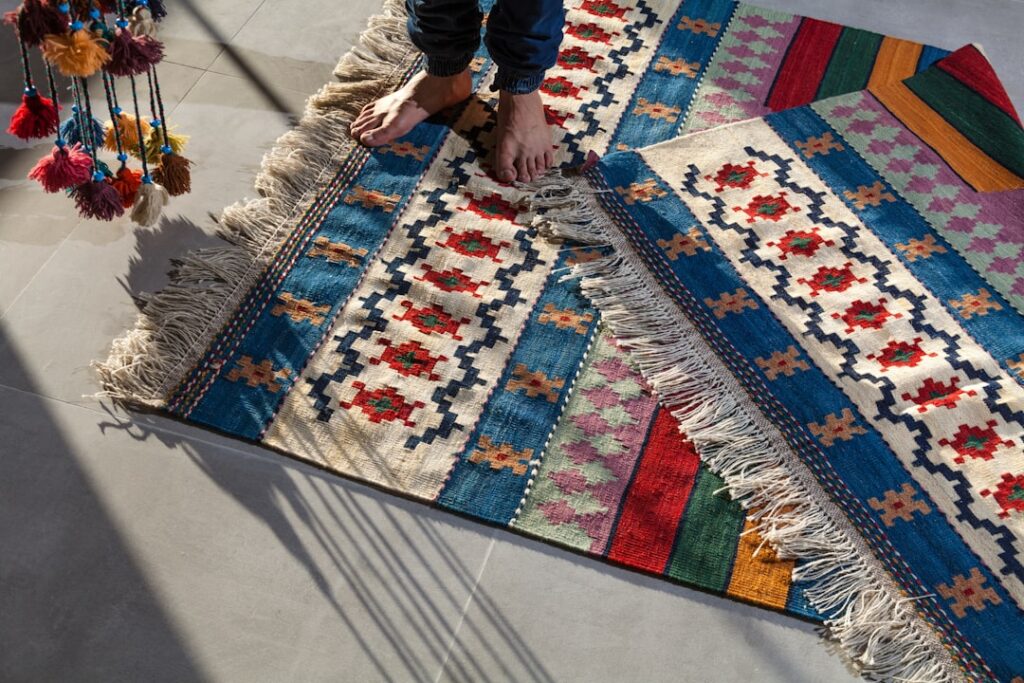
Two rugs can share the same size, color and pattern and still differ by a decade of useful life. Spotting quality area rugs comes down to a handful of physical checks you can run in five minutes: flip the rug over, read the fiber label, count the knots or stitches, tug the pile, and inspect the edges. None of it requires special tools, and most of it works just as well with a product listing and a good set of photos.
The short answer is this. A well-made rug has dense, even construction you can see from the back, a fiber that matches how the room is used, a backing that is either woven in or firmly bonded, and edges that are bound tightly enough that they will not unravel or curl. Price helps, but it is not proof. Plenty of high quality rugs sit in the middle of the market, and plenty of expensive ones are mostly marketing.
- How to Judge Quality Area Rugs: The 7-Point Checklist
- Construction Types and What the Back Reveals
- Fiber Content: Matching Material to the Room
- Reading Online Listings Like a Pro
- Rug Pads and Slip Safety
- Troubleshooting Common Quality Problems
- General Cost Ranges
- When to Bring in a Professional
- Frequently Asked Questions
Here is a buyer’s checklist you can carry into a showroom, plus guidance on reading online listings, matching fiber to traffic, and choosing a rug pad that keeps the rug flat and keeps people from slipping.
How to Judge Quality Area Rugs: The 7-Point Checklist
Run through these seven checks in order. Each one takes under a minute, and together they separate quality area rugs from pieces that will flatten, shed or fray within a couple of years.
- Flip it over. The back tells you how the rug was made. Look for a clear, sharp version of the front pattern (a sign of hand knotting or tight machine weaving) or a smooth, evenly glued backing cloth (tufted construction).
- Measure density. Count knots or stitches across one inch in both directions on the back. More points per square inch means crisper detail and better resistance to crushing.
- Read the fiber label. Federal rules require fiber content on textile products, so the tag should list percentages. Vague wording such as “art silk” or “luxury blend” deserves a follow-up question.
- Do the shedding test. Grab a small tuft of pile and pull gently, then run your palm hard across the surface. A few loose fibers are normal for new wool. A handful is not.
- Check pile height and resilience. Press your thumb into the pile for five seconds and release. Dense pile springs back quickly. Thin, loosely packed pile stays dented.
- Inspect the edges. Side bindings should be wrapped tightly and evenly, with no gaps where the foundation shows. Fringe should be part of the foundation warp threads, or at least sewn on securely, not glued.
- Lay it flat. A good rug lies flat on the floor without ripples, wavy edges or corners that lift. Mild curling from shipping relaxes in a few days; a rug that is cut crooked never will.
Construction Types and What the Back Reveals
Most rugs fall into one of four construction groups, and each one has its own quality signals. Knowing which type you are looking at keeps you from comparing apples to oranges.
Hand-Knotted
Each knot is tied by hand around warp threads, so the pattern runs straight through to the back. Density is measured in knots per square inch (KPSI). Under about 60 KPSI is coarse and suits bold, simple designs. Roughly 100 to 200 KPSI is a solid everyday rug with good detail. Above 250 KPSI usually means fine silk or wool pieces with intricate curves. The back should show slight irregularity, which is normal for handwork, but rows should stay straight and tight.
Hand-Tufted
Yarn is punched through a canvas with a tufting gun, then locked in place with latex and covered with a backing cloth. Quality depends heavily on the latex and how well the cloth is bonded. Peel at a corner of the backing: it should not lift easily, and there should be no strong chemical odor. Low-grade latex dries out and crumbles, which is when tufts start pulling loose.
Machine-Woven (Power-Loomed)
Large looms weave pile and backing together, so there is no glued layer. Density here is described by points per square meter or by shot count. Look for a firm, flexible hand and a back where the pattern is visible but slightly blurred. A rug that feels stiff like cardboard often has too little yarn propped up by heavy sizing.
Flatweave
Flatweaves have no pile at all. Quality shows in tight, even weaving with no loose loops on either side and edges that run straight. Because they are reversible and thin, flatweaves need a good pad more than any other type.
Fiber Content: Matching Material to the Room
Fiber is the single biggest factor in how a rug wears, cleans and feels. A beautifully constructed rug in the wrong fiber for the space will still disappoint.
- Wool is naturally resilient, flame resistant and good at hiding soil. It sheds for the first few months, then settles. It is the default choice for living rooms and bedrooms.
- Nylon is the most crush-resistant synthetic and handles hallways and family rooms well. Solution-dyed nylon resists fading and bleach spots.
- Polypropylene (olefin) is inexpensive, stain resistant and fine for outdoor or high-spill areas, but it crushes faster and can feel waxy.
- Polyester has soft color and sheen at a low price. It resists stains but mats down in heavy traffic.
- Cotton and jute appear in flatweaves. Cotton washes well in small sizes; jute is durable underfoot but water spots easily and sheds fine dust.
- Silk and viscose give a high sheen. Real silk is strong but costly. Viscose (sometimes sold as bamboo silk or art silk) looks similar new but water stains, yellows and crushes quickly, so keep it in low-traffic, no-spill rooms.
Blends are common. A wool and nylon blend, for example, adds crush resistance to wool’s feel. The label should state each percentage so you know what you are paying for.
Reading Online Listings Like a Pro
Buying online removes the hands-on part, so you have to get the same information from the listing. Before you add anything to a cart, look for these details:
- Construction method stated plainly (hand-knotted, hand-tufted, power-loomed, flatweave).
- Fiber content with percentages, not just “soft” or “premium.”
- Pile height in inches. Under 0.25 inch is low pile; 0.5 to 0.75 inch is medium; over 1 inch is shag territory.
- A photo of the back. Sellers of high quality rugs usually show it. If none is posted, ask.
- Rug weight. For the same size and fiber, a heavier rug generally has more yarn. Compare weights across similar listings.
- Return policy that covers shipping both ways, since an 8 by 10 rug can be costly to send back.
Customer photos are often more honest than studio shots. Look for close-ups after a few months of use, especially reviews that mention shedding, fading or corners curling.
Rug Pads and Slip Safety
Even the best rug becomes a hazard if it slides or its edges curl. A properly sized pad prevents slipping, keeps corners down, absorbs foot traffic so the pile lasts longer, and protects the floor underneath.
- Size the pad about 1 inch smaller than the rug on every side (2 inches total in each dimension) so it stays hidden and the rug edges taper down to the floor instead of creating a lip.
- Choose a non-slip backing for hard floors. Felt and natural rubber combination pads grip wood, tile and vinyl without staining. Avoid cheap PVC grid pads, which can break down and discolor some finishes.
- Match thickness to traffic and doors. A 1/4-inch pad suits most living areas. Use 1/8 inch or thinner near doors that swing over the rug and in hallways where a thick edge could catch a toe.
- Keep edges flat. If a corner curls, reverse-roll it for a day, use rug corner grippers, or weight it while it relaxes. Never leave a flipped edge in a walkway.
- Think about who uses the room. For older adults, toddlers and pets, lower pile and secure edges reduce trip risk more than any other choice.
Rugs on carpet need a different pad, usually a firm felt or a specific rug-on-carpet grip pad that stops the rug from creeping across the carpet.
Troubleshooting Common Quality Problems
Heavy shedding after months. Some shedding from wool is normal for the first three to six months. If it continues well past that or leaves bald patches, the yarn was short-staple or loosely spun, and vacuuming will not fix it.
Tufts pulling out. On tufted rugs, this usually means weak latex. Trim a protruding tuft level with the pile using scissors; never pull it, because that can unzip a whole row.
Rippling or buckling. Ripples come from humidity changes, dragging furniture, or a rug that was never squared. A grip pad helps; a stubborn ripple may need professional stretching or blocking.
Color bleeding. Test any cleaning product on a hidden corner first. Rugs that bleed with plain water were likely dyed poorly and need professional cleaning only.
Fraying edges. Catch it early. A rug repair shop can rebind an edge for far less than replacing the rug.
General Cost Ranges
Prices vary widely by size, fiber and region, but broad bands help set expectations for an 8 by 10 rug. Machine-made synthetics often fall in the low hundreds of dollars. Good machine-woven wool and well-built hand-tufted wool typically run from several hundred to around two thousand dollars. Hand-knotted wool commonly starts near the low thousands and rises steeply with density, silk content and age. A quality pad usually adds 10 to 15 percent of the rug’s cost and is worth every dollar.
Spend where it matters for your room. A dining room rug that sees chair traffic and spills justifies a durable fiber and tight construction. A bedroom rug that sees bare feet twice a day can be softer and more modest.
When to Bring in a Professional
For an antique, a valuable hand-knotted piece, or any rug where you suspect the description is not accurate, a certified rug appraiser or experienced rug dealer can confirm construction, fiber and condition. Professional rug cleaners are the right call for silk, viscose, wool rugs with color bleed, and pet urine that has soaked into the foundation. Repair specialists handle rebinding, fringe replacement and reweaving holes.
Frequently Asked Questions
What is the fastest way to tell if a rug is good quality?
Flip it over. A clear, tight pattern on the back of a woven rug or a firmly bonded, odor-free backing on a tufted rug tells you more in ten seconds than the price tag or brand story.
How many knots per square inch makes a high quality rug?
For hand-knotted wool, roughly 100 to 200 KPSI is a strong everyday standard. Higher counts allow finer detail but do not automatically mean better durability, since fiber and spinning also matter.
Is it normal for a new wool rug to shed?
Yes. Loose fibers from the spinning process work out over the first few months of regular vacuuming. Shedding that continues past six months or creates thin spots points to lower-grade yarn.
Do I really need a rug pad?
On hard floors, yes. A non-slip pad keeps the rug from sliding, keeps edges flat to reduce trips, cushions the pile so it wears longer, and protects the floor finish.
Are viscose rugs a good buy?
They look luxurious and cost less than silk, but they stain with water, crush easily and are hard to clean. Reserve them for low-traffic spaces where spills are unlikely.
Why do some rugs smell strongly when unrolled?
A mild odor from new wool or latex fades within a few days with ventilation. A sharp chemical smell that lingers often signals low-grade latex backing, which tends to break down early.


