Few things look worse in an otherwise tidy room than a rug with corners that flip up like the cover of an old paperback. Rug corner grippers solve that exact problem, holding the four most troublesome points of any area rug flat against the floor while keeping the whole piece from sliding underfoot. They are inexpensive, easy to install, and one of the smartest small upgrades you can make to a living room or hallway.
Curling corners are not just unsightly. A lifted corner is a trip hazard, it wears unevenly, and it tends to collect dust along the fold. Grippers address the cause rather than the symptom, and the right product can last for years.
What Rug Corner Grippers Actually Do
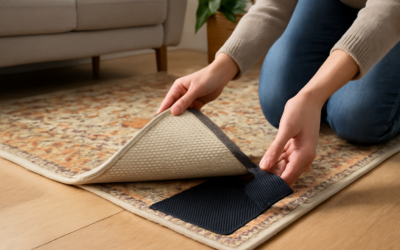
At their core, these are small pads or strips that bond to the underside of a rug’s corners and edges. One side adheres to the rug backing; the other grips the floor through a tacky, rubbery, or micro-suction surface. The combination does two jobs at once: it weighs and flattens the corner, and it anchors the rug so it does not creep across the room.
Most pads measure roughly 4 to 6 inches per side, sized to tuck neatly under a corner without peeking out past the fringe. Thin profiles matter here. A bulky gripper telegraphs through low-pile rugs and creates its own bump, defeating the purpose.
The Main Types Available
Not every gripper works on every floor, so it helps to know the categories before you buy.
- Adhesive corner pads: Triangular or square stickers with a peel-and-stick top that fixes to the rug and a textured bottom that clings to the floor. Best for keeping corners flat; the strongest hold, but the floor-side adhesive can leave residue on some finishes.
- Reusable gel grippers: Washable polyurethane pads that stick to the rug with a tacky surface rather than glue. Rinse them when they lose grip and they bond again. Gentle on hardwood and tile.
- Hook-and-loop (Velcro-style) systems: One half mounts to the floor, the other to the rug. Excellent for rugs you remove often, and very secure underfoot.
- Carpet-to-carpet grippers: Stiff plastic discs with gripping teeth designed specifically to anchor a rug placed over wall-to-wall carpet, where ordinary pads slide.
Matching Grippers to Your Flooring
Floor type drives most buying mistakes. On sealed hardwood and luxury vinyl, avoid aggressive permanent adhesives; the glue can pull at the finish or leave a gummy film when removed. Reach for gel or low-tack reusable pads instead, and test one corner for a few days before committing all four.
Tile and laminate tolerate most products well because their surfaces are hard and chemically stable. Over wall-to-wall carpet, only the toothed carpet-to-carpet style holds reliably; smooth pads simply skate. If you have radiant-heated floors, confirm the adhesive is rated for warmth, since heat can soften cheaper glues and cause migration.
How to Install Them Correctly
Installation takes about ten minutes and rewards a little patience.
- Vacuum the rug corners and wipe the floor clean. Adhesive will not bond through dust or oily residue.
- Flip the rug back to expose one corner at a time.
- Peel the rug-side backing and press the pad firmly into the corner, set in about half an inch from the edges so it stays hidden.
- For adhesive floor types, remove the second liner, lower the corner into final position, and press down hard for 20 to 30 seconds.
- Repeat on all four corners, then add edge grippers at the midpoint of long sides on large rugs.
Give the bond time. Most adhesives reach full strength after 24 hours, so resist the urge to drag furniture across the rug that first day.
Grippers Versus a Full Rug Pad
People often ask whether corner grippers replace a traditional rug pad. They do different jobs. A full pad cushions the rug, adds insulation, protects the floor from abrasion, and stops slipping across the entire surface. Corner grippers target curling and minor shifting without the bulk or cost of a full pad.
For a thin rug in a high-traffic hallway, both together are ideal: the pad underneath, grippers at the corners. For a heavier rug that already lies flat in the field but flips at the edges, grippers alone usually do the trick for a few dollars.
Choosing the Right Size and Shape
Grippers come in triangles, squares, and long edge strips, and the shape should follow the problem. Triangular pads tuck cleanly into corners and waste no material, which is why they are the most common. Square pads cover slightly more area and suit rugs whose corners curl over a wider span. Edge strips, sometimes a foot or more long, run along the middle of a rug’s sides to tame ripples that form between the corners on larger pieces.
Pile height matters too. On a thick shag, a thin corner pad can disappear into the fibers and lose contact with the floor, so look for grippers rated for high-pile rugs or pair them with a full pad. For low-profile flatweaves and kilims, the thinnest pads keep the corner truly flush without creating a visible lump.
How Long They Last and When to Replace Them
Even the best gripper has a service life. Adhesive pads gradually lose tack as they collect dust, lint, and skin oils transferred from the rug backing, and aggressive foot traffic accelerates the process. When you notice a corner starting to lift again or the pad sliding rather than gripping, it is time to refresh.
Reusable gel grippers are the exception, since a quick rinse under warm water and a thorough air-dry restores most of their original cling. Make a habit of checking the corners whenever you vacuum, and you will catch a failing gripper before it becomes a trip hazard or lets the rug shift out of place.
Cost and What to Expect
A four-pack of quality corner grippers typically runs $8 to $20, while larger multi-packs with edge strips land around $15 to $30. Reusable gel sets cost a bit more upfront but pay off because you can wash and reposition them. Compared to replacing a prematurely worn rug, the math is easy.
Expect adhesive pads to hold six months to a couple of years depending on traffic and how often you clean the rug. Reusable grippers last longer since you can refresh their tack with water.
Troubleshooting Common Problems
If a corner still lifts, the pad is probably too small or set too far from the tip; move it closer to the corner point. Grip fading on a reusable pad means it needs a rinse. Residue left on a hardwood floor usually wipes away with a dab of mineral spirits on a soft cloth, but always spot-test first.
When a heavy rug keeps sliding despite corner grippers, the issue is field slippage, not corners, and that calls for a full non-slip rug pad. Choose the tool for the symptom and your rug will sit flat, stay put, and last longer.