A rug that slides across the floor or curls up at the corners is more than an annoyance. It is a genuine trip hazard, and after 30 years of walking clients through flooring problems, I can tell you that a good non slip rug gripper solves both issues for a few dollars. A quality non slip rug gripper anchors the rug to the subfloor, keeps the edges lying flat, and protects the finish underneath from grit and abrasion.
Whether you have a hardwood hallway, a tile entryway, or wall-to-wall carpet with an area rug layered on top, there is a gripper made for that exact situation. The trick is matching the product to your floor type. Use the wrong one and you can dull a polyurethane finish or leave a sticky residue that takes an hour to scrub off.
Why Rugs Slip in the First Place
Rugs move because the backing has almost no friction against a smooth, sealed floor. Machine-woven rugs with polypropylene or cotton backings are the worst offenders. On hardwood coated with a modern water-based finish, the surface is deliberately slick, so there is nothing for the rug to grab. Radiant floor heat and low winter humidity make it worse, because both dry out natural fibers and cause corners to cup upward.
Foot traffic does the rest. Every step nudges the rug a fraction of an inch, and over a week that adds up to a rug sitting 6 to 8 inches off its original spot. A gripper interrupts that cycle by adding a high-friction layer between the rug and the floor.
Types of Non Slip Rug Grippers
There are four main categories, and each has a clear best use. Knowing the difference saves you from buying the wrong thing twice.
- Full-surface pads: A grid or felt-and-rubber sheet cut to sit under the entire rug. Best for large area rugs on hard floors. These also add cushioning underfoot.
- Corner and edge grippers: Small adhesive or gel triangles that stick to the underside of each corner. Ideal for smaller rugs where a full pad is overkill.
- Rug-on-carpet grippers: Stiff pads with tiny plastic teeth or spikes that dig into carpet pile to lock a layered rug in place.
- Adhesive tape strips: Double-sided tape rated for rugs. Fast and cheap, but not always kind to floor finishes.
Full-Surface Pads Explained
The best all-around choice for hard floors is a felt-and-natural-rubber pad, usually 1/4 inch thick. The felt side faces up against the rug and the rubber side grips the floor. Expect to pay $20 to $60 for an 8-by-10-foot pad. Cheaper PVC grid pads run $10 to $25 but can break down and leave a yellow film after two or three years, especially in warm rooms above 80°F.
Matching the Gripper to Your Floor
This is the part most homeowners skip, and it is where damage happens. On sealed hardwood and luxury vinyl plank, always choose a natural-rubber or felt-and-rubber pad labeled safe for hard floors. Avoid cheap foam or PVC pads that contain plasticizers, because those chemicals can migrate into a floor finish and leave permanent cloudy marks.
On ceramic and porcelain tile, almost any pad works because the glaze is chemically tough. On laminate, stick with felt-backed pads to avoid trapping moisture against the seams. For layering a rug over carpet, only the spiked rug-on-carpet gripper will hold, because a rubber pad simply slides on the pile along with the rug.
How to Install a Rug Gripper
Installation takes about 15 minutes for a room-sized rug. Start with a clean, dry floor, because dust and pet hair kill the grip fast.
- Vacuum both the floor and the back of the rug.
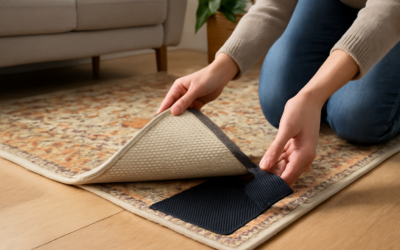
- Roll out the pad and trim it with scissors to about 1 inch smaller than the rug on all sides so it stays hidden.
- Place the rubber side down and the felt side up.
- Lay the rug on top and smooth it from the center outward.
- For corner grippers, peel the backing, press each corner down firmly for 30 seconds, and let the adhesive cure for a full hour before walking on it.
If you are using adhesive tape, test a small hidden section of floor first and leave it for 24 hours to confirm it lifts cleanly.
Common Mistakes to Avoid
The number one mistake is buying a pad the same size as the rug. It should be an inch smaller on every edge so the pad never peeks out. The second is leaving a cheap PVC pad down for years on hardwood. Check underneath every spring and rotate or replace pads that feel tacky or have started to discolor.
Do not layer two rugs and skip the between-layer gripper. And never use household double-sided tape or duct tape as a shortcut. Both leave adhesive that hardens over months and can pull up a floor finish when you remove it.
Maintenance and Replacement
A good felt-and-rubber pad lasts 5 to 7 years with normal use. Vacuum it whenever you clean the rug, and lift the rug to air out the floor a couple of times a year, especially in humid climates where trapped moisture above 60 percent relative humidity can encourage mildew. When the rubber loses its tack or starts to crumble, it is time for a new one.
Corner grippers wear faster because the adhesive collects dust. Plan to replace corner sets every 1 to 2 years, or sooner in a high-traffic entry. Keep a spare set in a drawer so a curled corner never becomes a fall.
What to Buy for Your Situation
For a large living-room rug on hardwood, spend the extra money on a 1/4-inch felt-and-natural-rubber pad. For a small bathroom or kitchen mat, corner grippers or a thin rubber pad are plenty. For a runner on stairs or a hallway, look for a low-profile pad no thicker than 1/8 inch so it does not create a lip. And for stacking a decorative rug on carpet, buy the spiked carpet-lock style specifically.
A non slip rug gripper is one of the cheapest safety upgrades you can make in a home. Spend $30 to $50 on the right product for your floor, install it correctly, and you will forget it is even there while your rugs finally stay put where you want them.
Grippers and Home Safety
It is worth stressing the safety angle, because it is the reason many people finally buy a gripper. Falls at home send hundreds of thousands of Americans to the emergency room every year, and a sliding rug or a curled corner is a classic cause. Older adults and small children are the most vulnerable, and a rug that shifts even 2 inches at the top of a staircase landing can be genuinely dangerous.
If you have anyone in the home who uses a walker, cane, or wheelchair, think hard about whether an area rug belongs there at all. When you do keep one, a full-surface pad that eliminates every wrinkle is far safer than corner grippers alone, because the whole rug becomes a stable, flat surface rather than a floating mat.
Eco-Friendly and Floor-Safe Options
If you are sensitive to off-gassing or worried about your floors, look for pads made from natural rubber and recycled felt rather than PVC or foam. Natural-rubber pads carry less chemical odor, contain no plasticizers that can harm a floor finish, and tend to last longer. Many are labeled phthalate-free and low-VOC, which matters in a bedroom or nursery where the rug sits for years.
These natural pads usually cost $10 to $20 more than the bargain grid style, but they are the only pads I recommend leaving on prefinished hardwood indefinitely. The small premium buys peace of mind that you will not lift the rug in three years to find a hazy, damaged finish underneath.