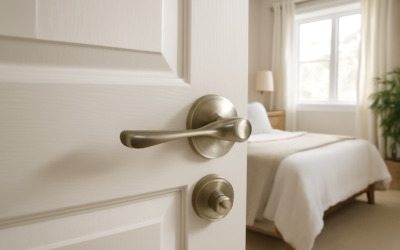
Not every lock is meant to stop a burglar. Most locks inside your home exist simply to give someone privacy in a bedroom or bathroom, and choosing the wrong type leaves you either locked out or exposed. Interior door knobs with locks come in a few distinct varieties, each designed for a specific purpose, from the push-button privacy knob on a bathroom to the keyed lock on a home office. Understanding which is which saves you from buying hardware that doesn’t fit your need or your door.
Part of our Windows & Doors guide — explore the full guide →
Privacy vs. Keyed Locks
The first decision is what kind of security you actually want. Privacy locks are the standard for bathrooms and bedrooms. They lock from the inside with a push button or turn button and have no key, but they include an emergency release, usually a small hole on the outside knob that a straightened paperclip or the provided pin can pop open. This is the safe choice for any room where someone might get accidentally locked in.
Keyed locks work like an exterior lock, requiring a physical key to open from the outside. These suit home offices, storage rooms, wine cellars, or any interior door where you genuinely want to control access. The trade-off is real: if someone locks it from inside and you don’t have the key, you are stuck, so keyed interior locks are wrong for bedrooms and bathrooms.
- Privacy knob — push/turn button lock with emergency release; bedrooms and bathrooms
- Keyed knob — requires a key from outside; offices and storage
- Passage knob — no lock at all; hallways and closets (included for context)
- Dummy knob — non-turning pull; closets and double doors
Knobs vs. Levers
Within locking hardware, you choose between round knobs and levers. Knobs offer a classic look and are slightly more tamper-resistant since they are harder to force open, but they require a firm grip and twist. Levers are easier to operate, requiring only a downward push, which makes them the accessible choice for children, older adults, and anyone whose hands are full or arthritic.
Many building accessibility guidelines favor levers for exactly this reason. If universal design or aging-in-place matters in your home, lean toward locking levers. Just note that levers should be installed so the handle points toward the hinges when possible, preventing clothing and bags from catching as you pass.
Measuring for a Proper Fit
Before buying, you need to confirm the hardware will fit your door. Three measurements matter, and getting them wrong means the knob won’t line up or won’t reach the latch. Standard interior doors are consistent, but always verify rather than assume.
- Backset — the distance from the door edge to the center of the bore hole, typically 2-3/8 inches or 2-3/4 inches
- Bore hole — the large hole for the knob mechanism, standardly 2-1/8 inches in diameter
- Door thickness — most interior doors are 1-3/8 inches thick; most knobs adjust to fit a range
The good news is that the vast majority of replacement knobs are designed as adjustable to fit both common backsets, so you rarely need an exact match. Measure your existing latch backset by looking at where the latch sits relative to the door edge, and pick hardware rated for that range.
Choosing a Finish
Finish is where function meets style, and consistency across a home makes a bigger impact than any single knob. Popular options include satin nickel, matte black, oil-rubbed bronze, polished chrome, and aged brass. Satin nickel remains the most versatile, hiding fingerprints and pairing with nearly any decor, while matte black has surged in modern and farmhouse interiors.
Match your door hardware to the other metals in the room where practical, such as light fixtures and cabinet pulls, but don’t obsess over a perfect match. Coordinating within a warm or cool family reads as intentional. Whatever you choose, buy all your interior knobs at once so the finish is identical, since dye lots and finish formulas can shift slightly between production runs.
Installing a Locking Knob
Swapping an interior door knob is one of the most approachable home projects, usually taking 15 to 20 minutes per door with just a screwdriver. If your door already has a knob, the new one installs into the existing holes. New doors without pre-bored holes require a hole saw and a chisel for the latch mortise, which adds time but is still manageable.
- Remove the old knob by loosening the visible or hidden set screws and pulling both sides apart.
- Unscrew and remove the old latch from the door edge.
- Slide the new latch into the edge bore with the beveled side facing the direction the door closes, and screw it in.
- Insert the outside knob so its spindle passes through the latch, then attach the inside knob and tighten the screws evenly.
- Test that the latch springs freely and the lock engages and releases smoothly before closing the door.
Make sure the beveled edge of the latch faces the strike plate; installing it backward is the most common rookie mistake and prevents the door from latching. Also confirm the strike plate on the frame aligns with the latch, adjusting the plate slightly if needed.
Quality and Security Considerations
Interior locks are about privacy, not defense, so you do not need heavy-duty security ratings. That said, cheap knobs with hollow, stamped-metal construction wear out and loosen quickly. Spend a little more for solid metal internals from a reputable brand, and the knob will turn smoothly for decades rather than developing a wobble within a year.
Look for a smooth, positive lock action and a return spring that snaps the latch back firmly. For homes with young children, remember that privacy locks are intentionally easy to open from outside in an emergency, which is a feature, not a flaw. Keep the release pin accessible, often stored on top of the door casing, so anyone can free a locked-in child in seconds.
Matching Hardware to Room Function
Think through each door before you buy. Bathrooms and bedrooms want privacy knobs or levers. A home office or a locked storage closet wants a keyed version. Hall closets and pantries need only passage or dummy hardware with no lock at all. Mapping your whole house first prevents the frustration of installing a keyed lock on a bathroom and realizing your mistake the hard way.
Understanding the Emergency Release
The emergency release on a privacy lock is a small feature with big importance, and every homeowner should know how it works. On the outside of a privacy knob or lever, you’ll see a small hole or slot. That opening lets you unlock the door from outside without a key, using the thin release tool that comes with the lock, a small flathead screwdriver, or a straightened paperclip.
Insert the tool into the hole and either push straight in to depress a pin or turn a slot to disengage the lock. This design exists so a child who locks a bathroom, or anyone who has a medical emergency behind a locked door, can be reached quickly. Store the little release pin somewhere obvious, like on top of the door casing, so every adult in the house can free a locked door in seconds. Test it once when you install the knob so you know exactly how your particular model releases.
Handedness, Latches, and Universal Fit
Interior door knobs, unlike some levers, are generally symmetrical and work on doors that swing either direction, which simplifies buying. Round knobs have no up-or-down orientation, so a single knob fits a left-hand or right-hand door without adjustment. Levers can be reversible on many models, letting you flip the handle so it points down correctly regardless of the door’s swing, though you should confirm this feature before buying.
The latch itself is the part that has direction. Its angled, beveled face must point in the direction the door closes so it slides against the strike plate and snaps into place. Most latches have an adjustable backset that extends or retracts to fit both the 2-3/8-inch and 2-3/4-inch standard positions, making a single replacement knob compatible with the vast majority of interior doors. Because of this near-universal fit, replacing a worn or dated knob is usually a quick, low-risk purchase, as long as you match the finish to the rest of your hardware and confirm the lock type suits the room.
Well-chosen interior door knobs with locks quietly do their job every day: giving privacy where you need it, controlling access where it matters, and never trapping anyone by accident. Match the lock type to the room, measure the backset and bore before buying, pick a consistent finish, and install the latch bevel the right way. Get those basics right and the hardware simply works, which is all anyone asks of a door knob.