Swap every door in a hallway and you change the character of the house more than most paint jobs will — doors are the largest repeating design element in any home. Yet most people can name only two or three interior door styles out of the dozen that are stocked at every millwork counter. This gallery walks the full lineup, from the six-panel colonial that dominated the 1990s to the flush slabs coming back with modern design, with realistic prices and honest notes on where each style belongs and where it fights the house.
Part of our Windows & Doors guide — explore the full guide →
- Panel Doors: The American Default
- Flush Doors: Minimalism, Rediscovered
- French and Glass Doors: Borrowing Light
- Barn Doors: Hardware as Statement
- Pocket Doors: The Space-Saving Classic
- Bifold, Bypass, and Louvered: The Closet Crew
- Dutch Doors, Briefly
- Cores and Finishes: The Decisions Under the Style
- What a Whole-House Swap Costs
- Choosing a Style: Three Rules That Keep You Out of Trouble
Panel Doors: The American Default
Panel doors divide the slab into rectangles framed by vertical stiles and horizontal rails — a construction method from the solid-wood era that survives as molded hardboard skins over hollow or solid cores.
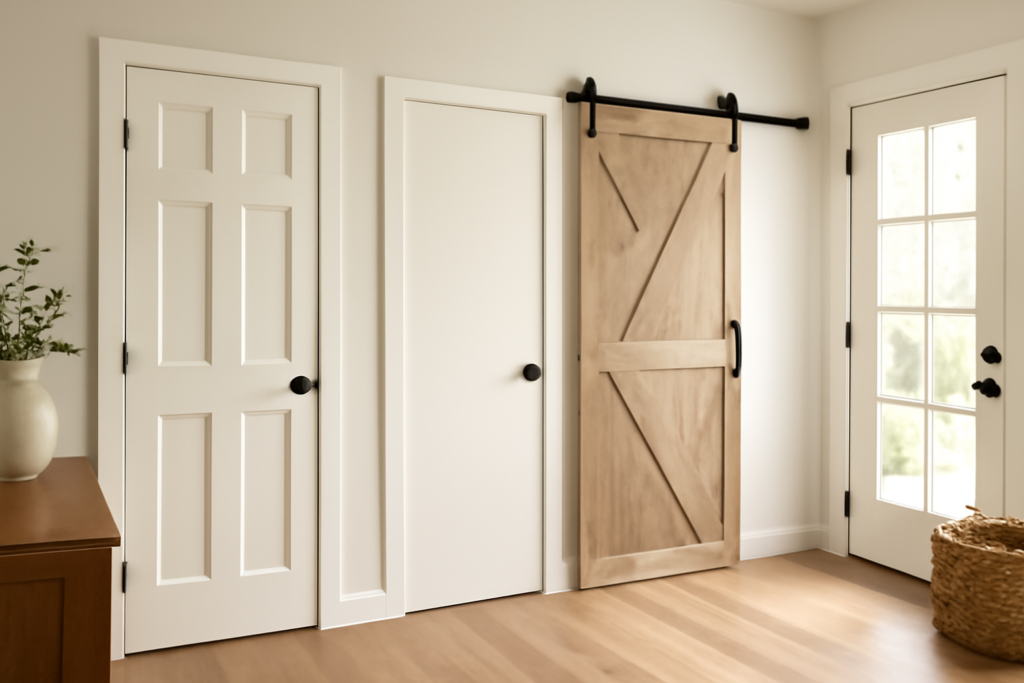
- Six-panel colonial: The classic. Three pairs of raised panels; suits traditional and transitional homes. Molded hollow-core slabs run $50 to $90.
- Two-panel shaker: Flat panels, square edges, clean lines. The runaway favorite of the last decade — it reads correctly in farmhouse, craftsman, and modern homes alike, which makes it the safest whole-house choice going. $60 to $130 as a slab.
- Three and five-panel: Horizontal stacked panels lean craftsman and mid-century; five-panel equal-lite versions fit 1910s bungalows authentically.
- Raised vs. flat panel: Raised profiles read formal and traditional; flat panels read casual and current. Mixing the two in one house is the most common door-styling mistake.
Flush Doors: Minimalism, Rediscovered
A flush door is a flat, unadorned slab — plywood or hardboard skins over a core. For decades it signaled cheap apartment construction, and hollow-core flush doors are still the budget floor at $40 to $70. But flush is also the correct door for genuinely modern and Scandinavian-leaning interiors, especially painted wall color for a disappearing effect or veneered in white oak or walnut ($200 to $600 solid-core) as a warm minimalist statement. If you go flush, upgrade to solid core; the hollow version’s drum-like knock undermines the effect.
French and Glass Doors: Borrowing Light
Interior French doors — stile-and-rail doors glazed with divided lites, hung as singles or pairs — solve the room that needs separation and daylight at once: home offices, dens, sunrooms off living areas. Pairs in 60 to 72-inch openings run $400 to $1,200 prehung. Single glass-lite doors (one big tempered pane, often frosted or reeded) do the same job in a modern register for pantries, offices, and laundry rooms at $150 to $400. Code note: glass in doors must be tempered safety glass — factory doors always comply, salvage doors often do not.
Barn Doors: Hardware as Statement
A sliding barn door hangs from an exposed track and rolls across the wall face, needing zero swing clearance — the reason it exploded in popularity for tight master baths, closets, and pantries. Slabs are oversized relative to the opening (a 36-inch opening wants a 40-inch-plus slab) and complete kits with track run $150 to $600, with reclaimed-wood and steel-framed versions past $1,000. Two honest caveats: barn doors do not seal — sound, light, and smells travel around all four edges, which matters at bathrooms and bedrooms — and they demand clear wall space equal to the door width beside the opening. Style-wise they now extend well past farmhouse: flat panels and glass-and-steel versions suit industrial and modern rooms.
Pocket Doors: The Space-Saving Classic
Pocket doors slide into a cavity inside the wall, vanishing entirely — the best solution ever devised for spaces too tight for any swing, like powder rooms and butler’s pantries. Any slab style can be pocket-hung, so the pocket is an installation, not a look: $200 to $500 for frame kit and slab, but installation means opening the wall, so they are remodel-time decisions, not weekend swaps. Modern soft-close hardware has fixed most of the old rattling-and-derailing reputation. Latching and privacy hardware is the weak point; spend on a quality pocket-door lock.
Bifold, Bypass, and Louvered: The Closet Crew
Bifold doors fold in half on a top pivot track and open nearly the full closet width ($60 to $200 per pair); bypass doors slide past each other on parallel tracks, covering wide openings cheaply but only ever exposing half the closet. Louvered doors — slatted for airflow — belong on laundry closets, HVAC and water-heater enclosures, and humid-climate closets, at $80 to $250. All three exist in panel and shaker faces now, so closet doors can match the passage doors in the same hall, which is exactly what they should do.
Dutch Doors, Briefly
The Dutch door — split horizontally so the top half opens independently — deserves more than a paragraph, and it gets one: our dedicated dutch door interior guide covers costs, uses (kids’ rooms, pet control, kitchens), and conversion options in full.
Cores and Finishes: The Decisions Under the Style
Every style above ships in multiple constructions, and the construction determines how the door lives. Hollow-core ($40 to $90) is a molded or veneer skin over honeycomb — light, cheap, and acoustically transparent. Solid-core ($100 to $300) fills the same skins with particleboard or MDF, adding 25 to 45 pounds and most of the sound-blocking a bedroom wants. Solid wood ($250 to $800-plus) is stile-and-rail lumber: the premium feel and the only construction that stains convincingly, but it moves with humidity and costs accordingly. MDF-skinned doors take paint beautifully — no grain telegraphing — while wood-veneer doors offer stain-grade looks at mid prices.
On finish: painted doors dominate current design, and white or off-white remains the default, though color-drenched doors (deep greens, blacks, matching wall color) are the visible trend of the decade. Use enamel — Benjamin Moore Advance or SW Emerald Urethane, $50 to $90 a gallon — because wall paint on a door surrenders to fingerprints in months. Stain-grade doors want matching stain-grade casing, which multiplies trim cost; commit to one finish philosophy per floor.
What a Whole-House Swap Costs
A typical three-bedroom house carries 12 to 18 interior doors. Replacing slabs like-for-like in standard sizes runs $60 to $130 per opening in materials for painted hollow-core, roughly double for solid-core, plus $75 to $150 per door in labor if hired — call it $1,500 to $4,500 for the whole house depending on core and who swings the hammer. Prehung replacements (new jambs and casing throughout) roughly double the labor but rescue houses with beat-up frames and painted-shut hinges. It is one of the highest-perceived-value renovations per dollar, because unlike attic insulation, you touch the result forty times a day.
Choosing a Style: Three Rules That Keep You Out of Trouble
- Match the architecture first, trends second. Shaker suits nearly everything built since 1900; six-panel suits colonial and traditional; flush suits genuinely modern. A craftsman bungalow full of raised-panel colonial doors looks off forever.
- One style per floor, ideally per house. Consistency across every visible door — including closets — is what makes door upgrades read as architecture instead of shopping. Reserve statement doors (barn, glass French) for one or two featured openings.
- Buy the core, not just the face. Solid-core versions of any style cost $60 to $150 more per door and deliver the two upgrades you feel daily: sound blocking between bedrooms and a substantial, furniture-grade swing. Prioritize solid core at bedrooms and baths; hollow core is fine on closets.
Hardware finishes ride along with the style decision: matte black and satin brass suit shaker and modern doors, oil-rubbed bronze leans traditional, and satin nickel remains the neutral that offends no one. Whatever you choose, choose once — levers or knobs, one finish — and carry it through the house, because mismatched hardware undoes the consistency the doors just bought you.
Sizing is its own decision — widths, heights, and rough openings are covered in our standard interior door size chart. Pick the style with the architecture, pick the core with your ears, and buy them all at once: door styles get discontinued, and matching a five-year-old molded panel profile is harder than it has any right to be.