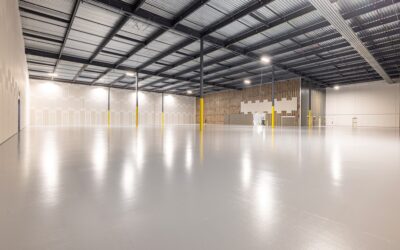
Ask any contractor who has ever poured a garage or a restaurant kitchen and the short answer is yes, is epoxy flooring slippery becomes very real the moment water, oil, or snowmelt hits a smooth high-gloss coat. Dry epoxy is perfectly safe to walk on, with a static coefficient of friction around 0.6 that beats most polished concrete. The problem is that a freshly squeegeed self-leveling epoxy has the surface tension of glass, so a puddle turns it into a skating rink. The good news is that slip resistance is a design choice, not a defect, and anti-slip aggregates solve the issue cleanly when they are specified upfront.
Part of our Epoxy, Concrete & Garage Floors guide — explore the full guide →
The Honest Answer: It Depends on the Top Coat
A bare two-part epoxy cured to a high-gloss finish measures well below the OSHA target of 0.5 dynamic coefficient of friction (DCOF) once liquids are introduced. That is why spec sheets from Sherwin-Williams, PPG, and Rust-Oleum quietly recommend broadcast aggregates for any area that will see moisture. The same coating installed with a non-skid additive can hit DCOF values of 0.8 or higher when wet, which clears both OSHA and ADA guidelines.
If you already have a slick existing floor, the fix is a recoat with aggregate rather than a teardown. A single broadcast pass plus a clear topcoat restores grip without changing the color or gloss dramatically.
Which Anti-Slip Aggregates Work Best
Aluminum Oxide
The most common additive in industrial and commercial jobs. Aluminum oxide is sharp, angular, and extremely hard (Mohs 9). It resists wear for 15 to 20 years under forklift traffic. Grit sizes 40 to 80 give moderate texture for shop floors; 16 to 24 mesh produces aggressive grip for wet kitchens and ramps. Cost runs $8 to $14 per pound, and a gallon of coating typically takes 4 to 8 ounces broadcast.
Silica Sand
Cheaper than aluminum oxide at $1 to $3 per pound and widely available from any masonry supplier. Silica sand works fine for garages and residential patios but rounds off under heavy abrasion within 3 to 5 years. Use 30 to 50 mesh for light grip; 12 to 20 mesh for aggressive texture.
Polymer Beads and Plastic Grit
Rounded polymer or recycled-plastic beads add traction without sharp edges, which matters in bare-feet areas like pool decks and locker rooms. They feel softer underfoot and clean more easily than aluminum oxide. Expect $10 to $18 per pound. Durability is lower under heavy wheeled traffic, so match them to the setting.
Decorative Vinyl Chips or Quartz
Broadcast color flakes and colored quartz are primarily aesthetic but add meaningful micro-texture. A fully broadcast quartz system on a commercial kitchen delivers DCOF around 0.85 wet and looks like a terrazzo floor. Cost adds $3 to $6 per square foot to a base epoxy install.
Coefficient of Friction Targets by Room
- Dry garages and workshops: 0.5 DCOF minimum; a light silica broadcast is fine.
- Residential basements: 0.6 DCOF; 40 grit aluminum oxide at 4 oz per gallon is the standard call.
- Commercial kitchens and wash bays: 0.8 DCOF wet; full broadcast aluminum oxide at 16 mesh, two coats.
- Pool decks and locker rooms: 0.8 DCOF wet with polymer beads for bare feet.
- ADA-compliant ramps: 0.6 DCOF minimum with broadcast silica or aluminum oxide.
How Aggregate Is Installed
There are two methods, and the difference shows up years later. The first is blending grit directly into the second coat and rolling it on. Easier to apply, but the aggregate settles and you get uneven grip where the coat pools. The second is broadcast, where the installer throws aggregate by hand into the wet coat to refusal, vacuums the excess after cure, and then applies a clear sealer coat to lock everything in. Broadcast delivers uniform texture and outlasts the blended method by a factor of three or more.
Time the broadcast carefully. On most two-part epoxies you have a 20 to 40 minute working window once the coat is rolled out. Broadcast too early and the grit sinks out of sight; too late and it bounces off a skinned surface.
Other Ways to Increase Grip
Matte and Satin Topcoats
Swapping a high-gloss topcoat for a satin or matte polyurethane reduces perceived slipperiness even without aggregate. Matte finishes scatter light and disguise micro-texture, so small variations read as grip. It is not a substitute for aggregate, but it helps in dry residential spaces.
Anti-Slip Additives in the Topcoat
Products like Shark Grip from Rust-Oleum and SlipDoctor additive are micronized polymer powders that mix into the final clear coat at 3 to 5 ounces per gallon. They create a fine matte texture that feels like 220 grit sandpaper. Easy DIY option for existing floors.
Safety Stripes and Mats
At zones where grip absolutely cannot fail — top of a ramp, in front of a walk-in freezer, at a garage threshold — add bright yellow slip-resistant tape or a rubber kitchen mat. Layered defenses beat single-point failure.
Maintenance to Keep the Grip
Slip resistance degrades over time if you let grease, floor wax, or mop residue fill the aggregate peaks. Clean with a pH-neutral degreaser like Zep Neutral Floor Cleaner diluted per label and scrub with a red or white deck brush, never a dust mop on a greasy floor. Avoid oil-based soaps which leave a slick film. Test DCOF once a year with a BOT-3000E meter or a field tribometer rental from SSR and recoat the clear sealer when readings drop below target.
When Epoxy Might Not Be the Right Call
Even with aggressive aggregate, epoxy in a constantly wet environment eventually wears smooth in traffic lanes. If your space is a commercial car wash, a brewery washdown zone, or a pool deck in direct sun, consider urethane cement overlays like BASF Ucrete or Sika PurCem instead. Those systems are built for permanent wetness and hit DCOF above 0.9 from day one.
Bottom Line
So, is epoxy flooring slippery? Only if you spec it slippery. Bare gloss epoxy plus water is a lawsuit waiting to happen, but the same floor installed with a correctly sized anti-slip aggregate hits OSHA and ADA targets and keeps them for a decade or more. Match the grit to the traffic type, choose broadcast over blended, and add a pH-neutral cleaning routine. Do that and an epoxy floor is no more slippery than any other professionally finished hard surface — and a lot safer than polished concrete.