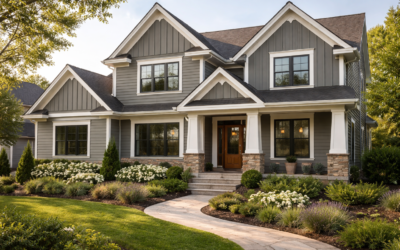
James Hardie Evening Blue is a deep, subdued blue for fiber cement siding that many homeowners describe as navy, while the manufacturer itself calls it a gray-blue hue that evokes a clear evening sky. It was named the company’s 2025 Color of the Year and belongs to its Statement Collection, the regionally stocked palette of factory-finished colors. Because the finish is baked on at the plant rather than brushed on after installation, it is designed to hold its color longer than a typical site-applied paint job.
The short answer for most buyers: Evening Blue looks best with white or cream trim, black or dark bronze windows, and a roof in charcoal, black or weathered gray. It sits between the softer, grayer Boothbay Blue and the other deep blue in the lineup, Deep Ocean. Availability depends on your region and the specific siding product, so confirm with a local dealer before you finalize plans.
- James Hardie Evening Blue Pairings at a Glance
- What Evening Blue Looks Like
- Products and Finish Details
- Evening Blue vs Deep Ocean vs Boothbay Blue
- How to Plan an Evening Blue Exterior Step by Step
- Architectural Styles That Suit It
- Landscaping and Accent Ideas
- Troubleshooting Common Concerns
- Cost and When to Call a Pro
- Frequently Asked Questions
James Hardie Evening Blue Pairings at a Glance
The trim and window suggestions here come from the manufacturer’s own Color of the Year guidance. Door and roof pairings are general exterior design practice for a deep blue body color.
| Element | Recommended pairing | Effect |
|---|---|---|
| Trim | Arctic White or another crisp white | Highest contrast; classic coastal or colonial look |
| Softer trim | Navajo Beige or Cobble Stone | Warmer, gentler contrast when white feels too stark |
| Windows | Black or dark bronze frames | A darker frame makes the body color read slightly lighter |
| Monochrome | Evening Blue body and trim | Modern look that relies on texture and architecture |
| Front door | Natural wood, red, mustard or black | Wood warms the blue; bold colors add a focal point |
| Roof | Charcoal, black or weathered gray | Cool roof tones keep the palette calm and cohesive |
| Stone or brick | Gray stone, whitewashed brick | Avoid strongly orange brick, which can clash |
What Evening Blue Looks Like
Evening Blue is darker and more saturated than the soft blue-grays that dominated exteriors for years, but it is muted enough that it does not look bright or nautical-toy blue. In full sun it reads as a rich mid-to-deep blue. In shade, on overcast days and at dusk, it deepens toward navy and can look almost charcoal on north-facing walls.
That shift is normal for any deep exterior color and is the main reason to view a physical sample on the house. Online images vary widely depending on camera settings and screen calibration. A small sample kit of factory-finished chips, or exterior paint samples in similar shades, lets you compare it against your roof, stone and surroundings in real light.
The manufacturer does not publish a light reflectance value for this color on its Color of the Year materials, so any LRV figure you see online should be treated as an estimate, not a spec.
Products and Finish Details
According to the manufacturer, Evening Blue is offered across several product types:
- Lap siding (shown in a cedar-texture lap style)
- Shingle siding for gables and accent areas
- Vertical panel siding, often used for board-and-batten looks
- Trim boards and batten boards for a monochrome finish
All of these use the company’s factory finish, which is applied and cured in a controlled environment to improve adhesion and resist fading, chipping and cracking. The manufacturer lists a 15-year limited finish warranty covering paint and labor, and a 30-year non-prorated limited substrate warranty on its siding, trim and soffit, which it describes as transferable. Warranty terms change, so read the current documents for your specific product and region.
The Statement Collection is a curated set of popular colors stocked by region. A separate made-to-order collection offers a much wider palette with longer lead times and added cost. If Evening Blue is not stocked in your area, a dealer can tell you whether it can be ordered.
Evening Blue vs Deep Ocean vs Boothbay Blue
These three blues are the ones most homeowners compare. The descriptions here combine the maker’s own language with how each color generally reads on a house.
| Color | Depth | Character | Best for |
|---|---|---|---|
| Boothbay Blue | Light to medium | Soft blue-gray, marketed as the softer option | Cottages, coastal homes, wooded lots |
| Evening Blue | Deep | Subdued gray-blue that reads navy in shade | Colonials, farmhouses, mid-century homes |
| Deep Ocean | Deep | A deep blue the maker calls both classic and modern | Traditional homes with strong white trim |
Boothbay Blue is the obvious choice if you want blue without heaviness; it tends to look bluer in direct sun and grayer in low light. Evening Blue and Deep Ocean are both deep, so the decision between them comes down to undertone, and that is impossible to judge from a screen. Order chips of both and hold them against your roof and trim samples outdoors in the morning and late afternoon.
How to Plan an Evening Blue Exterior Step by Step
- Confirm availability. Ask a local dealer whether Evening Blue is stocked in your region for the products you want: lap, shingle, panel and trim.
- Get physical samples. View chips outdoors on the actual wall, in sun and shade, over at least two days.
- Test against fixed elements. Your roof, stone, brick, driveway and neighbors’ houses all affect how blue reads.
- Choose trim contrast. White for high contrast, a cream or beige for a softer effect, or matching trim for a monochrome look.
- Pick window and door colors. Black or dark bronze windows sharpen the design; the door is the place for a bold accent or warm wood.
- Check HOA rules. Many associations require color approval for exterior changes, and deep colors are sometimes restricted.
- Hire an experienced installer. Fiber cement needs proper cutting, fastening, flashing and clearances to keep the warranty valid.
Architectural Styles That Suit It
The manufacturer names colonial farmhouse and mid-century modern as strong matches and says the color can work on almost any style. In practice:
- Colonial and Cape Cod: lap siding in Evening Blue with crisp white trim, black shutters and a red or wood door.
- Modern farmhouse: vertical board-and-batten in Evening Blue, black windows and natural wood accents.
- Mid-century: panels or lap in Evening Blue with warm wood soffits and a bright accent door.
- Craftsman: shingles in the gables with lap below, cream trim and stone column bases.
A monochrome approach, with body and trim in the same color, is increasingly popular. It suits houses with strong rooflines or interesting textures, because the architecture provides the contrast instead of the trim.
Landscaping and Accent Ideas
A deep blue body color is a strong backdrop for plants. Green foliage, white hydrangeas, ornamental grasses and boxwoods all stand out against it, and warm-toned mulch adds contrast at the foundation. Gray stone pavers and a light concrete walkway keep the palette cool and clean.
Hardware and fixtures finish the look. Black or oil-rubbed bronze light fixtures, house numbers and door hardware suit the blue’s subdued character. Brass works well on a front door for a warmer, traditional feel. If you add shutters, either white or black reads well; shutters in the same blue disappear and are best skipped.
Porch ceilings and soffits are another place to add character. A natural wood soffit warms the blue considerably, while a white soffit keeps the overall look crisp.
Troubleshooting Common Concerns
Will a dark color fade? Every exterior color fades somewhat over time, and deep colors show it more. The factory finish is designed to resist UV fading better than typical site-applied paint, and the warranty addresses finish issues for a set period.
Will it get hot? Dark siding absorbs more sun than light siding. In very hot, sunny climates, ask your installer about any guidance for dark colors on your product, and make sure the wall assembly is properly ventilated.
What about touch-ups? Use the manufacturer’s matched touch-up products for cut ends and nail heads. Generic paint rarely matches a factory finish exactly.
It looks almost black on my north side. Deep blues do darken in shade. Brighter trim and good exterior lighting help keep the facade from looking flat.
Cost and When to Call a Pro
Factory-finished fiber cement siding usually costs more than primed siding painted on site, but it avoids the first repaint cycle. Installed fiber cement siding generally falls in a range of roughly $6 to $14 per square foot depending on product, house complexity, region and how much old siding has to be removed. Ask for itemized quotes that list siding, trim, house wrap, flashing and disposal separately.
Siding installation is best left to a contractor experienced with fiber cement, since cutting it creates fine dust that contains silica. Cutting should be done with dust-reducing methods and respiratory protection. If your existing siding or underlying materials date from before the 1980s, have them checked for asbestos before removal, and confirm whether your project needs a permit.
Frequently Asked Questions
Is James Hardie Evening Blue navy?
It is often described as navy and reads that way in shade. The manufacturer calls it a subdued gray-blue, so in bright sun it can look lighter and grayer than a true navy.
What trim color goes with Evening Blue siding?
The manufacturer suggests white for the strongest contrast, with Navajo Beige or Cobble Stone as softer alternatives. Matching trim in Evening Blue creates a monochrome look.
Is Evening Blue darker than Boothbay Blue?
Yes. Boothbay Blue is the softer, lighter blue-gray, while Evening Blue is a much deeper shade.
Is Evening Blue available everywhere?
Not necessarily. It is part of a regionally stocked collection, so availability varies by area and product. A local dealer can confirm stock or ordering options.
What warranty does the Evening Blue finish have?
The manufacturer lists a 15-year limited warranty on the factory finish covering paint and labor, plus a 30-year non-prorated limited substrate warranty. Check the current warranty documents for your product.