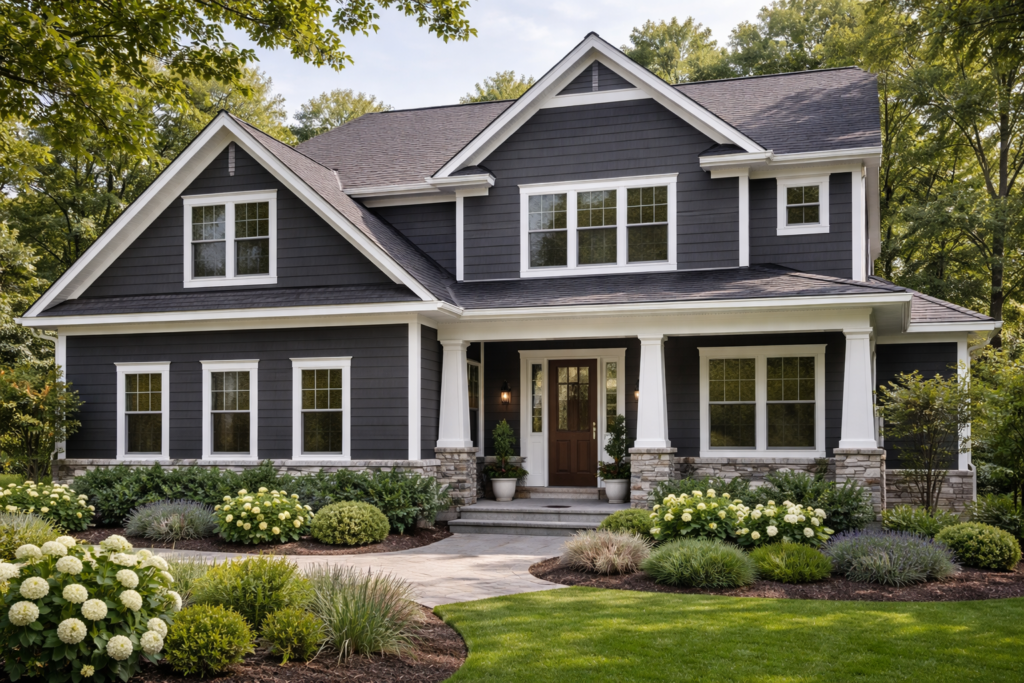
James Hardie Iron Gray is a deep, charcoal-leaning gray from the company’s Statement Collection, sold with its factory-applied ColorPlus Technology finish. James Hardie describes it as a deep, bold color with a dramatic yet elegant look, and it named Iron Gray its 2026 Color of the Year. On a house it reads as a rich, moody neutral that is softer than true black but far darker than a typical gray siding.
Because it is so dark, Iron Gray changes more with light than lighter siding colors do. It can look nearly black on an overcast day and lighter, almost silvery, in hard midday sun.
- James Hardie Iron Gray: Quick Facts and Pairing Table
- Undertones: How Iron Gray Reads on a House
- How to Test Iron Gray Before You Order
- Best Trim and Accent Strategies
- Practical Considerations for a Dark Siding Color
- Styles That Suit James Hardie Iron Gray
- Troubleshooting Color Disappointments
- Cost Considerations
- When to Call a Pro
- Frequently Asked Questions
James Hardie Iron Gray: Quick Facts and Pairing Table
James Hardie does not publish a light reflectance value (LRV) or a paint-style color code for its ColorPlus colors, so there is no official number to quote. Judge it from a physical sample on your wall instead of a screen.
| Element | Pairing option | Effect |
|---|---|---|
| Trim (high contrast) | Arctic White trim | Crisp, classic outline; the manufacturer’s own suggested pairing |
| Trim (monochrome) | Matching Iron Gray trim | Modern, unified look; lets windows and doors stand out |
| Trim (soft contrast) | Warm off-white or beige | Gentler than bright white; suits traditional homes |
| Window frames | Black or white | Black blends in for a sleek look; white adds sparkle |
| Roof | Charcoal, black or weathered gray shingles; black or dark bronze metal | Keeps the house grounded; avoid a roof that fights the siding |
| Front door | Natural wood stain, deep red, mustard or teal | A warm or saturated door becomes the focal point |
| Accents | Cedar soffits, stone veneer, light brick | Natural textures warm up the cool, dark field |
Iron Gray is part of the Statement Collection, which James Hardie offers in a regionally edited set of colors. The press release for the 2026 announcement notes that its Statement Collection products come in up to 19 colors including Iron Gray. Availability depends on your area, so check the color list for your zip code on the manufacturer’s site or with a local dealer before you plan around it.
Undertones: How Iron Gray Reads on a House
James Hardie calls Iron Gray a refined neutral and does not publish an official undertone. In practice, deep grays like this one tend to look fairly balanced, neither strongly blue nor strongly brown, which is why it works with both warm and cool materials. Some homeowners report a faint green cast when bright sun hits it, which is common with dark neutrals and worth checking against your landscaping.
In full sun
Strong, direct light lifts the color. Iron Gray can look a step or two lighter and slightly silvery, especially on south- and west-facing walls in sunny climates. Texture also plays a role: the shadow lines on a woodgrain or lap profile add depth that a smooth panel does not.
In shade and overcast light
On north walls, under deep eaves and on cloudy days, it moves toward charcoal and can read nearly black from the street. That moodiness is part of its appeal, but it also means a shaded house can feel heavy without bright trim or light-colored accents.
Morning and evening
Warm low-angle light softens the color and brings out any warmth in surrounding wood and stone. Cool blue-hour light pushes it darker and cooler. View samples at several times of day before committing.
How to Test Iron Gray Before You Order
- Order a physical sample. James Hardie offers samples through its website and dealers. A real ColorPlus board is the only reliable reference. A paint sample kit with a few exterior colors for trim and door candidates helps you test the full scheme.
- Look at it vertically. Tape or prop the sample against each main wall rather than laying it flat on the ground.
- Check every elevation. Look on the sunniest wall and the shadiest wall, because the difference with a dark color is large.
- Hold trim candidates beside it. Compare Arctic White, a warmer off-white and a matching dark trim side by side.
- Include fixed elements. Stand the sample next to your roof, stone, brick, driveway and any windows you are keeping.
- Drive by real houses. Seeing Iron Gray on full homes in your area shows how it handles local light and landscaping.
Best Trim and Accent Strategies
Classic contrast with white trim
This is the most popular approach and the one the manufacturer highlights. Bright white corners, fascia and window casings frame the dark siding and make architectural details pop. It works on farmhouse, Craftsman and colonial styles alike.
Tone-on-tone monochrome
Matching Iron Gray trim creates a modern, sculpted look where the house reads as one solid form. Pair it with black windows and a wood door. This scheme suits contemporary and modern farmhouse designs and hides minor dirt on trim boards.
Mixed materials
Iron Gray lap siding with board-and-batten gables, or Iron Gray panels next to natural cedar or stone, adds texture and warmth. Keep the number of materials to two or three so the facade does not look busy.
Doors and shutters
A stained wood door is the safest high-impact choice. Saturated colors such as brick red, deep teal or golden yellow stand out sharply against the gray. If you add shutters, black gives a quiet look, while a contrasting color should match the door.
Practical Considerations for a Dark Siding Color
Heat: Darker colors absorb more sunlight than light ones. Fiber cement handles this well compared with some vinyl products, but plan adequate attic ventilation and insulation, which matter more for indoor comfort than siding color.
Fading and finish: ColorPlus is baked on at the factory. James Hardie lists a 15-year limited finish warranty covering peeling, cracking and chipping, and its siding substrate carries a 30-year non-prorated limited warranty. Read the current written terms, since coverage details and proration language can change.
Dust and pollen: Dark siding shows light-colored dust, pollen and hard-water spray from sprinklers more than mid-tone colors. A gentle rinse with a garden hose and soft brush a couple of times a year keeps it looking sharp. Avoid high-pressure washing at close range.
Touch-ups and caulk: Use the manufacturer’s ColorPlus touch-up kit and color-matched caulk. A generic gray from the store will weather differently and stand out on a dark field.
Styles That Suit James Hardie Iron Gray
This color works on more architectural styles than most dark colors. On a modern farmhouse, Iron Gray board-and-batten or lap siding with black windows and a wood porch ceiling gives the look its sharp, graphic edge. On a Craftsman, it pairs well with white trim, stone column bases and a stained door. Contemporary homes can carry it in large smooth panels with matching trim and metal accents. Cape Cod and colonial houses can use it too, but bright white trim and shutters keep the facade from looking heavy on a symmetrical front.
Ranch homes benefit from Iron Gray on the main body with a lighter accent on a gable or entry bump-out, which breaks up a long, low wall. For two-story homes, consider Iron Gray shingles on the upper level and lap siding below to add texture without adding a second color.
Troubleshooting Color Disappointments
The house looks too heavy: Add brighter trim, lighten the soffits, or introduce a lighter accent material on gables or a porch.
It looks flat: A textured profile, such as a woodgrain lap or shingle, gives more shadow and depth than smooth panels in the same color.
The roof clashes: Brown or tan roofs with strong warm tones can fight Iron Gray. If the roof is staying, test warmer trim to bridge the two.
It looks different from the neighbor’s: Orientation, shade and texture all shift a dark color. Your sample on your own walls is the reference that counts.
Cost Considerations
Iron Gray is priced like other Statement Collection ColorPlus colors rather than as a premium color. Fiber cement siding in general commonly runs several dollars to the low teens per square foot installed, depending on profile, house complexity, trim details and local labor. Prefinished boards cost more than primed boards up front, but they skip the field painting step and the repaint cycle that comes with it. Ask installers to quote the exact products, profile and trim color so bids are comparable.
When to Call a Pro
Fiber cement siding installation involves cutting a material that produces crystalline silica dust, managing flashing and the weather barrier, and working on ladders or scaffolding. Installers trained on James Hardie products follow its installation instructions, which also affects warranty coverage. Hire a qualified contractor for full re-siding projects and anything above the first story. A homeowner can handle cleaning, small touch-ups and color testing.
Frequently Asked Questions
Is James Hardie Iron Gray a charcoal or a true gray?
It is a deep gray that reads as charcoal in shade and overcast weather and a bit lighter in direct sun. It is not as dark as a true black siding color.
What trim color goes best with Iron Gray siding?
Arctic White trim is the manufacturer’s suggested high-contrast option. Matching Iron Gray trim gives a modern monochrome look, and a warm off-white softens the contrast on traditional homes.
What is the LRV of James Hardie Iron Gray?
James Hardie does not publish an LRV for its ColorPlus colors. Use a physical sample on your walls to judge how light or dark it reads.
Is Iron Gray available everywhere?
Not necessarily. Statement Collection colors are tailored by region, so check the colors offered for your zip code or ask a local dealer before you finalize plans.
Does dark Iron Gray siding fade?
All exterior colors fade somewhat over time. The ColorPlus finish is designed to resist fading and carries a limited finish warranty, but check the written terms for what counts as covered fading.