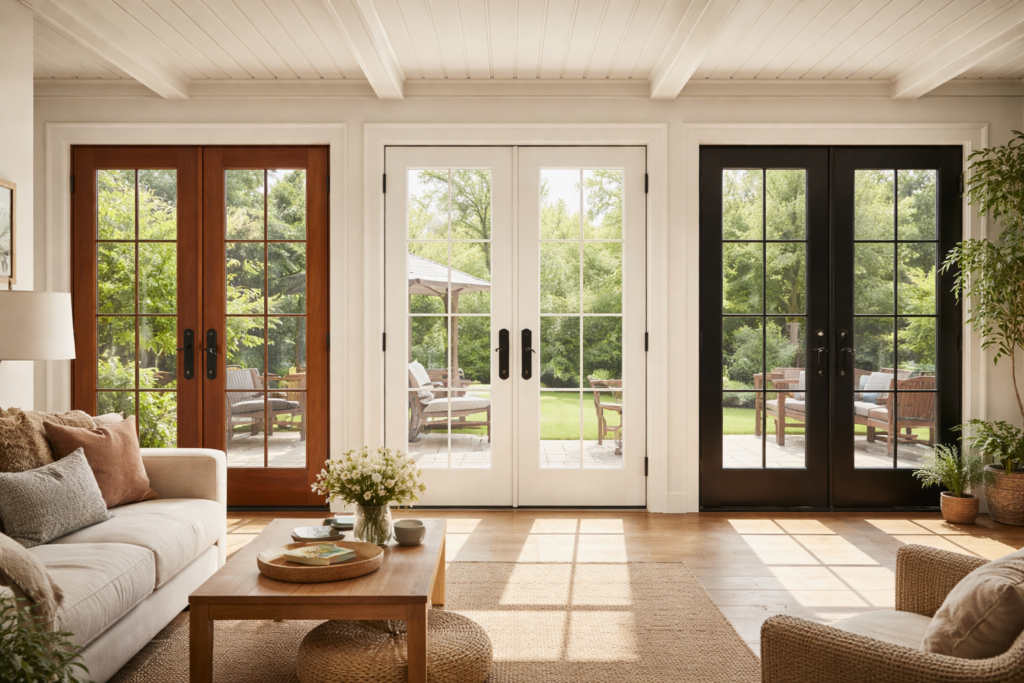
Most people shopping for a pair of glass doors assume the hard choice is the style. In practice, the bigger decisions are the material, the swing direction and the exact opening size, because those set the price, the maintenance and whether the door fits the hole in your wall. JELD-WEN French doors come in two broad families: exterior patio French doors built in wood, clad-wood, fiberglass and steel, and interior French doors made as primed wood-composite or wood glass-panel doors for dens, offices and dining rooms.
Part of our Windows & Doors guide — explore the full guide →
The quick answer: pick steel for the lowest-cost exterior pair, fiberglass for a dent-resistant, paintable or stainable door that handles weather well, and wood or clad-wood when you want real wood inside and the widest custom options. For interior rooms, a primed glass-panel door in a standard width is the usual route. Common exterior units are nominal 60 by 80 inches and 72 by 80 inches, while interior glass doors run from 24 to 36 inches wide per panel.
The sections that follow break down each material, the sizes you are likely to see, in-swing versus out-swing, glass choices, installation and the general cost tiers.
Jeld Wen French Doors at a Glance
JELD-WEN describes a French door as two operating doors that open in or out on side hinges and meet in the center. A “patio door” in its catalog, by contrast, has one operating panel and one fixed panel that only looks like a French pair. Product lines change, so treat this summary of jeld wen french doors as a starting point and confirm the current series with a dealer.
| Type | Material and examples | Swing options | Typical sizes | What it means |
|---|---|---|---|---|
| Steel patio French | Galvanized steel skins over an insulated core (S-2500 line) | S-2500 is in-swing; other steel units sold in out-swing | Nominal 60 x 80 in and 72 x 80 in | Budget tier, arrives primed to paint |
| Fiberglass patio French | Fiberglass panels, paintable or stainable (F-4500 line at retail) | In-swing and out-swing, left or right hand | Nominal 60 x 80 in and 72 x 80 in | Resists dents, warping and water damage |
| Clad-wood patio French | Wood interior with exterior cladding (W-5500 line) | In-swing and out-swing | Made to order in many sizes | Wood look inside, low-upkeep outside |
| Wood patio French | AuraLast treated pine (Custom Wood, Siteline) | In-swing and out-swing | Made to order; Siteline up to four swinging panels | Most customizable, highest tier |
| Interior French | Primed wood-composite glass panels; some pine lite doors | Swing into the room you choose | 24 to 36 in per panel; 80, 84 or 96 in tall | No weather seals; privacy depends on glass |
Vinyl is part of JELD-WEN’s patio door range, but its own literature presents vinyl as a sliding door, so if you specifically want a hinged French pair, look at steel, fiberglass or wood instead.
Exterior Materials in Detail
Steel
Steel is the entry point. The brand’s patio door literature describes galvanized steel doors that resist rust, water penetration and corrosion, arrive primed and include a double bore lockset and deadbolt. The S-2500 line is an in-swing design offered as single-entry patio doors or hinged French patio doors. Steel’s weakness is dents: a hard knock from a grill or a ladder leaves a mark that needs body filler and paint. In older JELD-WEN literature, steel patio doors carried a 10-year limited warranty, but check the current warranty document for your exact product.
Fiberglass
Fiberglass sits in the middle tier and is the most common choice for people searching for a jeld wen french door to replace an old sliding door. The panels resist denting, warping and water damage, can be painted or stained to look like wood, and the F-4500 line found at large retailers is sold prehung in both in-swing and out-swing versions with composite jambs. Retail listings describe it as having slimmer frames and more glass than a standard patio door. The brand’s patio literature has listed fiberglass doors with a limited lifetime warranty, though terms vary by line.
Wood and clad-wood
Wood French doors are built with AuraLast pine, a treated wood the company says protects against rot, water saturation and termites. Custom Wood doors swing in or out on side hinges and offer the widest range of species, finishes, grilles and handle sets. Clad-wood doors such as the W-5500 put a durable exterior skin over a wood interior, so you get warm stained or painted wood indoors with less exterior upkeep. These lines are usually ordered through dealers with longer lead times. Older brand literature listed a 20-year limited warranty for wood and clad-wood patio doors, transferable for a shorter period, so confirm what applies today.
Sizes and Rough Openings
Exterior French doors are sold by nominal size, which roughly matches the rough opening, not the actual unit. Retail listings for JELD-WEN units show a nominal 60 by 80 inch pair measuring about 59-1/2 inches wide, and a 72 by 80 inch pair about 71-1/2 inches wide, with actual heights a little under 80 inches depending on the sill. Jamb depth on many stock units is 4-9/16 inches, which suits a standard 2×4 wall with drywall; thicker walls need jamb extensions.
- Measure the rough opening at the top, middle and bottom, and use the smallest width and height.
- Measure wall thickness from interior drywall face to exterior sheathing to confirm jamb depth.
- Check the floor for level across the opening. A sill set on an uneven subfloor leaks and binds.
- Allow shim space of roughly 1/4 to 1/2 inch around the unit, as the installation instructions specify.
Interior glass-panel doors from the brand come in widths from 24 to 36 inches per panel, heights of 80, 84 or 96 inches, and thicknesses of 1-3/8 or 1-3/4 inches. Two 30-inch panels make a 60-inch pair, a popular size for a home office. The brand lists its interior glass-panel doors as supplied prehung in a knocked-down frame, which suits a full frame replacement rather than swapping slabs into an old jamb.
In-Swing vs Out-Swing
Swing direction affects weather resistance, security, furniture layout and the screen. Handing is described from the exterior: stand outside facing the door and note which side the hinges sit on and whether the active panel swings toward you or away.
- In-swing is the traditional choice in most of the US. Hinges sit inside, which protects them, and a screen can mount on the exterior. The trade-off is floor space: you need clear room for both panels to open, so rugs and furniture must stay out of the arc.
- Out-swing saves interior space and wind pressure pushes the panels tighter against the weatherstrip, which helps in coastal and high-wind areas. You need a clear deck or patio for the swing, security hinges help with exposed pins, and screens usually mount inside or retract.
Match the choice to the room. A small dining area with a table near the door usually works better with out-swing. A large living room facing a narrow deck often works better with in-swing. Searchers comparing jeld wen double doors for a front entry face the same question, and the same reasoning applies.
Glass, Grilles and Energy Options
Exterior units commonly offer Low-E insulated glass, with argon fill standard on many wood lines, plus impact-rated glass for hurricane zones. Grilles come as simulated divided lites, grilles between the glass, or none at all for a clean modern look. Blinds between the glass are offered on several steel and fiberglass units, which keeps the blinds dust-free and avoids cords. Decorative and privacy glass options suit bathroom-adjacent and street-facing rooms.
For interior French doors, the glass is about light and privacy rather than insulation. The brand’s interior glass-panel doors are available with clear, reeded, rain, grooved and frosted-style patterns. A textured glass is a good compromise for an office that needs daylight but some visual separation.
Installation Steps and Glass Handling Safety
Replacing an interior French pair is a reasonable DIY project for someone with carpentry experience. Exterior French doors are heavier, must be flashed into the wall correctly and need the sill sealed, so many homeowners hire an installer. If you do it yourself, follow the manufacturer’s instructions exactly, since warranty coverage usually excludes improper installation.
- Remove the old unit and inspect the subfloor and framing for rot. Repair before setting the new door.
- Flash the opening. Install a sill pan or flexible flashing at the bottom and wrap the sides as the instructions show.
- Dry-fit the unit with a helper, then apply sealant to the sill area per the instructions.
- Set, shim and fasten. Plumb and square the frame, shim behind every hinge, and check that the panels meet evenly in the center.
- Adjust and seal. Check the gaps and astragal, fill the gap around the frame with low-expansion foam, install trim and caulk the exterior.
- Test the weatherstrip. Close the doors on a strip of paper at several points; if it slides out easily, the seal needs adjustment or replacement. A door weatherstripping kit fixes worn seals on older doors.
Glass doors are heavy and awkward. Wear cut-resistant gloves and eye protection, carry panels upright with two people, and never let a panel flex, twist or rest on a corner. Do not strike glass edges, and set units on padded blocks rather than concrete. Exterior French doors and doors near tubs, showers or floors must use tempered or otherwise safety-rated glass, which stock units include; never replace a broken pane with ordinary annealed glass. If a pane cracks, tape over it and call a glass shop rather than trying to remove shards by hand.
Troubleshooting Common Problems
Panels do not meet in the center
Usually the frame is out of square or the hinge screws are short. Replace one screw per hinge with a long screw that reaches the framing, then re-check the gap.
Drafts or water at the sill
Check the sweep, the astragal seal and the sill adjustment. Water inside often points to missing sill pan flashing, which means pulling the unit and reinstalling.
Door rubs on rugs
In-swing doors need clearance across the full swing. Use a thinner rug or trim the bottom of interior slabs, sealing any cut edge.
Condensation between panes
That indicates a failed insulated glass seal. It is often covered under warranty, so contact the dealer with the label information from the glass spacer or frame.
Price Tiers and When to Call a Pro
Cost follows material. Interior primed glass-panel pairs are the least expensive. For exterior units, steel is the budget tier, fiberglass sits in the middle, and clad-wood and wood lines are the premium tier, with impact glass, custom sizes, factory finishing and between-glass blinds all adding to the price. Professional installation of an exterior French door adds a substantial labor charge, more if the opening must be widened. Get quotes that name the line, size, handing, glass package and finish.
Hire a pro if you are widening an opening, since that usually means a new header and a permit; if the wall is load-bearing; if there are signs of rot in the subfloor; or if you live in a hurricane zone where impact-rated installation rules apply. A licensed contractor also knows local code for egress, safety glazing and step heights at exterior doors.
Shoppers often type jeld wen french doors without the hyphen, but the lineup is the same: the range covers most budgets once you match material to climate and swing to the room. Measure carefully, choose the handing from outside, and treat glass with respect during the install, and a new pair will open the room for years.
Frequently Asked Questions
Does JELD-WEN make vinyl French doors?
The brand’s patio door literature presents vinyl as a sliding door. For hinged French doors, the main options are steel, fiberglass, clad-wood and wood.
What size are standard JELD-WEN exterior French doors?
Stock units are commonly nominal 60 by 80 inches and 72 by 80 inches, with actual widths about 1/2 inch smaller. Wood and clad-wood lines can be made to order in many sizes.
Should exterior French doors swing in or out?
In-swing protects hinges and allows an exterior screen. Out-swing saves floor space and seals tighter under wind pressure. Choose based on room layout, climate and patio space.
Are interior JELD-WEN French doors solid wood?
Many interior glass-panel doors are primed wood composite, while some lite doors are pine. Check the product description for the core and material.
Can I install a French door myself?
An interior pair is a manageable DIY job with carpentry skills. Exterior units need proper flashing, sill sealing and careful glass handling, so many homeowners hire an installer.