
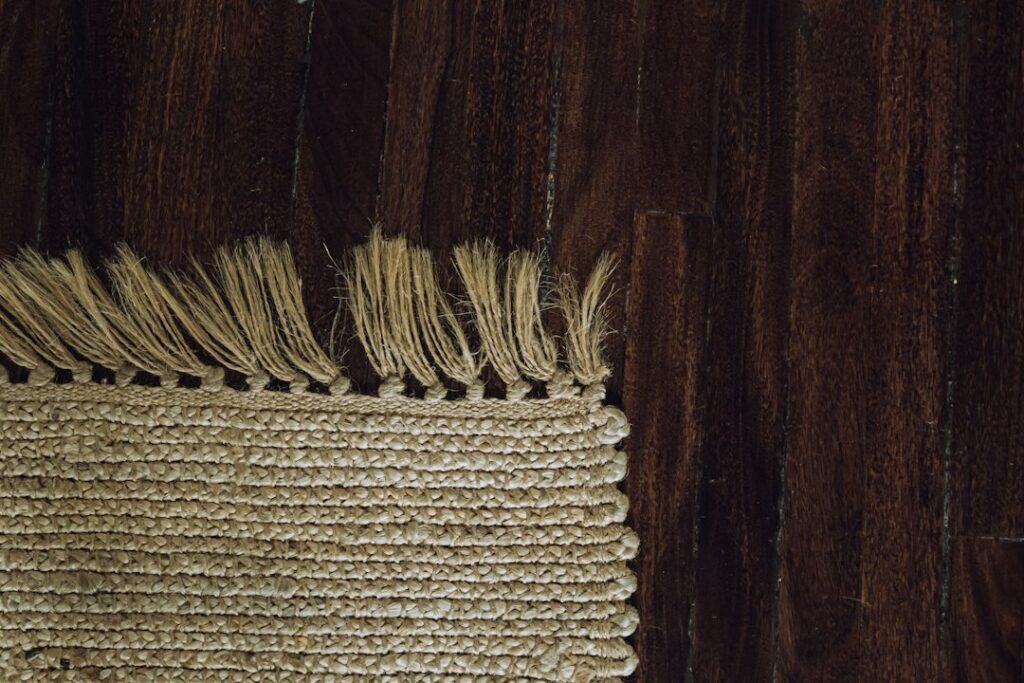
Most homeowners fall for the look of natural fiber on a staircase long before they think about how it will hold up under 30,000 footsteps a year. A jute stair runner delivers warm, textured, coastal-casual style at a lower price than wool, but it behaves very differently from synthetic carpet. Jute is soft underfoot, sheds a little at first, stains easily from water, and flattens faster on the nose of each step. Knowing those tradeoffs up front is the difference between a runner that looks great for ten years and one you rip out after two.
Part of our Stairs & Stair Flooring guide — explore the full guide →
- What a Jute Stair Runner Is and Why It Appeals to Homeowners
- Pros and Cons of Jute on Stairs
- Jute vs Sisal vs Seagrass vs Wool for Stair Runners
- How Much a Jute Stair Runner Costs
- Choosing the Right Width, Weave, and Binding
- Installing a Jute Stair Runner Step by Step
- Padding and Slip Safety
- Cleaning and Caring for a Jute Stair Runner
- Is a Jute Stair Runner Right for Your Home?
What a Jute Stair Runner Is and Why It Appeals to Homeowners
Jute is a plant fiber harvested from the stalks of the Corchorus plant, grown mostly in India and Bangladesh. Once spun, it becomes a golden-tan yarn with a slight sheen that weavers turn into flat weaves, boucle loops, herringbone, and the chunky basketweave patterns you see in design magazines. A jute stair runner is a narrow strip of that woven material, usually 27 to 32 inches wide, installed down the center of a staircase so a band of exposed wood shows on each side.
Why do people choose it? Three reasons come up again and again. It is inexpensive compared to wool, often $15 to $40 per linear foot for the material versus $50 to $120 for a comparable wool runner. It adds grip on slippery hardwood or painted treads. And it quiets footsteps on an open staircase, which matters in older homes where every step echoes through the house.
Jute is also renewable and biodegradable. It grows to maturity in about four to six months without heavy pesticide use, so it appeals to buyers trying to keep synthetic materials out of their home.
Pros and Cons of Jute on Stairs
Stairs are the hardest-working surface in a house. Every step concentrates your body weight onto a small area, and your heel grinds against the nosing as you descend. Here is how jute handles that job.
Advantages
- Price: A standard 13-step staircase can be covered for $400 to $900 in material, far below wool or sisal-wool blends.
- Texture and traction: The coarse weave gives your socks and shoes something to grip, reducing slips.
- Soft hand: Jute is the softest of the common natural fibers, noticeably gentler on bare feet than sisal or seagrass.
- Style range: Neutral tones work with farmhouse, coastal, traditional, and modern interiors.
Drawbacks
- Durability: Jute is the least durable natural fiber. On a busy family staircase, expect visible wear on the nose of each tread in 3 to 7 years.
- Moisture sensitivity: Water can leave brown rings and cause the fibers to weaken or even rot if they stay damp.
- Shedding: New runners shed fibers for the first several weeks. Frequent vacuuming solves it, but it surprises people.
- Stain response: Jute absorbs spills quickly and does not tolerate wet cleaning methods well.
If your stairs see kids, dogs, and daily laundry trips, consider a jute-wool blend or a sisal runner instead. If the staircase is a low-traffic front stair or leads to guest rooms, pure jute is a reasonable choice.
Jute vs Sisal vs Seagrass vs Wool for Stair Runners
Buyers often lump every natural fiber together, but the differences on a staircase are real. This table summarizes how they compare for stair use.
| Fiber | Durability on Stairs | Softness | Material Cost per Linear Foot |
|---|---|---|---|
| Jute | Low to moderate | Softest natural fiber | $15 to $40 |
| Sisal | High | Coarse | $25 to $60 |
| Seagrass | High, stain resistant | Smooth, slippery | $20 to $45 |
| Wool | Very high | Soft and springy | $50 to $120 |
Seagrass is naturally water resistant but can feel slick under socks, which is a concern on stairs. Sisal is tough but scratchy. Wool outlasts all of them and cleans more easily, though you pay for it. Jute wins on softness and budget. Many installers now recommend jute-wool or jute-cotton blends as a middle ground, since the wool content improves resilience while keeping the natural look.
How Much a Jute Stair Runner Costs
Budgeting starts with measuring. For each step, measure the tread depth (typically 10 to 11 inches) plus the riser height (typically 7 to 7.75 inches), then add about 2 inches for the nose wrap. Multiply by the number of steps and add 6 to 12 inches for trimming. A 13-step straight staircase usually needs 20 to 22 linear feet of runner.
- Ready-made jute runner rolls (2.5 x 25 feet): $120 to $350
- Custom-bound jute runner from a carpet shop: $25 to $60 per linear foot including binding
- Stair padding: $2 to $5 per step
- Professional installation: $15 to $35 per step, or $250 to $600 for a straight run
- Stair rods (optional decorative hardware): $20 to $60 per step
Winders, landings, and pie-shaped steps add labor because each one has to be cut and folded individually. Expect installers to charge $40 to $75 per winder step. All in, most homeowners spend $700 to $1,800 for a professionally installed jute runner on a standard staircase.
Choosing the Right Width, Weave, and Binding
Runner width is mostly an aesthetic decision, but there is a working rule: leave 3 to 5 inches of exposed tread on each side. On a 36-inch-wide stair, that means a 27-inch runner. On a 42-inch stair, a 32-inch runner looks proportionate. Going too wide makes the staircase feel carpeted wall to wall; too narrow looks like an afterthought.
Weave matters more for jute than for any other fiber. Tight flat weaves and herringbone patterns wear better because the fibers support each other. Chunky, loose basketweaves look gorgeous in photos but snag on heels and pet claws, and the loops loosen on the stair nose. For stairs, pick a weave with a dense, low profile.
Binding finishes the long edges so they do not fray. Cotton or linen tape binding costs $3 to $6 per linear foot, while serged edges run $1.50 to $3. A contrasting binding, such as navy or charcoal, frames the runner and hides wear along the edges. Always ask the fabricator to bind both long sides before installation; unbound jute unravels fast.
Installing a Jute Stair Runner Step by Step
Skilled DIYers can install a jute runner in a weekend. You need an electric or pneumatic staple gun with 9/16-inch staples, a carpet knife, a bolster or stair tool, a tape measure, a chalk line, and double-sided carpet tape or padding.
- Prep the stairs. Clean the treads, set any popped nails, and sand or paint the exposed wood edges first. Finishing the sides after installation is messy.
- Mark centerlines. Measure the width of each tread and mark the center, then snap a line from top to bottom so the runner tracks straight.
- Install padding. Cut stair pads about 1.5 inches narrower than the runner and staple them to each tread, wrapping them over the nose. Keep pads off the risers.
- Start at the bottom. Staple the runner end under the bottom riser lip, then pull it tight up the riser and staple into the crotch where the tread meets the riser.
- Waterfall or hollywood. In a waterfall install, the runner drops straight from the nose to the next crotch. In a hollywood (upholstered) install, you wrap and staple under the nose for a tailored look. Hollywood holds jute tighter and reduces nose wear.
- Staple every 3 to 4 inches in the crotch, tucking staples into the weave so they disappear.
- Finish at the top by folding the end under and stapling beneath the top nose or against the top riser.
Work slowly and keep tension consistent. Jute stretches slightly when first pulled, so re-tension each riser before stapling the next crotch. If you plan to add stair rods, install the brackets after the runner is stapled.
Padding and Slip Safety
Jute is thin, so padding does a lot of work. A 1/4-inch felt or rubber-felt stair pad cushions each step, absorbs heel impact, and adds years to the runner. Avoid thick 1/2-inch pads; they make the nose round and bulky, and they let the runner shift. Rubber-backed felt pads also help prevent creeping on smooth hardwood. For homes with older adults, a well-anchored runner with padding is safer than bare hardwood, provided every step is stapled tight and nothing lifts at the nose.
Cleaning and Caring for a Jute Stair Runner
Jute rewards gentle, dry care. Vacuum at least weekly with suction only; turn off the beater bar or use a stair attachment, because a rotating brush pulls fibers loose. For spills, blot immediately with a dry white towel, working from the outside in. Never soak the runner or steam clean it, as heat and water can shrink jute and leave brown water marks.
- Dry spills: Brush out with a stiff brush, then vacuum.
- Wet spills: Blot, then sprinkle a dry carpet powder, let it sit 30 minutes, and vacuum.
- Mud: Let it dry completely, then break it up and vacuum.
- Grease: Dab with a small amount of dry-cleaning solvent on a cloth, testing in a hidden spot first.
Once a year, consider a professional dry-extraction cleaning ($100 to $200 for a staircase). Keep indoor humidity between 35 and 55 percent; very dry air makes jute brittle, and very humid air invites mildew. If the runner starts wearing on the lower steps first, which is common, some homeowners shift it by a few inches during installation so fresh sections hit the nosing.
Is a Jute Stair Runner Right for Your Home?
A jute stair runner makes sense when you want natural texture, softness, and a budget-friendly price on a moderately used staircase. It is less suited to homes with large dogs, frequent spills, or stairs leading straight from a mudroom or pool deck. If you love the look but worry about wear, a jute-wool blend with a tight herringbone weave, bound edges, and a hollywood installation over a 1/4-inch pad gives you the best odds of long service. Plan on replacement every 5 to 8 years on a busy stair, budget $700 to $1,800 installed, and treat it with dry cleaning methods, and you will enjoy a warm, grounded staircase that looks far more expensive than it was.


