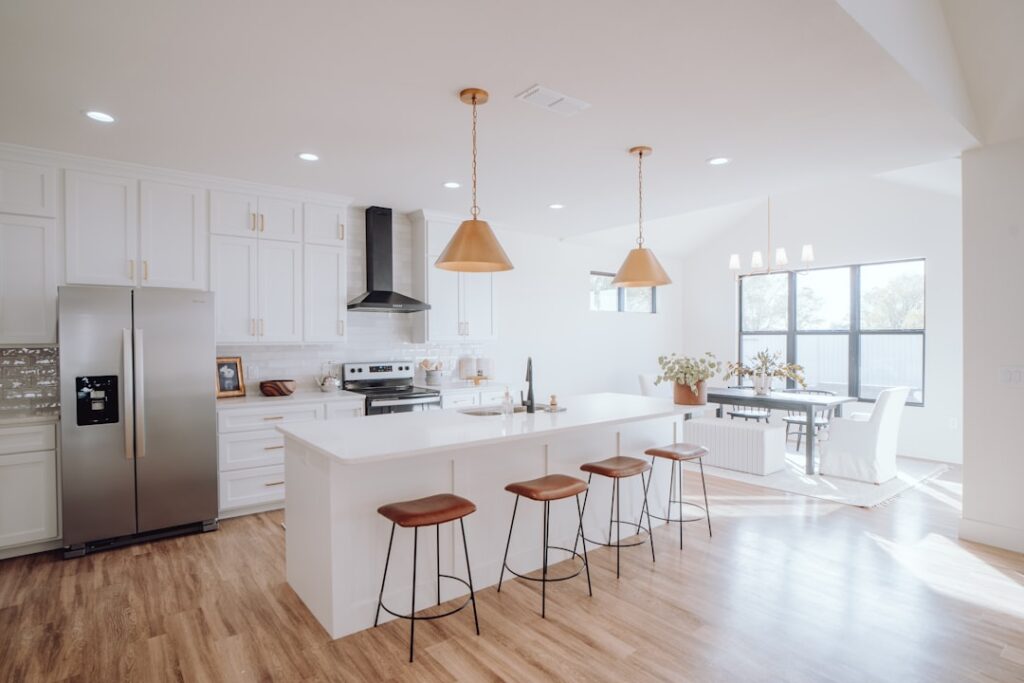
Cabinets usually eat the largest share of a kitchen remodel budget, often 25 to 40 percent of the total, so choosing the wrong ones is an expensive mistake to live with. Understanding the main kitchen cabinet types before you shop keeps you from overspending on features you do not need or buying cheap boxes that sag in five years. The different kitchen cabinet types break down along three axes: how they are built, how they are sold, and what door style and material you choose.
Part of our Kitchen Remodeling guide — explore the full guide →
This guide covers each axis in plain terms so you can walk into a showroom or a big-box store knowing exactly what to ask. Get the construction and material right and cabinets will outlast two or three countertop changes.
Framed vs Frameless Construction
The most fundamental split is how the cabinet box is built, and it affects both look and access.
Framed cabinets, the traditional American style, have a face frame of solid wood around the front of the box. Doors and drawers attach to that frame, which adds rigidity and a classic look. The frame slightly narrows the opening, so drawers and pull-outs are a touch smaller than the box itself.
Frameless cabinets, often called European or full-access, skip the face frame. Doors mount directly to the sides of the box, giving wider openings, larger drawers, and a sleek modern look. They demand precise, sturdy box construction since there is no frame to hide behind. Neither is objectively better: framed suits traditional and transitional kitchens, frameless suits contemporary designs and maximizes storage.
Stock, Semi-Custom, and Custom
How cabinets are sold determines price, lead time, and how well they fit an odd space. There are three tiers.
- Stock: Pre-made in fixed sizes, usually in 3-inch width increments. Cheapest and fastest, often in stock or a few weeks out. Limited styles and finishes, and filler strips cover gaps where sizes do not line up.
- Semi-custom: Made to order from a set catalog with more sizes, finishes, and modifications. A middle ground on price and lead time, typically several weeks.
- Custom: Built to your exact dimensions and specifications by a cabinetmaker. The priciest and slowest, often 8 to 12 weeks or more, but the only route for unusual layouts and premium materials.
Most kitchens land well with semi-custom, which balances fit and cost. Reserve full custom for genuinely irregular spaces, ultra-tall ceilings, or a specific look you cannot get off the shelf.
Cabinet Categories by Location
Within any kitchen, cabinets are grouped by where they go, and each group has standard dimensions worth knowing.
- Base cabinets: Sit on the floor and carry the countertop, standard 24 inches deep and 34.5 inches tall before the counter.
- Wall cabinets: Mount above the counter, typically 12 to 15 inches deep in heights of 30, 36, or 42 inches.
- Tall cabinets: Pantry and utility units running 84 to 96 inches, used for food storage or to house ovens.
- Specialty cabinets: Corner units with lazy Susans, sink bases, and drawer stacks that solve specific problems.
Planning starts with base and wall runs, then you add tall and specialty units to fill corners and awkward spots. Getting the standard depths right ensures appliances and countertops fit without custom filler.
Door Styles That Define the Look
The door front is what you actually see, and it sets the entire style of the kitchen even though the box behind it may be identical.
- Shaker: A recessed flat panel with a clean square frame. The most versatile, working in traditional and modern kitchens alike.
- Flat or slab: A single smooth panel with no frame. Sleek and contemporary, easy to clean.
- Raised panel: A center panel that stands proud of the frame, formal and traditional.
- Glass front: A framed door with glass inserts to display dishware and lighten upper runs.
- Beadboard: Vertical grooved panels for a cottage or farmhouse feel.
Shaker remains the safe, resale-friendly default. Slab doors read modern and hide fingerprints better in matte finishes, while raised panel leans formal. Pick the door style first, then the finish, because the two together carry the design.
Material and Finish Choices
What the box and doors are made of drives durability and price. Solid wood doors on a plywood box are the gold standard, resisting moisture and holding screws better than particleboard. Plywood boxes cost more than particleboard or MDF but stand up to the occasional leak under a sink far better.
Door and surface materials include solid hardwood such as maple, oak, and cherry, MDF that paints beautifully without wood grain showing, and thermofoil, a vinyl skin over MDF that is affordable and wipeable but can peel near heat. Laminate and melamine surfaces are budget-friendly and durable for the boxes. In a busy family kitchen, a painted MDF Shaker door on a plywood box is a common sweet spot of looks, cleanability, and value.
Hardware and Interior Accessories
The boxes and doors get the attention, but the hardware and interior fittings are what make cabinets pleasant to use every day. Full-extension, soft-close drawer slides let you reach the very back of a drawer and stop it from slamming, and they are worth insisting on even if they add a little cost. Concealed soft-close hinges do the same for doors and give a cleaner look than exposed hinges.
Interior accessories turn ordinary cabinets into organized storage. Pull-out trash and recycling bins, roll-out trays in base cabinets, a lazy Susan or a blind-corner pull-out for that awkward corner, and drawer dividers for utensils all earn their keep. A pull-out pantry with tiered shelves makes a narrow cabinet hold far more than a fixed shelf. Under-cabinet lighting, tray dividers next to the oven, and a spice pull-out beside the range are small touches that a well-planned kitchen includes. Prioritize these where you work most, typically around the sink, range, and prep area, and add them elsewhere as the budget allows.
Finishes and Color Choices
Finish is the final layer of the decision and it drives both durability and style. Painted finishes, usually on MDF or smooth hardwood, give a crisp, contemporary look and hide grain, but they can show wear at high-touch edges over many years. Stained finishes on solid wood showcase the grain and touch up more easily, making them forgiving in a busy household. Thermofoil and laminate wipe clean and resist moisture but can be damaged by heat near ovens.
Color trends move slowly in kitchens because cabinets are a long-term investment. White and off-white remain the most resale-friendly and make small kitchens feel larger, while warmer whites and soft greens and blues have grown popular for islands and lower cabinets. A two-tone approach, with darker base cabinets under a lighter upper run, adds depth without committing the whole room to a bold color. Whatever you choose, order a door sample in your exact finish and view it in your kitchen’s light before committing, since showroom lighting can mislead.
How to Choose the Right Cabinets
Start with budget and timeline, since those alone often narrow you to a tier. If you need cabinets fast and cheap, stock is your lane. If your layout is irregular or you want a specific finish, semi-custom or custom makes sense despite the wait. Match the construction to your style: framed for traditional, frameless for modern and maximum storage.
It also pays to think about the layout the cabinets will form before you order. Standard base cabinets come in 3-inch width increments, so map your run and use filler strips or a custom size to close awkward gaps at walls and appliances. Plan the work triangle between sink, range, and refrigerator so the cabinets support how you actually cook, and leave room for appliance doors and drawers to open without colliding. A cabinet layout that looks fine on paper can frustrate you daily if a dishwasher door blocks a drawer or a corner cabinet swallows its own contents. Take accurate measurements of the room, including window and door locations and the height to the ceiling, before finalizing any order, since a tall pantry cabinet that will not clear a soffit is an expensive surprise on delivery day.
Then prioritize where quality matters most. Spend on solid drawer boxes with dovetail joints and full-extension soft-close slides, since those are the parts you touch every day and the first to fail on cheap units. Plywood boxes over particleboard are worth the upgrade under sinks and in humid kitchens, where a single leak can ruin a cheaper box in a matter of days. With the main kitchen cabinet types sorted by construction, sales tier, door style, and material, you can shop confidently and land cabinets that fit your space, your budget, and years of daily use.