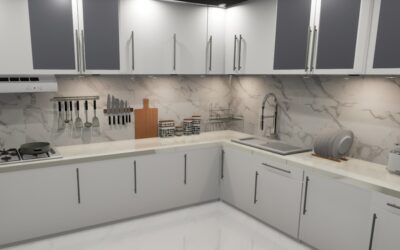
Countertops account for roughly 18 percent of a typical mid-range kitchen remodel budget but probably 75 percent of the visual impact. A kitchen counter remodel done right transforms a tired kitchen for a fraction of a full gut renovation — and done poorly leaves you with seams in the wrong places, an uneven sink reveal, and color you cannot un-see. Below I cover materials, real installed prices in 2026, timelines from template to install, and the questions to ask before signing any fabricator contract.
Part of our Kitchen Remodeling guide — explore the full guide →
The Real Scope of a Counter-Only Remodel
Replacing countertops alone is one of the few mid-budget renovations that consistently delivers measurable resale value. Remodeling Magazine’s 2025 Cost vs Value report shows a midrange countertop replacement returns 73 percent of project cost at sale, beating most bathroom and basement projects. The scope is also contained — fabrication and install typically run 2 to 3 weeks total with the actual install day taking just 4 to 8 hours.
The catch is that “just” replacing counters almost always triggers secondary work. Backsplashes either get removed or chipped during counter demolition. Sink and faucet plumbing usually needs new supply lines and a new disposal flange. Cabinets may need leveling shims after the old tops come off. Budget another 15 to 25 percent on top of the counter quote for these adjacent items.
Material Options Ranked by Installed Cost
The 2026 market has consolidated around five mainstream countertop materials. Each has a sweet spot of kitchen style and use case.
- Laminate (Formica, Wilsonart) — $25 to $50 per sq ft installed; updated patterns now mimic marble and concrete convincingly
- Butcher block (maple, walnut, acacia) — $40 to $90 per sq ft installed; needs oiling every 3 months, develops patina
- Granite — $45 to $85 per sq ft installed; natural stone, slight maintenance, vast color range
- Quartz (Cambria, Caesarstone, Silestone) — $55 to $95 per sq ft installed; engineered, non-porous, lifetime warranty
- Quartzite (Taj Mahal, Macaubas, Sea Pearl) — $80 to $145 per sq ft installed; natural stone harder than granite, marble-like veining
- Marble (Carrara, Calacatta, Statuario) — $80 to $200 per sq ft installed; etches and stains, but unbeatable visual depth
- Soapstone — $90 to $130 per sq ft installed; soft, scratches readily, develops gorgeous patina with mineral oil
- Concrete (custom) — $80 to $185 per sq ft installed; bespoke shapes, requires sealing
Why Quartz Won the Last Decade
For roughly 65 percent of kitchen counter remodels in 2026, quartz is still the right answer. Three reasons: it does not stain, it does not need sealing, and the manufacturer warranties (Cambria offers transferable lifetime, Caesarstone 25 years) actually pay claims when honored color or seam defects appear. Modern quartz patterns from Cambria Brittanicca, Caesarstone Statuario Maximus, and Silestone Eternal Calacatta Gold mimic marble so convincingly that even fabricators sometimes need to check the back stamp.
Brand spotlight: Cambria Brittanicca Warm is the most-installed quartz pattern in the US for three years running. It runs $72 to $88 per sq ft installed depending on slab thickness (the 3cm jumbo slabs cost $14 to $18 more per sq ft than 2cm but eliminate seams on islands up to 10 feet). The Cambria warranty transfers once, which matters at resale. The downside is that bright sunlight over 140°F can yellow the resin binder over many years — keep quartz out of unshaded south-facing windows.
The Template-to-Install Timeline
Step-by-step depth on a typical 50 sq ft counter remodel:
- Day 0: Signed contract and 50 percent deposit; fabricator orders slab from distributor
- Days 1 to 7: Slab arrives at fabrication shop; homeowner visits to approve the actual slab (mandatory for natural stone, optional for quartz)
- Days 7 to 10: Field template appointment — fabricator brings laser template tool, scans existing cabinets, sink, cooktop locations; takes about 90 minutes for an L-shaped kitchen
- Days 10 to 18: Shop fabrication — CNC cutting, edge profiling, sink cutout, polishing
- Day 18 to 21: Install day — old counters out, new counters set, sink and cooktop drop-in, silicone seams cured 24 hours before water use
Faster turnarounds happen with in-stock slabs at warehouse fabricators (Floor and Decor, MSI Surfaces) — sometimes 5 to 7 days total — but selection is narrower and you cannot pre-approve the exact slab.
Demo and Sink Replacement Realities
Removing old counters takes 1 to 3 hours depending on what is underneath. Laminate counters come off in long pieces using a circular saw to cut between cabinet bays. Tile counters require chiseling that often damages the cabinet tops, leaving you to repair plywood substrate before install day. Stone counters get cut into manageable sections with a diamond blade then carried out — they weigh 18 to 24 pounds per sq ft so a 50 sq ft kitchen has nearly 1,000 pounds of stone to move.
Sink replacement is the right time to upgrade. If you have a top-mount sink in old laminate, switching to an undermount on stone or quartz costs $300 to $600 extra and dramatically improves cleanup. Switching from a double basin to a single large workstation sink (32 to 36 inches) requires a wider sink base cabinet — verify your cabinet’s interior width before ordering. Faucet supply lines and shutoff valves should always be replaced during the swap; they cost $35 to $80 in parts and save a future call to the plumber.
Edge Profiles and Their Cost Premiums
Edge profile is a small detail that signals quality and adds $4 to $14 per linear foot to the total. Common options ranked by popularity in 2026:
- Eased (slight 1/16-inch round) — included standard, modern and crisp
- Beveled — small chamfer at top, $4 to $7 per linear foot upcharge
- Half bullnose — top is rounded, bottom is flat, classic transitional look, $5 to $9 upcharge
- Full bullnose — both edges rounded, common on traditional kitchens, $6 to $10 upcharge
- Ogee — S-curve, ornate, formal kitchens, $10 to $14 upcharge
- Mitered waterfall — 90-degree fold where the slab continues down the side of an island, adds $400 to $1,200 to the total
Negotiation, Mistakes, and Final Walkthrough
Three negotiation moves that consistently save 8 to 15 percent. First, ask whether the fabricator stocks remnants — leftover pieces from larger jobs that fit small kitchens for 30 to 50 percent off. Second, choose 2cm slabs with a built-up edge instead of 3cm; the visual difference is minimal but the price drop is $8 to $14 per sq ft. Third, batch the entire kitchen with a single fabricator including island, perimeter, and any banquette tops — the per-sq-ft rate drops noticeably above 60 sq ft total.
The most common installation mistakes are seams placed in obvious sight lines (always demand seam layout drawings before fabrication starts), uneven reveal around an undermount sink (specify 1/16 inch positive reveal in the contract), and silicone color that does not match the stone (most fabricators stock 8 to 12 colors of color-matched silicone — ask for the swatch). At final walkthrough, run your hand along every seam and edge with the kitchen lights off and a flashlight held parallel to the surface. Any imperfection visible in that raking light will haunt you for the life of the counter — get it fixed before final payment.