Painting a kitchen looks simple until you have stripped the cabinet doors and realized the grease soaked into the wood is laughing at your primer. Kitchen painting is the highest-difficulty room in the house — high humidity, heavy daily use, grease, splatter, and surfaces that range from drywall to oak cabinetry to glossy melamine. Done right, a refresh can transform the space for $400 in materials. Done sloppily, the paint peels within a year. This guide covers paint selection by surface, color combinations that age well, and the prep work that separates a contractor finish from a DIY mess.
Part of our Kitchen Remodeling guide — explore the full guide →
Paint Types for Each Kitchen Surface
Different kitchen surfaces need different paints. Walls work best with a satin or eggshell latex like Sherwin-Williams Duration Matte or Benjamin Moore Aura. These are scrubbable, hold up to grease, and clean up with water. Skip flat finishes — they absorb cooking oils and stain permanently within a year.
Cabinets are a different game entirely. Use a urethane-fortified acrylic enamel like Benjamin Moore Advance, Sherwin-Williams Emerald Urethane Trim Enamel, or Behr Alkyd Enamel. These cure to a hard, washable finish that resembles factory paint. Trim and door casings can use the same cabinet paint or a standard Aura Semi-Gloss for less critical areas. Ceilings get standard ceiling paint with a touch of mildew resistance — Benjamin Moore Waterborne Ceiling Paint runs about $40 a gallon.
The Cabinet Repaint Process
Repainting cabinets is the highest-value kitchen update for the dollar. The full process:
- Remove all doors, drawers, and hardware. Label each door with painter’s tape and a number that matches the cabinet box.
- Degrease everything. Krud Kutter or TSP, two passes minimum. Wait until rinse water runs clear.
- Sand with 220 grit. Just enough to break the gloss, not bare wood. Vacuum and tack-cloth dust.
- Prime with stain-blocking primer. Zinsser BIN shellac primer for oak (handles tannin bleed), Sherwin-Williams Extreme Bond for laminate.
- Two coats of cabinet enamel. Light sand with 320 grit between coats.
- Cure undisturbed for 7 to 10 days before reinstalling and using normally.
Total time for an average kitchen: 5 to 10 days. Total material cost: $250 to $500. Pro labor for the same job: $1,200 to $5,000 depending on cabinet count and finish complexity.
Color Combinations That Age Well
The era of all-white kitchens is fading and 2026 trends point toward richer combinations. Three pairings consistently look good five years post-paint.
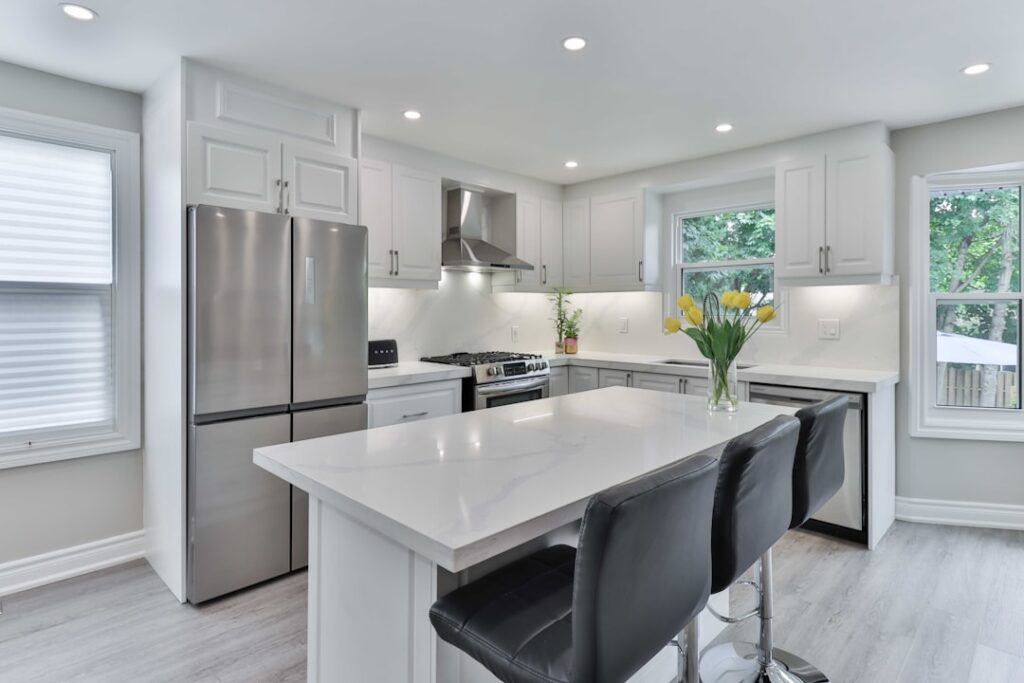
White uppers with a dark or colorful island. Sherwin-Williams Pure White uppers, Sherwin-Williams Naval (deep navy) island, brass hardware. Reads modern, photographs well, and tolerates color trend shifts because the white anchors it.
Two-tone with stained wood accent. Painted uppers in Benjamin Moore Simply White, lower cabinets and island in walnut stain, white quartz countertops. Warm, balanced, and forgiving of style updates over time.
Greige monochrome. All cabinets in Benjamin Moore Revere Pewter or Sherwin-Williams Agreeable Gray, with white trim and beige walls. Subtle, timeless, and works in any architectural style.
Wall Color Recommendations
For walls, lean lighter than cabinet color to avoid the “boxed-in” effect. Whites worth knowing: Benjamin Moore White Dove, Sherwin-Williams Alabaster, Farrow & Ball Wimborne White (warmer). Off-whites and creams: Benjamin Moore Natural Cream, Sherwin-Williams Creamy.
If you want color, soft sage and pale blue walls work in kitchens with white cabinets. Sherwin-Williams Sea Salt is the safe pale green pick. For deeper moves, Farrow & Ball Cooking Apple Green or Card Room Green pair well with cream cabinetry. Avoid red and yellow walls in kitchens — both colors compete with food and make the room feel smaller.
Equipment That Makes a Difference
Good tools matter more than expensive paint in this room. Use a 4-inch foam roller for cabinet faces (Whizz brand is the contractor pick) and a 2.5-inch Wooster Shortcut angle brush for cut-ins. Avoid bristle rollers entirely — they leave stipple texture that no enamel sands out.
For larger projects, an HVLP (high-volume low-pressure) sprayer like the Fuji Mini-Mite 4 produces a glass-smooth finish but requires masking everything else in the room. Renting an HVLP for a weekend runs $50 to $80 at most rental yards. Pair with a 4-mil polyethylene sheet for masking and Frog Tape Multi-Surface for tape lines.
Common Mistakes to Avoid
Five mistakes ruin most DIY kitchen paint jobs. First, skipping degreasing. Even invisible cooking oil residue causes paint to peel within months. Second, painting in high humidity. Below 40 percent or above 70 percent relative humidity guarantees finish problems. Aim for 50 to 60 percent during cure.
Third, rushing recoat times. Latex enamel calls for 4 to 16 hour recoat windows on the can but the paint is not actually hard for 7 to 30 days. Reinstall hardware too soon and the dings become permanent. Fourth, using cheap brushes. A $5 chip brush leaves bristles in the paint that you will see forever. Fifth, painting over loose or peeling paint. Anything not solidly bonded must come off — scrape, sand, prime, then paint.
Refresh Versus Replace Math
Painting cabinets makes sense when the boxes are structurally sound and the door style is acceptable. New cabinet boxes run $5,000 to $30,000 installed for a typical kitchen. Repainting existing cabinets costs $400 to $5,000. The difference is significant if your cabinets are solid wood with quality joinery — even oak cabinets from the 1980s can paint up beautifully and serve another 20 years.
Replacement is the right call when the boxes are warped, the doors are particle board with damaged edges, or the layout no longer suits how you cook. Painting will not fix a kitchen that is fundamentally laid out wrong.
Timing the Project
Schedule kitchen painting for the season with the most stable humidity. In most US climates, that means late spring or early fall. Avoid running the dishwasher, stove, or shower during the paint cure window if possible — kitchens are vapor-heavy rooms and high moisture extends drying times. Plan to eat out or use a microwave on a folding table for at least four days for a full repaint.
Done with care and the right products, kitchen painting transforms the space at a fraction of the cost of any other renovation. The work is real but the results last 10 to 15 years if you respect the cure times and use professional-grade enamel rather than the cheapest can on the shelf.