Not every kitchen comes with a walk-in pantry, and building one is expensive and disruptive. The simplest solution is a piece of furniture you can buy today and use tonight. A kitchen pantry cabinet freestanding unit delivers tall, enclosed storage for food, small appliances, and kitchen overflow without touching your walls or plumbing. This guide covers the sizes, materials, features, and placement strategies that help you choose a freestanding pantry that fits your space and dramatically expands your storage.
Part of our Kitchen Remodeling guide — explore the full guide →
- Why Choose a Freestanding Pantry
- Common Sizes and Dimensions
- Material and Construction Options
- Storage Features Worth Having
- Matching Style to Your Kitchen
- Where to Place a Freestanding Pantry
- Safety and Stability
- Assembly Tips
- Cost and Where to Buy
- Organizing the Interior for Maximum Use
- Freestanding Versus Built-In Pantries
- Final Thoughts
Why Choose a Freestanding Pantry
A freestanding pantry is the fastest, most affordable way to solve a storage shortage. Unlike built-in cabinetry, it requires no contractor, no permits, and no permanent changes, and you can take it with you when you move. For renters, small kitchens, and anyone who wants extra storage without a renovation, it is an ideal solution.
- No installation: Assemble and load; no wall or plumbing work.
- Portable: Move it within the room or take it to a new home.
- Affordable: A fraction of the cost of custom built-ins.
- Flexible: Use it in the kitchen, dining room, garage, or laundry area.
- Instant capacity: Adds significant enclosed storage right away.
Common Sizes and Dimensions
Freestanding pantries come in a range of footprints, so measuring your available space first is essential. Note both the floor space and the ceiling height.
- Height: Most stand 60 to 72 inches tall, with some reaching 84 inches to use vertical space.
- Width: Common widths run from 24-inch narrow units to 36- and 48-inch wide cabinets.
- Depth: Typically 12 to 24 inches; deeper units hold more but need more floor space.
- Slim profiles: Narrow 12- to 16-inch-deep pantries fit tight nooks and gaps.
Always leave clearance for doors and drawers to open fully, and measure doorways and hallways to be sure the assembled or boxed cabinet will fit through.
Material and Construction Options
Construction quality determines how much weight the pantry holds and how long it lasts. Match the material to your budget and how heavily you will load it.
- Solid wood: The most durable and refinishable, but the heaviest and most expensive.
- Plywood: Strong and stable, a good balance of cost and durability.
- MDF: Smooth and affordable, but heavier and less moisture-resistant.
- Particleboard with laminate: The budget option; fine for light loads but prone to sagging under heavy cans.
- Metal: Industrial-style steel units for garages and utility spaces.
For a pantry loaded with canned goods, look for solid wood or plywood shelves and reinforced construction to prevent sagging over time.
Storage Features Worth Having
The best freestanding pantries do more than offer bare shelves. Look for features that maximize usability.
- Adjustable shelves: Reposition shelves to fit tall boxes, small appliances, or bulk items.
- Pull-out drawers or baskets: Bring items at the back within easy reach.
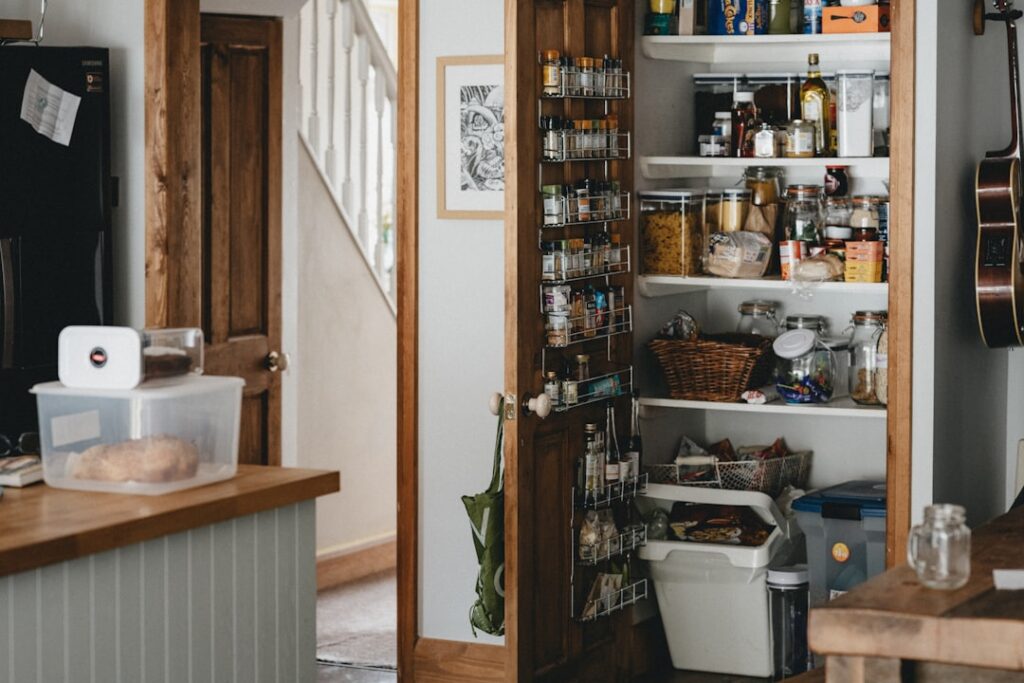
- Door-mounted racks: Spice and can racks on the inside of the doors add capacity.
- Upper and lower sections: Cabinets over open shelves or drawers for varied storage.
- Countertop surface: Some units include a work surface for prep or appliances.
Matching Style to Your Kitchen
Since a freestanding pantry sits in plain view, its style matters. Coordinate it with your existing cabinets and decor rather than treating it purely as utility.
- Shaker doors: Clean and versatile, blending with most kitchens.
- Glass-front doors: Display dishware while enclosing it from dust.
- Farmhouse styling: Beadboard, distressed finishes, and turned legs for a cozy look.
- Modern flat-panel: Sleek doors and minimal hardware for contemporary spaces.
- Finish matching: Choose a color close to your cabinets or a deliberate contrast accent.
Where to Place a Freestanding Pantry
Placement affects both convenience and how the room flows. Consider these spots.
- Empty wall in the kitchen: The most convenient, keeping food near where you cook.
- Adjacent dining room: A hutch-style pantry doubles as a serving station.
- Kitchen nook or alcove: A slim unit tucks into an otherwise wasted corner.
- Laundry or mudroom: Overflow storage for bulk goods and paper products.
- Garage: A metal or utility pantry for warehouse-club purchases.
Keep the pantry away from heat sources like the range and out of direct sunlight, which can shorten the shelf life of stored food.
Safety and Stability
A tall, loaded cabinet can tip, so stability is a real concern, especially in homes with children. Most quality pantries include an anti-tip strap or bracket that anchors the unit to a wall stud, and you should always use it. Load heavier items on lower shelves to keep the center of gravity low, and make sure the cabinet sits level on the floor; shims can correct an uneven surface. These simple steps prevent a dangerous tip-over.
Assembly Tips
Most freestanding pantries ship flat-packed and require assembly. A few practices make the job smoother.
- Read the instructions fully: Understand the sequence before starting.
- Work on a soft surface: A blanket protects panels from scratches during assembly.
- Use a drill carefully: Drive screws by hand or on low torque to avoid stripping particleboard.
- Check for square: Confirm the frame is square before tightening everything, so doors align.
- Enlist a helper: A second person makes raising a tall cabinet safer.
Cost and Where to Buy
Freestanding pantries fit nearly any budget. Basic particleboard units start around $80 to $200, mid-range wood-and-plywood cabinets run $200 to $500, and solid-wood or feature-rich pantries reach $500 to $1,200 or more. Furniture retailers, home improvement stores, and online marketplaces carry a wide selection. Spending a bit more on solid construction pays off if you plan to store heavy canned goods, since cheap shelves sag and doors sag out of alignment under load.
Organizing the Interior for Maximum Use
A freestanding pantry only delivers on its promise if the inside is organized well. Empty shelves quickly become a jumble of half-used boxes, so a few inexpensive additions dramatically improve how much the cabinet actually holds and how easily you find things.
- Clear bins and baskets: Corral snacks, packets, and loose items into pull-out groups.
- Lazy Susans: Spin oils, sauces, and cans into easy reach on deep shelves.
- Tiered shelf risers: Step up cans and jars so back rows stay visible.
- Airtight canisters: Store flour, sugar, pasta, and cereal uniformly and keep pests out.
- Labels: Mark bins so the whole household maintains the system.
Grouping like items together, keeping everyday staples at eye level, and placing rarely used items up high turns a plain cabinet into an efficient, well-ordered pantry.
Freestanding Versus Built-In Pantries
Homeowners weighing storage options often wonder whether to buy a freestanding unit or invest in a built-in pantry. Each has a place, and the right answer depends on your budget, your plans, and your kitchen. A freestanding pantry wins on cost, speed, and flexibility; you can have one assembled and loaded in an afternoon for a few hundred dollars, and you can take it with you when you move, which makes it ideal for renters and anyone unsure of their long-term plans. A built-in pantry, whether a tall cabinet run or a walk-in closet, offers a more seamless, permanent look and can add resale value, but it costs far more and requires construction. Many homeowners choose a freestanding unit as an immediate solution and later upgrade to built-ins during a full remodel. If your kitchen has an awkward alcove or a gap beside the refrigerator, a well-chosen freestanding pantry can look nearly built-in while preserving the freedom to rearrange, giving you much of the polish of custom cabinetry at a fraction of the price and none of the demolition.
Final Thoughts
A freestanding kitchen pantry cabinet is one of the most practical upgrades you can make, delivering a substantial storage boost without a renovation, a contractor, or a permanent commitment. Measure your space carefully, choose construction sturdy enough for the loads you plan to store, and prioritize features like adjustable shelves and pull-out drawers that make every inch usable. Coordinate the style with your kitchen, place it where it serves you best, and always anchor it for safety. With the right unit, you gain the organized, spacious pantry a small kitchen was missing, all in an afternoon of assembly.