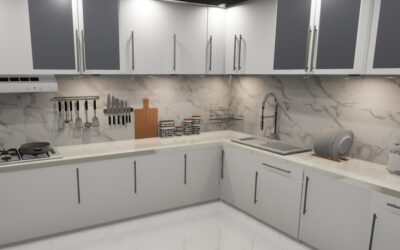
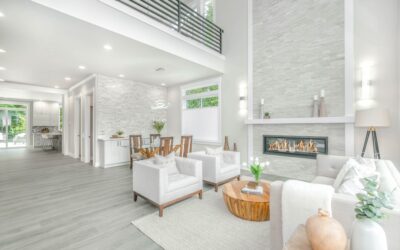
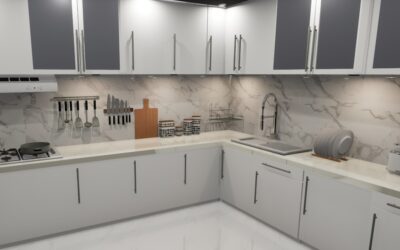
Open kitchen shelving has been on every design magazine cover for a decade, but most homeowners who install it regret at least one decision within six months. The dishes get dusty. The shelves sag. The brackets show through, and the entire wall reads “Pinterest from 2018.” Smart kitchen wall shelves ideas start with the right bracket choice, the right wood depth, and a styling approach that survives daily use without looking staged. Here’s how to design open shelving that earns its place above your counter for the next 15 years.
Part of our Kitchen Remodeling guide — explore the full guide →
- Bracket Types: What Actually Holds the Weight
- Shelf Thickness, Length, and Wood Choice
- Where to Install (and Where Not To)
- Styling Strategy That Actually Holds Up
- Mixed Configurations: Shelves Plus Cabinets
- Care, Cleaning, and Refinishing
- Lighting to Highlight Open Shelves
- Costs and DIY vs. Hired Install
Bracket Types: What Actually Holds the Weight
Open shelves typically carry 25 to 50 pounds per linear foot once loaded with dishes. Most decorative shelf brackets are rated for half that. Three bracket families handle real kitchen loads:
- Hidden floating brackets (Federal Brace Drake, RTC Industries): Steel rods inserted through holes drilled into the shelf’s back edge. Cleanest look. Each rod holds 75 to 100 pounds when anchored into studs. $35 to $90 per shelf depending on length.
- L-brackets (Liberty Hardware, Simpson Strong-Tie): Workhorse hardware-store option. Powder-coated black or matte gold. Less elegant but bombproof. $8 to $25 each.
- Pipe brackets (Industrial Pipe Decor, Goodman Made): Black iron pipe and floor flanges. Industrial look, very strong. About $25 to $40 per bracket assembly.
For walls without studs in the right place (common above countertops where a window or mechanical chase lands), use heavy-duty toggle bolts rated for 100 pounds in 1/2-inch drywall. Even better: install 3/4-inch plywood backing during a remodel so brackets can land anywhere.
Shelf Thickness, Length, and Wood Choice
Two-inch thick shelves read substantial; 3/4-inch shelves look like an afterthought. Build to 1.5 to 2 inches by laminating two pieces of 3/4-inch plywood or solid wood, or buy ready-made walnut and white oak shelves from companies like Walnut Wood Works or East Coast Lumber. Expect:
- Solid walnut, 1.75-inch thick, 10-inch deep, 36-inch long — $180 to $260
- Solid white oak, 1.5-inch thick, 10-inch deep, 36-inch long — $145 to $200
- Engineered walnut veneer over plywood, same dimensions — $90 to $130
Shelf length matters for sag. A 1.5-inch solid wood shelf spans up to 36 inches between brackets safely. Beyond that, add a third bracket or step up to 2-inch thickness. For 48-inch shelves with heavy dishware, three brackets is mandatory.
Where to Install (and Where Not To)
The best locations for open shelving are above counters where you want easy access to daily-use items, flanking a range hood, or filling a small awkward wall between cabinets and a window. Worst locations:
- Directly above a cooktop without a hood — grease coats everything within 18 inches
- Above a sink where water splash hits glassware
- In corners next to dishwashers (steam from open dishwasher discolors finish)
- Above an under-counter coffee station — fine dust from grinders settles instantly
Two shelves stacked, spaced 14 to 16 inches apart, hold dinner plates on the bottom and shorter items (cups, bowls) on the top. Three shelves work in tall ceilings but require a ladder to reach the top tier.
Styling Strategy That Actually Holds Up
Magazine-perfect shelves with vintage books and matched white dishes ignore reality. A working open shelf needs to look styled but accept daily use. The 70/30 rule works: 70 percent functional items used at least weekly, 30 percent decorative pieces (a cutting board, a small framed print, two ceramic vases).
Stick to a tight palette of two to three colors plus natural wood tones. White, walnut, and brushed brass is a reliable combination. Avoid stacking too many pieces — five to seven groupings per shelf reads styled, fifteen reads cluttered. Cookbooks add visual weight and can sit lying flat under a small bowl or vertically between two ceramic bookends.
Mixed Configurations: Shelves Plus Cabinets
The strongest open shelving designs don’t go full open. They mix one or two shelves with closed cabinets nearby. Closed storage absorbs the bulk and ugly items (small appliances, plastic containers, mismatched mugs), letting the open shelves carry only intentional pieces. A typical configuration:
- Lower cabinets full height
- Two open shelves above the counter (flanking range or window)
- Closed upper cabinets on the rest of the wall
This layout gives you 75 to 85 percent of the closed storage of a fully cabinet wall while opening up the most visible 4 to 6 feet of upper wall space.
Care, Cleaning, and Refinishing
Open shelves in a cooking kitchen accumulate fine grease film within weeks. Plan a 15-minute weekly wipe with a microfiber cloth and a mild cleaner like Method Wood for Good Daily Cleaner ($6 per bottle). For deeper care twice a year, refresh oil-finished shelves with Howard Feed-N-Wax ($12 per can) applied with a soft cloth and buffed off.
For polyurethaned shelves, simple soap and water is fine. If the finish dulls after a few years, lightly sand with 220-grit, vacuum, and apply one coat of Bona Mega satin polyurethane ($45 per quart) using a foam pad. The shelves come back looking new.
Lighting to Highlight Open Shelves
Open shelves catch the eye, so light them like a small gallery. Three options to consider:
- Recessed wall washers above: Two 4-inch LED downlights placed 12 to 18 inches forward of the wall throw light down across the shelves. Best installed during framing.
- LED tape under each shelf: 24V warm white tape (Diode LED Fluid View at $8 per foot) hidden in a small channel routed into the bottom front edge of each shelf.
- Sconces flanking the shelves: A pair of wall sconces at 60 to 72 inches above the floor centers light on the styled items.
Wire any new shelf lighting to a dimmer separate from your overhead kitchen lighting. Evening lighting at 20 to 30 percent transforms a workaday kitchen into an inviting room.
Costs and DIY vs. Hired Install
A pair of solid walnut shelves with hidden brackets, professionally installed over a 6-foot kitchen wall, runs $700 to $1,100 in most US markets. DIY brings that to $300 to $500 for the same materials if you have a stud finder, a level, a 1/2-inch drill, and basic carpentry skill. The hidden bracket install is the only step that intimidates first-timers: it requires drilling perfectly horizontal holes into the back edge of the shelf to receive the steel rods. A drill press or a $25 self-centering doweling jig makes it almost foolproof.