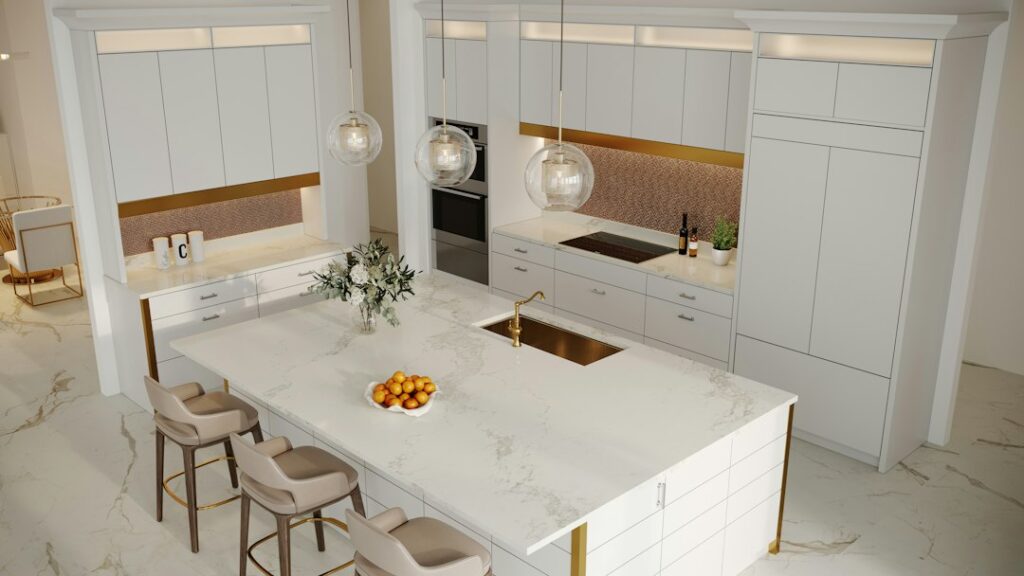
Gold hardware went from a 1980s embarrassment to one of the most-requested finishes in custom kitchens — but only because the industry quietly replaced bright polished brass with warmer, softer tones that age more gracefully. Building a kitchen with gold hardware done right means choosing the correct undertone, pairing it with cabinet colors that complement rather than fight the finish, and resisting the urge to mix in too many other metals.
Part of our Kitchen Remodeling guide — explore the full guide →
Why Gold Came Back
Designers shifted toward warmer kitchen palettes around 2018 to counterbalance a decade of cold gray-and-white interiors. Brushed brass and unlacquered brass returned first, followed by satin gold and champagne bronze. The current dominant finish is what manufacturers call “matte gold” or “warm gold” — a muted version of the original that reads as a neutral rather than a statement.
Gold also hides fingerprints better than polished chrome or stainless. In a busy kitchen, that practical advantage drives a lot of decisions homeowners think are purely aesthetic.
The Five Gold Finishes You Will Encounter
- Polished Brass — bright, mirror-like, very 1980s, but coming back in transitional spaces
- Satin Brass — muted with subtle texture, the safest modern choice
- Unlacquered Brass — patinas over time, ranges from yellow to deep amber after 5 years
- Champagne Bronze — pinker undertone, pairs beautifully with cool whites and grays
- Matte Gold or Warm Gold — flatter sheen, hides smudges, very forgiving in busy households
Bring samples home before committing. Showroom lighting is almost always 3000K or warmer, which flatters every gold finish. Your kitchen probably runs cooler, especially if you have north-facing windows.
Cabinet Color Pairings That Work
Deep navy (Benjamin Moore Hale Navy or Sherwin-Williams Naval) with satin brass is the most reliable combination. The contrast is high enough to make the hardware pop without feeling theatrical. Forest green (Sherwin-Williams Pewter Green) hits a similar note for homeowners who want something less expected.
White cabinets work, but you have to choose the white carefully. Pure cool whites (Decorator’s White, Chantilly Lace) can make gold look yellow and tired. Stick to warm whites with a hint of cream like Benjamin Moore White Dove or Simply White. Sage green and warm taupe are quieter pairings that read as upscale rather than trendy.
Avoid: cool gray, pure black, and anything with a strong blue or purple undertone. Gold against cool tones often reads as cheap brass instead of intentional design.
Faucets and Fixtures: Match or Mix
If you can match your cabinet hardware finish to your faucet finish, do it. Brizo and Delta both make matching collections in champagne bronze and brilliance luxe gold (around $400 to $900 per faucet). Kohler’s Vibrant Brushed Moderne Brass is another strong option at roughly $500.
Mixing metals is fine, but limit yourself to two. Gold cabinet pulls plus a stainless range and gold faucet works. Adding chrome pendant lights, copper accents, and matte black bar stools turns the room into a metals showroom.
Lighting That Complements Gold
Pendant lights over an island are the second-most-noticed metal element after hardware. Match the finish family but allow some variation in tone. A satin brass pull on the cabinets paired with a slightly darker antique brass pendant reads as collected, not mismatched. The trick is keeping the warmth in the same family.
For under-cabinet lighting, choose warm white LEDs at 2700K to 3000K. Cooler bulbs (4000K and up) wash gold out and make it look greenish. The same applies to recessed cans over the work zone.
Common Mistakes to Avoid
The single biggest mistake is buying polished brass thinking it will “warm up” the room, then realizing two years later that the high shine looks like the brass faucet at your grandmother’s house. If you want longevity, choose a brushed or satin finish.
Second most common: matching every fixture exactly to the cabinet hardware. The room ends up feeling like a hotel display. Vary the tone slightly between pulls, faucet, and lighting so each element has its own presence.
Third: forgetting that gold hardware is not maintenance-free. Most coated finishes need occasional wiping with a microfiber cloth dampened with water only. Skip Bar Keepers Friend, vinegar, and ammonia-based cleaners — they all damage the protective lacquer.
Budget Considerations
Quality gold hardware runs $8 to $35 per pull at big-box stores and $25 to $80 at specialty retailers like Rejuvenation or Schoolhouse. A 25-cabinet kitchen needs roughly 30 pulls and 6 knobs, so budget $400 to $1,500 for hardware alone. Faucets and pendants add another $800 to $2,500 depending on brand.
Cheap gold-tone hardware from generic online sellers tarnishes within a year, especially around the sink where water exposure is constant. Spend the extra $5 to $10 per piece for a known brand with a real lifetime finish warranty. The math always favors quality over replacement.
Hardware Placement and Sizing
Pull length should scale with drawer width. A 30-inch drawer wants a 10 to 12 inch pull. A 24-inch drawer looks balanced with a 7 to 8 inch pull. Anything smaller than 4 inches on a wide drawer looks like an afterthought.
Mounting position matters too. On standard upper cabinets, install pulls horizontally near the bottom rail. On lower cabinets, install pulls vertically near the top rail. On drawers, install pulls horizontally and centered. This is the layout people expect, and deviating from it without a strong reason looks like a mistake rather than a design choice.
Use a hardware installation template ($15) to mark holes consistently across every cabinet. The True Position TP-1934 jig is the gold standard for DIY installations and saves hours of measuring and remarking.
Caring for Gold Hardware Long-Term
Most coated gold hardware needs nothing more than a weekly wipe with a damp microfiber cloth. Avoid Bar Keepers Friend, ammonia-based cleaners, and any product containing chlorine. Unlacquered brass is the exception — it is supposed to patina, and trying to keep it shiny defeats the design intent. A small amount of mineral oil on a soft cloth, applied twice a year, keeps coated finishes looking new and prevents the dull haze that builds up from cooking residue and skin oils.