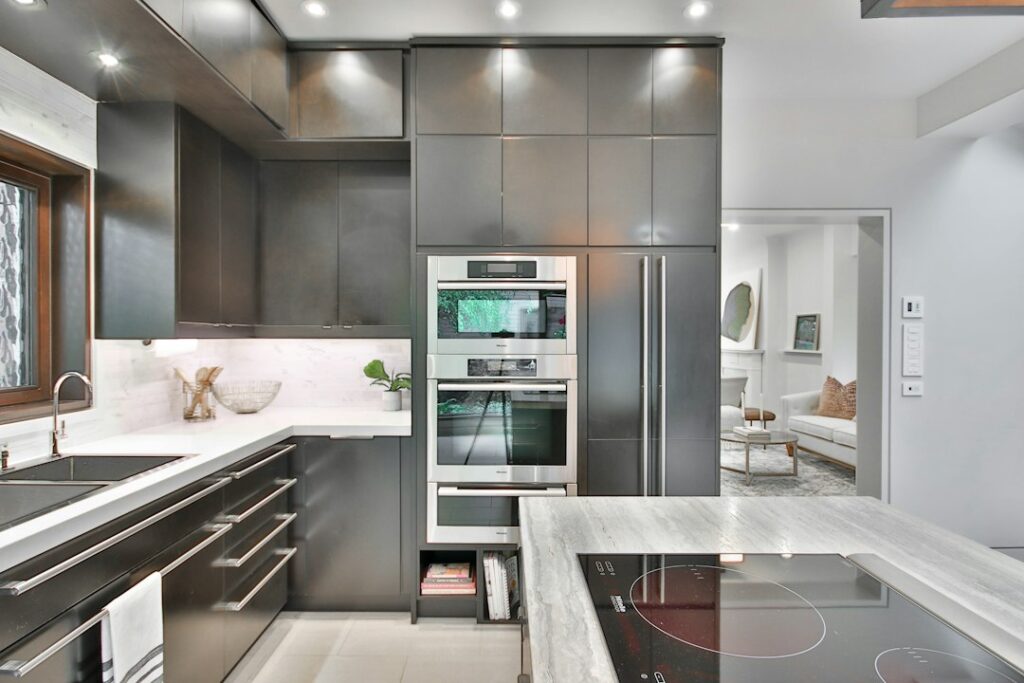
Most people looking for Kohler cabinet pulls already have a Kohler faucet picked out and want the vanity or kitchen drawers to match it exactly. That instinct is sound, because two “brushed gold” finishes from different makers rarely look the same side by side. The catch is that Kohler is first a faucet, sink and fixture company, and its cabinet hardware has always been a small, coordinating range rather than a huge catalog. Individual pulls come and go, and some listings you find online are older stock.
Part of our Kitchen Remodeling guide — explore the full guide →
The practical approach is to match by finish code first, by collection style second, and by center-to-center size last. Kohler identifies every finish with a short suffix on the model number, such as BN for Vibrant Brushed Nickel or 2MB for Vibrant Brushed Moderne Brass. If a pull carries the same suffix as your faucet, it is intended to match. If the exact pull you want is no longer offered, you can still build a coordinated room by matching the finish code family and choosing a pull with the same visual language as your faucet collection.
- Kohler Cabinet Pulls: Finish Codes That Match Your Faucet
- Common Center-to-Center Sizes
- How Kohler Collection Styles Translate to Hardware
- Tools and Materials for Installing Pulls
- Step-by-Step Installation
- Troubleshooting Common Problems
- Cost Ranges and Buying Tips
- Care and Cleaning
- When to Hire a Pro
- Frequently Asked Questions
The sections that follow cover finish matching, standard sizes, how Kohler collection styles translate to hardware, installation, troubleshooting and cost ranges.
Kohler Cabinet Pulls: Finish Codes That Match Your Faucet
Finish is where the real value of brand-matched hardware lies. The codes in the table are the ones Kohler uses across faucets, drains and accessories. Kohler adds and retires finishes over time, so check the finish selector on the specific product page before ordering.
| Kohler finish | Code | Look | Hardware matching notes |
|---|---|---|---|
| Vibrant Brushed Nickel | BN | Warm silver, brushed | Easiest finish to find in pulls from any maker; hides fingerprints |
| Vibrant Polished Nickel | SN | Glossy warm silver | Shows smudges on high-touch drawers; best in light-use baths |
| Polished Chrome | CP | Bright, cool, mirror-like | Cooler than polished nickel, so do not mix the two |
| Vibrant Brushed Moderne Brass | 2MB | Pale, champagne-toned gold | Golds vary widely; match the code, not a photo |
| Vibrant French Gold | AF | Richer polished gold | Reads more traditional; pairs with ornate pull shapes |
| Vibrant Brushed Bronze | BV | Muted warm bronze | Middle ground between brass and dark bronze |
| Oil-Rubbed Bronze | 2BZ | Dark brown, copper highlights | Color varies by batch; buy all pulls at once |
| Matte Black | BL | Flat black | Simple to match across brands; shows oily fingerprints |
Kohler uses the word Vibrant for its physical vapor deposition (PVD) finishes, where the color layer bonds to the base metal in a vacuum chamber. That process resists tarnish and scratching better than standard plating, which matters on drawer pulls because they get grabbed far more often than a faucet handle. Non-PVD finishes such as Matte Black and Oil-Rubbed Bronze are still durable but reward gentler cleaning.
Why finish codes beat color names
“Brushed brass,” “champagne,” “satin gold” and “soft gold” are marketing words, and every brand uses them differently. A Kohler towel ring ending in -2MB is meant to sit beside a faucet ending in -2MB. If you buy Kohler drawer pulls with the same suffix, they should land in the same color family. If you buy pulls from another maker, bring a physical Kohler piece to compare in person.
Common Center-to-Center Sizes
Center-to-center (often written c-c or CTC) is the distance between the two screw holes, measured from the middle of one hole to the middle of the other. It is the number that decides whether a new pull fits existing holes. Overall length is longer and varies with the design. Kohler hardware, like most modern pulls, follows the standard sizes used across the industry, but confirm the exact spacing on the product spec sheet before you drill.
| Center-to-center | Metric equivalent | Typical use |
|---|---|---|
| 3 in | 76 mm | Older cabinets, small vanity drawers |
| 3-3/4 in | 96 mm | Most common modern drawer size |
| 5-1/32 in | 128 mm | Wide drawers, doors on modern cabinets |
| 6-5/16 in | 160 mm | Larger drawers, tall doors |
| 7-9/16 in | 192 mm | Pantry doors, wide base drawers |
| 12 in and up | 305 mm and up | Appliance panels and tall pantry doors |
A useful rule for drawers: choose a pull roughly one third of the drawer width. On a 24-inch drawer that points to an 8-inch class pull; on a 15-inch drawer, something in the 3-3/4 to 5-inch range looks balanced. Doors usually look right with the same pull mounted vertically, or with knobs if you want a quieter look.
How Kohler Collection Styles Translate to Hardware
Kohler organizes its bath faucets into collections with a consistent design language. Even when a dedicated pull for a given collection is not currently sold, the collection tells you what shape of pull will look intentional next to the faucet.
- Purist: minimalist, straight lines and crisp edges. Pair with slim bar pulls or flat-ended rectangular pulls.
- Margaux: transitional with gentle curves. Pair with arched or softly rounded pulls.
- Devonshire: traditional and widely sold. Pair with classic cup pulls, bin pulls or curved handles with small end posts.
- Memoirs: formal traditional with detailed profiles. Pair with backplate pulls or decorative bail pulls.
- Artifacts: vintage, early twentieth century inspiration. Pair with ribbed, knurled or bin pulls.
The same logic works for kitchens. A clean, modern pull-down faucet pairs with bar or edge pulls; a bridge faucet or traditional gooseneck pairs with cup pulls on drawers and knobs on doors.
Mixing on purpose
Matching everything is not required. A brushed brass faucet with matte black pulls reads as a design choice. What reads as a mistake is two slightly different golds or two slightly different silvers next to each other. If you mix, make the contrast obvious.
Tools and Materials for Installing Pulls
- Tape measure and a combination square
- Cabinet hardware jig (a drilling template that locks onto the door or drawer edge)
- Drill with a sharp 3/16-inch bit (or the size listed in the pull’s instructions)
- Painter’s tape and a pencil
- Scrap block of wood to back the drill exit and prevent blowout
- Phillips screwdriver; breakaway or longer screws if your drawer fronts are thick
- Wood filler matched to the cabinet color, if moving away from old holes
A cabinet hardware jig is the single tool that saves the most frustration. It sets the same distance from the edge and the same height on every drawer, so a long run of pulls lines up perfectly without measuring each one.
Step-by-Step Installation
- Check the existing holes. Measure the current center-to-center distance. If it matches the new pull, you can skip drilling entirely.
- Decide placement. Drawers usually get pulls centered left to right and either centered top to bottom or set in the upper third on deep drawers. Doors get pulls near the opening edge, typically 2 to 3 inches from the bottom corner on uppers and from the top corner on base cabinets.
- Set the jig. Adjust it for your center-to-center spacing and edge distance, then lock it.
- Tape and mark. Put painter’s tape over the drilling area to reduce splintering and make pencil marks visible.
- Drill straight. Hold the drill square to the face, with a scrap block clamped behind the panel. Drill slowly through the last bit of wood.
- Test fit and tighten. Insert the screws from inside the drawer or door. Snug them by hand; overtightening can strip threads in soft pulls or crack thin fronts.
- Repeat with the same settings. Keep the jig locked until every matching pull is done.
Thicker drawer fronts, such as those with a separate false front, may need longer screws than the ones in the box. Measure the total thickness and add the depth of thread the pull needs, usually about a quarter inch.
Troubleshooting Common Problems
- Old holes do not match the new size. Choose a pull with a backplate that covers the old holes, or fill and touch up the old holes before drilling new ones.
- Pull wobbles. Screws are too short or stripped. Use the correct length, or fill the hole with wood glue and toothpicks, let it set, and redrill.
- Finish does not match the faucet. Check the suffix on both model numbers. Polished nickel and chrome, or French Gold and Brushed Moderne Brass, are frequently confused.
- Pulls are crooked. The jig moved or the drill wandered. A small amount of play in the holes can often be absorbed by adjusting before final tightening.
- Finish wearing at the grip. Common on older plated hardware. PVD finishes resist this far better.
Cost Ranges and Buying Tips
Brand-name pulls from a fixture company usually cost more per piece than generic pulls, and finishes such as PVD brass or nickel tend to cost more than chrome or matte black. A small vanity might need only four to six pieces, while a full kitchen can need forty or more, so the price per pull adds up quickly. Bulk packs of generic pulls are far cheaper per piece, which is why many people use Kohler pieces in the bathroom where the faucet is right next to the vanity and use a well-matched generic pull in a large kitchen.
- Buy every pull you need at the same time to avoid finish variation between batches.
- Order one or two spares in case a piece is damaged or discontinued later.
- Look at pieces in the room’s own light before installing the full set.
- Confirm current availability, since Kohler cabinet pulls appear and disappear from the catalog over time.
Care and Cleaning
Wipe pulls with warm water and mild soap on a soft cloth, then dry. Avoid abrasive powders, scouring pads and harsh chemical cleaners on every finish. Spray cleaner onto the cloth rather than the hardware so it does not drip onto the cabinet finish. Dark and flat finishes show oily fingerprints, so a quick weekly wipe keeps kitchen hardware looking new.
When to Hire a Pro
Swapping pulls is one of the simplest upgrades in a house, and most homeowners handle it in an afternoon. Consider a handyman or cabinet installer if you are drilling into expensive custom cabinets, working with thick or veneered fronts that splinter easily, or installing long appliance pulls on integrated panels, which need precise alignment and solid backing.
Frequently Asked Questions
Does Kohler make cabinet pulls?
Kohler has offered a small range of cabinet pulls and knobs designed to coordinate with its bath collections. Examples include Purist bar pulls such as the K-14485 (3-inch center-to-center) and K-25499 (7-inch center-to-center), and the Margaux K-16263 3-inch pull, which Kohler now lists as discontinued. The selection changes over time, so confirm that a listed pull is still in production.
How do I match Kohler drawer pulls to my faucet?
Match the finish suffix on the model numbers, such as BN, 2MB or BL. Pieces with the same suffix are intended to match, which is more reliable than comparing color names or photos.
What size cabinet pull should I buy?
Measure the center-to-center distance of existing holes first. For new holes, a pull about one third of the drawer width looks balanced, and 3-3/4 inches (96 mm) is the most common modern size.
Can I mix Kohler pulls with another brand’s faucet?
Yes, but compare finishes in person. Brushed nickel and matte black are easy to mix across brands, while golds and bronzes vary the most.
Are PVD finishes worth it on cabinet pulls?
Pulls get handled constantly, so a PVD finish that resists scratching and tarnish is a sensible upgrade, especially in a busy kitchen or family bath.