Owning waterfront property is a dream right up until you watch your yard slowly slide into the water after a wet spring. A lake retaining wall, often called a seawall or shoreline retaining wall, holds back soil, absorbs wave action, and stops the relentless erosion that eats away at a lakefront lot. Building near water is not like building a garden wall in the backyard, though. The constant moisture, fluctuating water levels, and strict environmental rules make this one project where planning matters as much as muscle.
- What a Lakeside Wall Has to Withstand
- Common Materials and Their Trade-offs
- Drainage Is the Whole Game
- Permits and Environmental Rules
- Building the Wall Right
- Cost Expectations
- Working with the Water Level
- Living Shorelines as an Alternative
- Maintaining Your Wall Over Time
- Should You DIY or Hire Out?
What a Lakeside Wall Has to Withstand
A retaining wall along a lake faces forces a typical landscape wall never sees. Wave action pounds the face during storms and boat wakes. The water table sits high, so the soil behind the wall stays saturated and heavy. Water levels rise and fall seasonally, and in northern climates the ground behind the wall freezes and expands, pushing outward with tremendous force.
All of that means a lake wall must resist not just the weight of soil but hydrostatic pressure, the push of trapped water, and frost heave. A wall that ignores these forces will bulge, crack, and eventually fail, often within a few seasons. Drainage and a solid footing are not optional extras here; they are the difference between a wall that lasts 30 years and one that collapses in three.
Common Materials and Their Trade-offs
Shoreline walls are built from several materials, each with a clear personality:
- Riprap (loose stone) is the most natural and forgiving option. Large angular rocks absorb wave energy, allow water to pass through, and are relatively cheap. They look rugged rather than tidy and need periodic re-setting.
- Poured or precast concrete creates a hard, vertical seawall that maximizes usable yard and resists ice. It is durable and clean-looking but expensive and requires excellent drainage behind it.
- Steel or vinyl sheet piling is driven vertically into the lakebed and excels where you need a sharp edge for a dock or deep water. Vinyl resists corrosion and has become a popular long-term choice.
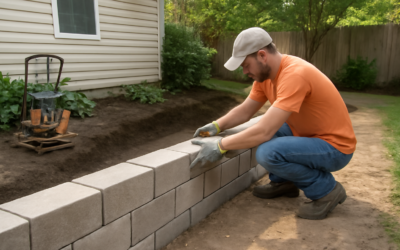
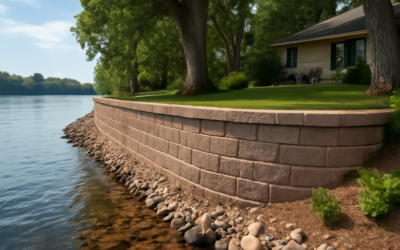
- Interlocking segmental blocks and boulder walls suit gentler slopes and shorter heights, offering a DIY-friendly middle ground.
Match the material to your shoreline energy. A calm cove can get away with a boulder or block wall, while a wide-open lake that generates real waves usually calls for riprap or engineered seawall systems.
Drainage Is the Whole Game
If you take one thing from this guide, make it drainage. The number-one killer of retaining walls near water is hydrostatic pressure from water trapped behind the wall. Every well-built lake wall includes a drainage system: a layer of clean crushed stone backfill, a perforated drain pipe (weeping tile) at the base, and often weep holes through the wall face that let water escape rather than build up.
Behind the stone, a geotextile fabric keeps fine soil from washing into and clogging the drainage layer. Skip these details to save a few hundred dollars, and you will pay ten times that when the wall leans and cracks. On a lake, the water will always find a way; your job is to give it a controlled path out.
Permits and Environmental Rules
Here is the part homeowners consistently underestimate: you almost certainly cannot just build a wall at the water’s edge. Shorelines are regulated. Depending on your state and county, you may need permits from the Army Corps of Engineers, a state department of natural resources, and your local zoning office. Many jurisdictions restrict new vertical seawalls and instead encourage “living shorelines” or riprap that preserve habitat.
Setbacks from the ordinary high-water mark, limits on how much shoreline you can harden, and rules protecting spawning areas are all common. Start with your local permitting office before you buy a single stone. Building without approval can trigger fines and an order to tear the wall out, which is a far worse outcome than the paperwork.
Building the Wall Right
Whatever material you choose, the fundamentals are consistent. Excavate down to stable, undisturbed soil for the footing, well below the frost line in cold climates. Set a compacted gravel base so the wall has a level, draining foundation. Build with a slight backward lean, called batter, so the wall tips into the slope it holds rather than falling away from it.
Tie taller walls back into the bank with deadmen or geogrid, buried anchors that resist the soil’s push. Cap the top to shed water and finish the face. Throughout, keep that drainage layer continuous. Rushing any of these steps on a waterfront wall is how a weekend project becomes a costly failure.
Cost Expectations
Shoreline walls are not cheap because of the site access, materials, and engineering involved. As a rough guide, riprap runs $30 to $60 per linear foot for a modest shoreline, segmental block walls land around $40 to $70 per linear foot, and engineered concrete or steel seawalls can climb to $150 to $600 per linear foot for tall or difficult installations. Permitting, engineering stamps, and equipment access can add thousands more.
Height drives cost dramatically. Most jurisdictions require a licensed engineer’s design for walls over three to four feet, and rightly so given the pressures involved. Get multiple bids and confirm each contractor carries proper permits and marine-work experience.
Working with the Water Level
Lakes rise and fall, and a wall that ignores those swings is a wall that fails. Before you design anything, learn your lake’s normal high and low water marks and, if it is a managed reservoir, whether the operator draws it down seasonally. The wall’s footing must sit below the lowest expected water level so it is never undermined, and the face must be tall enough to hold soil at the highest expected level plus wave splash.
On lakes with big seasonal swings, a stepped or riprap design that tolerates changing water lines often outperforms a single rigid vertical wall. Ice is the other seasonal force in northern lakes: expanding sheet ice can shove against and lift a wall with enormous force, which is why cold-climate designs favor riprap or heavily anchored systems that give ice somewhere to go. Design for the full range your lake actually experiences, not just the calm summer day when you are standing there planning.
Living Shorelines as an Alternative
Not every erosion problem needs a hard wall, and increasingly regulators prefer softer solutions. A “living shoreline” stabilizes the bank using natural materials, native plants with deep root systems, strategically placed stone, and graded slopes, instead of a vertical seawall. Deep-rooted grasses and shrubs hold soil in place, absorb wave energy, and filter runoff, all while providing habitat for fish and birds.
Living shorelines often cost less than engineered seawalls, blend into the landscape, and sail through permitting because they improve rather than harden the shore. They work best on lower-energy shorelines where waves are modest. On a calm cove or a gently sloping bank, a planted buffer combined with a low riprap toe can outperform a wall for a fraction of the cost and disruption.
Maintaining Your Wall Over Time
Even the best-built shoreline wall needs periodic attention. Walk the wall each spring and after major storms, looking for bulging sections, cracks, leaning, or soil settling behind the cap, all early warnings of drainage trouble or undermining. Clear any weep holes that have clogged with sediment so trapped water can keep escaping.
Watch the base of the wall for scouring, where wave action carves away the lakebed at the foot and slowly undermines the footing. Adding a stone toe or riprap apron at the base protects against this. Catching a small problem, a single leaning block or a clogged drain, early is a cheap fix; ignoring it until the wall bows is a full rebuild. A little seasonal vigilance is what stretches a shoreline wall’s life toward its full potential.
Should You DIY or Hire Out?
A low riprap edge or a short boulder wall on a calm shoreline is within reach for a capable homeowner with a strong back and a rented machine. Anything vertical, anything over a few feet tall, and anything involving driven piling belongs to a specialist with the right equipment and insurance. The stakes are high because a failing lake wall can undermine your yard, your dock, and sometimes your neighbor’s shoreline too.
Done properly, a lake retaining wall protects your investment for decades, keeps your usable yard from washing away, and can even improve access to the water. Respect the permits, obsess over drainage, and match the material to your shoreline, and your wall will hold the line long after the storms have passed.