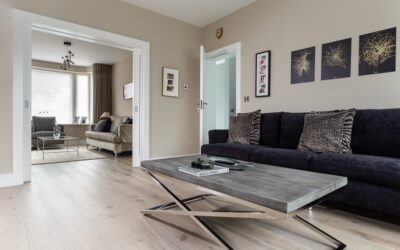
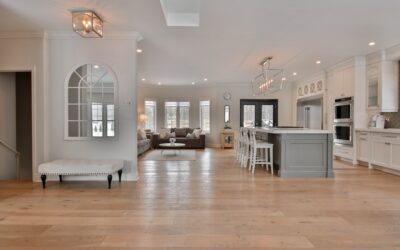
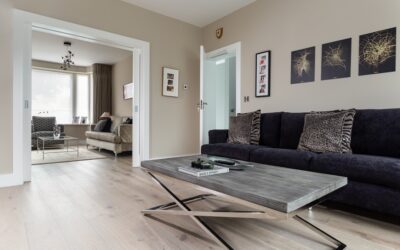
The laminate floor your parents installed in 1998 had four visuals to choose from, all of them obviously fake oak. Twenty-five years later, the printing technology has caught up to the point that a high-end laminate plank looks identical to engineered hardwood from a normal standing height. Laminate flooring designs now span everything from European white oak to French herringbone, distressed barn wood, polished concrete looks, and ceramic tile mimics, with pricing between $2 and $5 per square foot for the material. The design choice you make affects the room far more than the brand name on the box.
Plank Width and Length Trends
Plank dimensions drive the visual style as much as the color does. Standard 5-inch planks read traditional and busy in larger rooms. Wide planks at 7 to 9 inches read modern and minimalist, and they make small rooms feel bigger. Extra-wide planks at 9-plus inches and lengths up to 72 inches mimic the look of premium custom-milled engineered hardwood.
The current sweet spot for contemporary design is a 7.5-inch wide plank at 48 to 60 inches long. Pergo TimberCraft, Quick-Step Reclaime, and Mohawk RevWood Plus all offer this format in dozens of visuals, with the wider format adding about $0.30 to $0.60 per square foot over standard 5-inch lines.
Surface Texture and Embossing
Three texture types dominate the laminate market. Smooth finish gives a clean, modern look but reads less like real wood. Embossed adds random grain patterns to the surface in a single texture, the workhorse of mid-tier laminate. Embossed in Register (EIR) aligns the embossed texture exactly with the printed grain image, producing the most realistic look available at this price point.
- Smooth: lowest cost, formal modern aesthetic
- Embossed: general-purpose texture, hides scratches well
- EIR (Embossed in Register): premium realism, matches printed grain
- Handscraped: heavy scraped grooves, rustic character
- Wirebrushed: subtle linear grain emphasis, contemporary feel
Visuals That Are Trending Right Now
White oak in pale natural tones leads the residential market in 2025-2026 by a wide margin, mimicking the engineered hardwood designs popular in new construction. Walnut and hickory hold the second tier, with herringbone patterns at 36% wider distribution than five years ago.
On the rustic end, weathered barn wood and reclaimed-look planks with knots, mineral streaks, and color variation continue strong sales. On the modern end, concrete and stone-look laminate (Pergo TimberCraft+WetProtect Stone, Mohawk Solidtech Plus) target homeowners who want tile aesthetics with the warmth and click-lock installation of laminate.
Herringbone and Chevron Patterns
Specialty patterns now make up about 15% of premium laminate sales, up from 4% in 2020. Herringbone planks are sold in short sizes (typically 5 inches wide by 24 inches long) that lock together at 90 degrees. Chevron uses 45-degree mitered ends that meet in a continuous V. Both patterns add 25% to 40% to material cost and 50% to 75% to labor cost, but they transform the visual impact of a room.
Quick-Step Disegno and Pergo Mediterranean Tile are two of the best widely-distributed herringbone laminates, with EIR surfaces and AC4 wear ratings appropriate for high-traffic residential use. Plan on 12% to 15% waste factor instead of the usual 7% to 10% because of the directional cutting required.
Brand Spotlight: Pergo TimberCraft+WetProtect
Pergo invented the laminate flooring category in Sweden in 1977 and continues to set the design benchmark in mainstream retail. The TimberCraft+WetProtect line ships at 7.48 inches wide by 47.24 inches long in a 12mm total thickness, with Embossed in Register surface texture aligned to a high-resolution printed photo image. The WetProtect technology uses a hydrophobic edge treatment and water-resistant core that survives 24-hour water exposure without swelling. Twenty-eight visuals cover oak, hickory, maple, walnut, and exotic species, with pricing through Lowe’s at $3.49 to $3.99 per square foot. The AC4 rating handles full residential and light commercial duty, and Pergo provides a lifetime residential warranty plus 10-year light commercial coverage. The locking system uses Uniclic angle-tap installation.
Color Coordination With Cabinets and Walls
Three color principles guide successful laminate selection. First, pick a floor that contrasts with your dominant cabinet color, not matches it. White kitchen cabinets pair best with mid-tone oak or walnut laminate. Espresso cabinets pair with lighter blonde or wirebrushed gray oak.
Second, the floor undertone should align with the wall paint undertone. Warm wood floors (red oak, hickory, maple) belong with warm neutrals like Sherwin-Williams Alabaster, Benjamin Moore White Dove, or any beige. Cool wood floors (gray oak, weathered ash, white oak with smoke stain) belong with cool whites and grays.
Third, lighting matters more than the showroom suggests. The same plank can look amber under incandescent, gray under fluorescent, and natural under LED. Always test samples in the actual room with the actual lighting before ordering 1,500 square feet.
The Honest Drawbacks of Premium Designs
Higher-end laminate visuals carry two trade-offs. First, the surface gloss level affects scratch visibility. Glossy laminate shows every chair leg scrape under direct light. Matte and ultra-matte finishes hide minor wear far better and feel more like real hardwood underfoot.
Second, the wider the plank, the more sensitive the floor is to subfloor flatness. A 9-inch wide plank requires the subfloor flat to within 3/16 inch over 10 feet. Anything worse and the locking joints will gap during seasonal expansion-contraction cycles. Budget another $200 to $500 in floor leveler if you are upgrading from 5-inch to 9-inch planks on the same subfloor.
Choosing the Right Design for Your Home
Match the visual style to the home, not the trend. A 1920s craftsman bungalow looks wrong with extra-wide European white oak laminate but right with quarter-sawn oak or hickory in 5 to 6-inch widths. A modern open-plan new build looks dated with handscraped distressed laminate but right with 7.5-inch wide plank in a clean matte finish. The best laminate flooring designs are the ones that look like they always belonged in the house, which means picking the visual that fits the architecture before picking the visual that catches your eye in the showroom.
Prefer to explore on your own?
See how new flooring looks in your actual room in seconds — free, no signup.
Try the free Floor Studio →