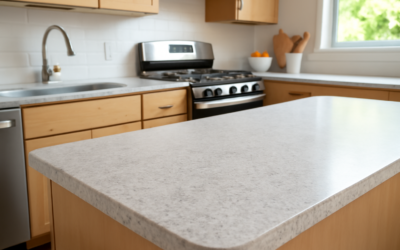
If you’ve ever called a plastic countertop a “Formica counter,” you already understand why laminate Formica confuses so many homeowners. Formica is a brand name, not a material, in the same way Kleenex is a brand of tissue. The company makes high-pressure laminate, or HPL, and its name became shorthand for the entire category of plastic laminate surfacing. In this guide I’ll clear up exactly what Formica is, where it belongs in your home, what it costs, and how to install and care for it so it lasts decades.
Part of our Countertops guide — explore the full guide →
What Formica Actually Is
Formica Corporation has been manufacturing decorative laminate since 1913, and the product is best described as high-pressure laminate. It’s built from layers of kraft paper soaked in resin, topped with a printed decorative sheet and a clear protective overlay, then fused under roughly 1,000 pounds per square inch of pressure and high heat. The result is a hard, thin sheet, typically about 1/16 inch thick for standard grades, that resists stains, scratches, and moisture far better than the paper it started as.
Because the design layer is printed, Formica comes in hundreds of patterns, from convincing wood grains and stone looks to bold solids. Real granite or quartz it is not, but for the money, a quality laminate delivers a durable, easy-care surface that photographs and wears well.
Where Laminate Formica Is Used
The brand shows up in three main places around the home, and understanding each helps you buy the right product.
Countertops
This is the classic use. HPL sheets are bonded to a particleboard or MDF core to create kitchen and bathroom counters. Post-formed tops with a seamless rolled backsplash are the affordable stock option, while custom fabricated tops let you choose edge profiles and pair any laminate color with the substrate.
Cabinets and Furniture
Laminate faces plenty of cabinet doors, closet systems, and furniture. Here it’s often applied as a thinner cabinet-grade or vertical-grade laminate, since these surfaces take less abuse than a countertop.
Formica-Brand Flooring
Formica also sells laminate flooring, which is a different construction: a rigid fiberboard core with a laminate wear layer and a click-lock edge. Don’t confuse the flooring planks with the sheet goods used on counters; they install completely differently.
Thickness and Grades
Choosing the correct grade prevents waste and failures. General-purpose horizontal-grade laminate runs about 0.048 inch thick and is what most countertops use. Vertical-grade, around 0.028 inch, is thinner and cheaper, made for cabinet sides and backsplashes that don’t get direct wear. Post-forming grade is slightly more flexible so it can be heated and bent around a rolled edge without cracking.
For flooring, Formica planks come in the usual 7mm to 12mm thicknesses with AC ratings that indicate abrasion resistance; AC3 suits most homes, while AC4 and AC5 handle heavier traffic.
Finishes and Looks
Finish changes the feel as much as the color. Common options include:
- Matte: Low sheen, hides fingerprints and light scratches well. A safe default for kitchens.
- Gloss: Reflective and vivid, but shows smudges and fine scratches faster.
- Textured / embossed: Surfaces with grain or stone texture that line up with the printed pattern for realism.
Formica’s premium lines, like their 180fx collection, use large-scale stone imagery so the pattern doesn’t repeat obviously across a big counter, which was always the tell of cheaper laminate.
Cost Per Square Foot
Laminate remains one of the best values in surfacing. Here’s a realistic breakdown:
- Material only (raw sheets): roughly $1.50 to $5 per square foot depending on pattern and grade.
- Stock post-formed countertops: about $10 to $30 per linear foot at home centers.
- Custom fabricated and installed counters: commonly $25 to $50 per square foot installed.
- Formica laminate flooring: roughly $1.50 to $4 per square foot for the planks.
Compare that to $50 to $100-plus per square foot for quartz, and you see why laminate stays popular in budget-conscious remodels and rental properties.
Installing Laminate Sheets With Contact Cement
Fabricating a laminate counter is a genuine DIY project if you’re careful. The bond comes from contact cement, which is applied to both the substrate and the back of the laminate, allowed to flash off until tacky, then pressed together, where it grabs instantly.
- Cut the laminate slightly oversized using a laminate blade or a scoring tool, then trim flush later.
- Brush or roll contact cement on both surfaces and wait 15 to 20 minutes until it’s dry to the touch.
- Lay wood dowels or venetian-blind slats across the substrate so you can position the sheet without it bonding prematurely, then pull them out one at a time.
- Press from the center outward with a J-roller to force out air, then trim the overhang with a flush-trim router bit.
The catch is that contact cement bonds on contact, so you get one shot at placement. Take your time positioning before the two surfaces touch.
Laminate Formica vs. Other Surfaces
Knowing where laminate lands against the alternatives helps set expectations. Against solid surface materials like Corian, laminate is cheaper and easier to install yourself, but it can’t be sanded to remove scratches the way solid surface can. Against quartz and granite, laminate loses on heat resistance and repairability, yet it wins decisively on price and installs without heavy lifting equipment.
Compared to butcher block, laminate needs no oiling and shrugs off water better day to day, but it lacks the warmth and the ability to be refinished. For a first kitchen, a rental upgrade, or a laundry room, laminate is often the most sensible balance of looks, durability, and cost that you’ll find anywhere on the market.
Repairing Minor Damage
Small chips and lifted edges are fixable, which is another reason the material stays popular. A lifted seam or corner can be re-bonded with fresh contact cement and clamped or weighted overnight. Manufacturers, including Formica, sell color-matched seam fill and repair compounds for filling tiny chips, and for a hairline scratch a matching laminate marker often hides it well enough. Deep gouges, though, usually mean replacing the affected sheet, since you can’t sand laminate the way you can a wood or solid-surface counter.
Care and Maintenance
Formica surfaces are famously low-maintenance. Wipe them with warm water and mild dish soap; for stubborn spots, a soft-scrub nonabrasive cleaner works. Avoid abrasive pads and harsh scouring powders, which dull the finish over time.
The two real enemies are heat and standing water. Always use a trivet, since a hot pan can scorch or bubble the surface, and never set a burning-hot pot directly on laminate. Wipe up water promptly around seams and sink cutouts, because moisture that reaches the particleboard core can cause swelling that no cleaner will reverse.
Is Laminate Formica Right for You?
For homeowners who want a durable, attractive surface without a stone-slab budget, laminate Formica is hard to beat. It won’t survive a knife dragged across it or a scorching pan the way granite will, but with reasonable care a laminate counter easily lasts 15 to 25 years, and the flooring holds up well in living spaces. Match the grade to the job, respect heat and water, and you’ll get decades of value from a genuinely practical material.
Prefer to explore on your own?
See how new flooring looks in your actual room in seconds — free, no signup.
Try the free Floor Studio →