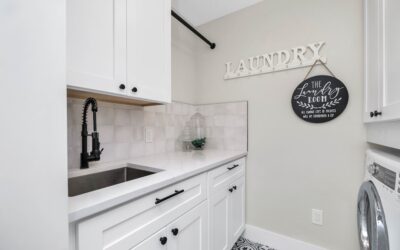
The laundry room is a workspace, and like any workspace it needs to be well lit to function. Good laundry room lighting lets you spot stains, read care labels, match socks, and fold neatly without squinting, while poor lighting turns a small chore into an eye-straining hassle. Yet lighting is often an afterthought in this hardworking room, with a single dim bulb left to do a job that really calls for a layered plan.
This guide covers how much light a laundry room needs, the best fixture types, the right brightness and color temperature, and layout ideas for rooms of every size so you can turn a dark corner into a bright, efficient space.
- How Much Light a Laundry Room Needs
- Choose the Right Color Temperature
- Best Fixture Types
- Layer Your Lighting
- Layout Ideas by Room Size
- Energy Efficiency and Bulbs
- Common Lighting Mistakes
- Budgeting Your Lighting
- Natural Light and Windows
- Switches, Controls, and Placement
- Lighting for Small and Windowless Rooms
How Much Light a Laundry Room Needs
Laundry rooms are task-oriented, so they need more light than a hallway or closet. Lighting is measured in lumens for brightness and foot-candles for how much light lands on a surface. A laundry room should target roughly 70 to 80 lumens per square foot, higher than a living room because of the detailed visual tasks involved.
For a typical 50-square-foot laundry room, aim for around 4,000 lumens total spread across your fixtures. Concentrate extra light over the folding counter, the sink, and the machines where you actually work.
Choose the Right Color Temperature
Color temperature, measured in Kelvin, changes how a space feels and how well you see detail:
- 2700K to 3000K (warm white): cozy and yellow-toned, better for living spaces than task areas.
- 3500K to 4000K (neutral white): a clean, balanced light that is ideal for laundry tasks.
- 5000K (daylight): crisp and blue-white, excellent for spotting stains and matching colors accurately.
For laundry work, neutral to daylight in the 4000K to 5000K range is best because it renders colors truthfully, helping you treat stains and match fabrics. Look for a high color rendering index, ideally 90 or above, for the most accurate color.
Best Fixture Types
Different fixtures solve different problems, and the best laundry rooms combine several.
- Recessed can lights: clean, unobtrusive, and great for even overall illumination, especially in rooms with low ceilings.
- Flush or semi-flush mounts: a simple, affordable ceiling fixture for general light in smaller rooms.
- LED flat panels or wraparound fixtures: bright, broad, shadow-free light that suits a utility space.
- Under-cabinet lighting: LED strips or pucks that light the countertop directly for folding and stain treatment.
- Pendant lights: a decorative touch over a folding island or sink in larger laundry rooms.
Layer Your Lighting
The secret to a well-lit laundry room is layering three types of light rather than relying on one source.
Ambient Lighting
This is your general, overall light, usually from ceiling fixtures or recessed cans. It fills the room and eliminates dark corners so you can move safely.
Task Lighting
This targets the work zones: under-cabinet strips over the counter, a bright fixture above the machines, and focused light at the sink. Task lighting is what lets you see fine detail and is the layer most often missing.
Accent Lighting
Optional in a laundry room, accent lighting adds style, such as a pendant over an island or a small fixture highlighting open shelving. It makes the space feel intentional rather than purely utilitarian.
Layout Ideas by Room Size
- Small closet laundry: a single bright LED flush mount or a compact panel, plus an under-shelf LED strip over the machines.
- Medium laundry room: two to four recessed cans for even ambient light, with under-cabinet lighting over the folding counter and a dedicated fixture at the sink.
- Large laundry or mudroom combo: a grid of recessed lights, a decorative pendant over a folding island, task lighting at each work zone, and possibly a window for daylight.
Energy Efficiency and Bulbs
LED is the clear choice for laundry room lighting. LEDs use up to 80 percent less energy than incandescent bulbs, last 15,000 to 25,000 hours, and run cool, which matters in a small room with a hot dryer. Choose LED fixtures or LED bulbs in your preferred color temperature, and consider fixtures with integrated LEDs for a clean look and long life.
Adding a dimmer or an occupancy sensor can boost convenience and savings. A motion sensor is especially handy in a laundry room, turning lights on automatically when your arms are full of clothes and off when you leave.
Common Lighting Mistakes
- Relying on one central bulb that casts shadows over the very surfaces you work on.
- Choosing warm, dim light that hides stains and makes color-matching hard.
- Ignoring task zones like the counter and sink where you need the most light.
- Forgetting a switch location that is easy to reach when carrying a basket.
Budgeting Your Lighting
Laundry room lighting is an affordable upgrade. A quality LED flush mount runs $30 to $80, recessed can lights cost $15 to $40 each plus installation, and under-cabinet LED strips are $20 to $60 for a kit. A full lighting refresh for an average laundry room, done as a DIY project, often lands between $150 and $400, with professional electrical work adding to that if you are moving or adding circuits.
Natural Light and Windows
Where possible, natural light is a valuable asset in a laundry room. A window not only brightens the space and helps you judge colors and stains accurately, it also provides ventilation to combat the humidity a dryer and sink generate. If your laundry room has a window, position your folding counter or work surface near it to take advantage of the daylight. For rooms without a window, a solar tube or skylight can channel daylight from the roof, and choosing daylight-temperature LEDs helps mimic the color-accurate quality of natural light. Just remember that natural light is inconsistent, so you still need strong task lighting for evenings and cloudy days.
Switches, Controls, and Placement
The best fixtures are only as convenient as their controls. Because you often enter the laundry room with your arms full, place the switch where you can reach it easily, ideally right at the door. Consider these control upgrades:
- Motion sensors that turn lights on automatically when you walk in and off when you leave, saving energy and hands-free hassle.
- Dimmers to soften the light when you are just passing through and brighten it for detailed work.
- Separate switches for ambient and task lighting so you can use only what you need.
- Smart switches for scheduling or voice control if the room is part of a connected home.
Lighting for Small and Windowless Rooms
Many laundry areas are tucked into closets, basements, or interior rooms with no natural light, which makes fixture choice even more important. In these spaces, prioritize bright, high-lumen LED fixtures and lighter wall and cabinet colors that reflect light around the room. A single flush mount is rarely enough; add under-cabinet or under-shelf strips directly over the work surface to eliminate the shadows your own body casts when you stand at the counter. In a basement laundry, extra lumens and a daylight color temperature counteract the naturally dim, cave-like feel and make the space genuinely pleasant to work in.
Thoughtful laundry room lighting transforms a dim, frustrating chore space into a bright, efficient workroom. Aim for around 70 to 80 lumens per square foot, choose neutral to daylight LEDs with good color rendering, and layer ambient and task lighting so every surface is clearly lit. With the right plan, even a small laundry room becomes a place where sorting, treating, and folding are genuinely easy.