Renters and homeowners stuck with neutral wall-to-wall keep asking the same question: can you put a rug over carpet without it looking like a mistake? Yes, and layering rugs on carpet is one of the fastest ways to add personality, define a seating area, or hide a stain you do not want to pay $2.50 per square foot to replace. The trick is choosing the right thickness, the right pad, and a rug that is at least 30 percent smaller than the room so the eye reads it as intentional.
- Why Designers Do It Anyway
- Choose a Flat-Weave or Low-Pile Rug
- The Right Rug Pad Changes Everything
- Sizing the Top Rug Correctly
- Color and Pattern Pairing
- Furniture Placement Over the Layer
- Cleaning and Maintenance
- Common Mistakes to Avoid
- Budget Tiers for Quality Layered Rugs
- Indoor-Outdoor Layered Looks for Sunrooms
Why Designers Do It Anyway
Pottery Barn, West Elm, and Restoration Hardware photo shoots all layer rugs on carpet because broadloom alone reads flat. A flat-weave kilim over plush nylon adds visual depth, anchors furniture, and creates a clear conversation zone in an open-concept living room. In rentals, this is often the only way to introduce real color and pattern without violating the lease.
Choose a Flat-Weave or Low-Pile Rug
Layering only works when the top rug sits flat. Avoid shag, sherpa, or anything thicker than 1/2 inch on the pile. Look for hand-knotted wool from Loloi, jute from Safavieh, or vintage-style Persians from Annie Selke that run between 1/8 and 3/8 inch thick. Karastan and Surya both publish exact pile heights on their product pages, which is more useful than guessing from a thumbnail.
If the underlying carpet is already medium-pile Berber or frieze, lean toward a stiffer flat-weave that will not ripple. Soft over soft creates bunching that catches every chair leg.
The Right Rug Pad Changes Everything
This is where most DIYers fail. A standard felt-and-rubber pad designed for hardwood will slide on carpet and the rug will creep toward the door within a week. You need a carpet-to-carpet gripper pad, sometimes labeled “rug-on-carpet” or “non-slip for carpet.” RugPadUSA’s Carpet Lock and Mohawk’s Dual Surface are two reliable options at $1.50 to $2.50 per square foot. The pad uses tiny PVC or polyester loops that hook into the broadloom fibers.
Skip the cheap waffle pads from Amazon. They flatten in three months and leave a rectangular dent in the carpet you will see when the rug moves.
Sizing the Top Rug Correctly
The cardinal rule: leave 12 to 24 inches of carpet visible around all four sides of the rug. A 9 by 12 area rug works in most 13 by 16 living rooms. In bedrooms, position an 8 by 10 so it covers two thirds of the bed and extends 18 inches beyond each side. If the rug runs all the way to the baseboards, it looks like you tried to install wall-to-wall on top of wall-to-wall, which never reads well.
- Living room with sectional: 9 by 12, front legs of furniture on the rug
- King bedroom: 8 by 10 under the lower two thirds of the bed
- Dining room: 8 by 10 minimum, table 24 inches inside the edge
- Home office: 5 by 7 under desk and chair
Color and Pattern Pairing
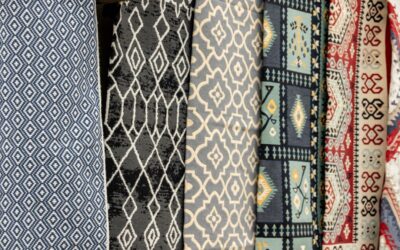
Wall-to-wall carpet is almost always neutral, which gives you wide latitude on top. A high-contrast pattern, like a black-and-cream Moroccan diamond, energizes a beige room. Tonal pairings, such as a slate blue kilim over light gray frieze, feel more sophisticated and read better on resale. Avoid putting two busy patterns together; pick one hero piece and let the carpet be the quiet base layer.
Furniture Placement Over the Layer
Heavy furniture stabilizes a layered rug. Place at least the front legs of your sofa and accent chairs on the rug to lock it in. Floor lamps and bookcases work too, but avoid putting bar carts or rolling office chairs on the layered rug, since wheels will eventually push it out of alignment. For dining rooms, all four legs of the table and chairs should sit on the rug even when the chairs are pulled out, which is why 8 by 10 is the minimum size.
Cleaning and Maintenance
Lift the rug every three months and vacuum both sides. Dust mites and dander collect between the layers, particularly with wool. Spot-clean spills on the top rug immediately using a soft cloth and lukewarm water; if it soaks through, blot the carpet underneath with a paper towel and run a small fan for 30 minutes to prevent mildew. Once a year, take the top rug outside, beat it with a broom handle, and let it air for an hour in the sun.
Wool rugs from Loloi or Surya should be professionally cleaned every two to three years for around $4 per square foot, never put in a washing machine.
Common Mistakes to Avoid
Three habits ruin the look. First, oversized rugs that crowd the baseboards. Second, mismatched textures, like fuzzy shag over plush carpet, which create static and bunching. Third, skipping the pad entirely, which guarantees a tripping hazard and a wrinkled rug within a week. Take an extra weekend to measure, order the right pad, and confirm the rug specs before clicking buy. Layering rugs on carpet looks effortless when it is done right and obvious when it is not.
Budget Tiers for Quality Layered Rugs
Entry-level flat-weaves under $300 work for rentals and starter homes. Look at Ruggable washable rugs ($250 for 8×10), Rugs USA hand-loomed jutes ($199 to $399), and Target’s Threshold collection ($150 to $250). Mid-tier from $400 to $900 covers Loloi Magnolia Home, Surya Hauteloom, and Annie Selke Dash and Albert flat-weave indoor-outdoors that read like an heirloom. Premium hand-knotted wool Persians from Revival Rugs or one-of-a-kind vintage finds from Etsy run $1,200 to $4,500 and become generational pieces. Match the spend to the room: high-traffic family rooms warrant a synthetic blend that survives spills, while formal living rooms can carry the cost of wool.
Indoor-Outdoor Layered Looks for Sunrooms
Sunrooms and screened porches with indoor-outdoor carpet take well to layered jutes and polypropylene flat-weaves. The synthetic fibers shed water from spills and resist UV fading from direct sunlight. Fab Habitat and NuLoom both publish UV ratings for their outdoor lines; look for at least 500 hours of accelerated weathering before pattern fade. Use the same Carpet Lock pad as indoor installations, then sweep both layers monthly with a stiff broom to prevent grit from grinding into the base carpet.