
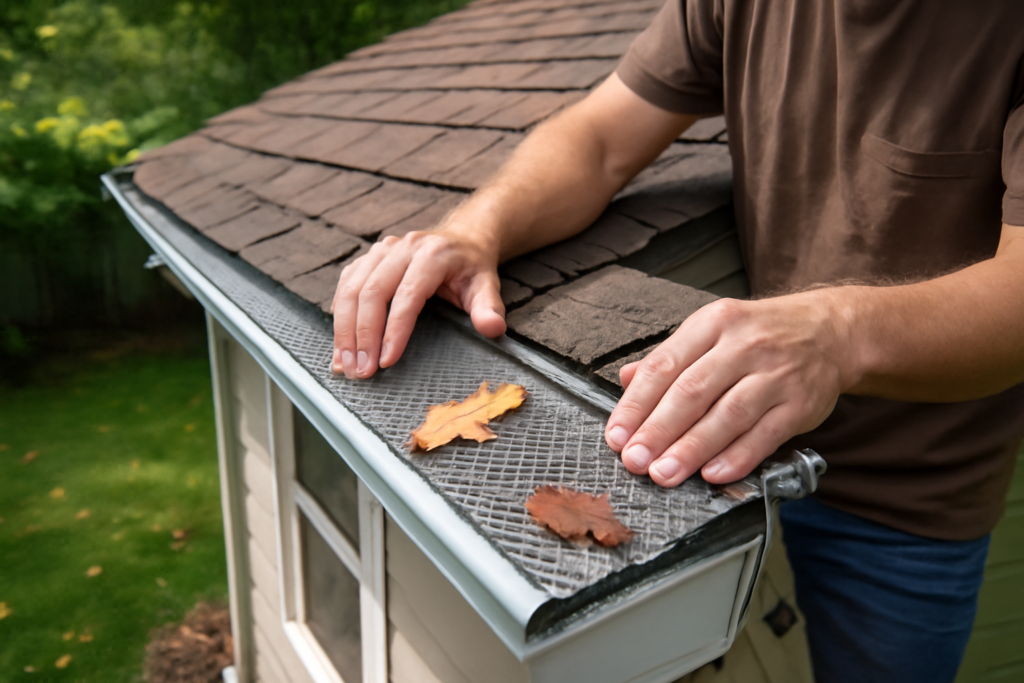
Cleaning gutters is one of the most dreaded and dangerous chores a homeowner faces, which is exactly why Leaf Relief gutter guards have become a popular fix. Made by Amerimax, Leaf Relief is an aluminum micro-perforated gutter cover designed to keep leaves, pine needles, and debris out while letting rainwater flow through. Unlike flimsy screen inserts, it is a rigid panel that attaches to the gutter and roof edge, promising to end the twice-a-year ladder ritual. This guide explains how the system works, what it costs, how it is installed, its real strengths and weaknesses, and the mistakes that undermine any gutter guard.
Part of our Roofing guide — explore the full guide →
- How Leaf Relief Works
- Key Features
- What Leaf Relief Gutter Guards Cost
- Professional vs. DIY Installation
- The Advantages
- The Drawbacks
- How It Compares to Other Guard Types
- Common Mistakes to Avoid
- Maintenance Expectations Over Time
- Comparing Leaf Relief to Premium Systems
- Are Leaf Relief Gutter Guards Worth It?
How Leaf Relief Works
Leaf Relief uses a solid aluminum panel stamped with thousands of tiny raised perforations. Water passes down through these micro-holes into the gutter, while leaves and larger debris ride over the surface and blow or wash off the roof edge. The raised dimple pattern is meant to reduce surface tension so water drops through rather than sheeting over the edge, and the small hole size blocks even fine material better than a wide-mesh screen. Because the panel is rigid aluminum, it does not sag into the gutter the way plastic screens can, and it will not rust.
Key Features
- Aluminum construction: Rust-proof and more durable than plastic, standing up to sun and freeze-thaw cycles.
- Micro-perforated surface: Thousands of small holes admit water while excluding leaves, seeds, and most pine needles.
- Fits standard gutters: Designed for common 5-inch K-style gutters, with versions for 6-inch as well.
- Low profile: It sits nearly flush, so it is unobtrusive from the ground compared to bulky reverse-curve systems.
- Debris-shedding design: The flat, hole-punched top lets wind and rain carry debris off rather than letting it collect.
What Leaf Relief Gutter Guards Cost
Pricing depends heavily on whether you install it yourself or hire a pro. As a DIY material, Leaf Relief panels run roughly $2 to $4 per linear foot. For an average home with about 150 to 200 linear feet of gutter, materials alone might total $400 to $800. Professional installation, often bundled with a gutter inspection and cleaning, typically brings the total to $8 to $20 per linear foot installed, or roughly $1,500 to $4,000 for a whole house. That is more than cheap DIY screens but less than premium branded reverse-curve systems that can exceed $30 per foot.
Professional vs. DIY Installation
Leaf Relief is available both through professional installers and, in similar Amerimax products, at home improvement stores for DIYers. Installation involves cleaning the gutters thoroughly, then securing the panels so they rest on the gutter and tuck under the first course of shingles or attach to the gutter lip, depending on the version. A confident homeowner comfortable on a ladder can install snap-in or screw-down panels, but the job means repeated ladder work along the entire roofline, which is where most gutter accidents happen. Many people who could technically do it still hire out the install to avoid the height risk and to get a workmanship warranty. If you DIY, secure ladder footing, work with a spotter, and never overreach.
The Advantages
- Far less cleaning: You will rarely need to scoop out gutters, though no guard is truly maintenance-free.
- Durability: Aluminum outlasts plastic screens and foam inserts, which degrade in UV light within a few years.
- Fine-debris blocking: The micro-holes handle small material better than open mesh, including many pine needles and seed pods.
- Fire resistance: Metal guards are safer than plastic or foam in wildfire-prone regions where embers can ignite debris.
- Discreet look: The low-profile panel is nearly invisible from the street.
The Drawbacks
- Fine grit can accumulate on top. Shingle grit, dust, and pollen can build a film over the perforations, so occasional brushing off the top surface is still needed.
- Heavy rain overflow. In torrential downpours, the small holes can limit intake and let some water sheet over the edge if the surface is dirty.
- Not fully maintenance-free. Debris that lands on top must blow or wash off; sticky wet leaves or a lot of tree litter may still require periodic clearing.
- Cost. It is a meaningful investment compared to simple screens.
How It Compares to Other Guard Types
Gutter guards fall into a few families. Foam inserts and plastic screens are cheap but short-lived and clog with fine debris. Wide mesh screens block big leaves but let needles through. Reverse-curve or surface-tension covers (the premium branded systems) use a solid hood and a curved lip to direct water in, and they cost the most. Micro-perforated aluminum panels like Leaf Relief sit in a strong middle ground: better fine-debris control than screens, more durable than plastic, and less expensive than reverse-curve hoods. For most homes with typical tree cover, that balance is attractive.
Common Mistakes to Avoid
- Installing over clogged gutters. Always clean and flush the gutters and downspouts first; guards trap existing debris underneath if you skip this.
- Ignoring downspouts. Guards keep the trough clean but debris and grit can still reach downspouts. Add downspout screens or strainers.
- Assuming zero maintenance. Plan on an annual look and an occasional brush-off of the panel surface, especially under pines and oaks.
- Poor roof pitch matching. On very steep or very flat roofs, water behavior changes; confirm the product suits your slope.
- Unsafe ladder work. If you are not fully comfortable and secure at height, hire a professional. No gutter guard is worth a fall.
Maintenance Expectations Over Time
No gutter guard is truly install-and-forget, and setting realistic expectations prevents disappointment. With Leaf Relief, the gutters themselves stay remarkably clean, but the top surface of the aluminum panel can accumulate a film of shingle grit, pollen, and fine organic dust over a season or two, especially under heavy tree cover. Left alone, this film can slowly reduce how freely water drops through the micro-perforations. The fix is simple: once or twice a year, use a soft brush on an extension pole or a gentle rinse from a hose to clear the top surface. This is a fraction of the effort of scooping wet leaves out of an open gutter, and it can often be done from the ground or a stable ladder in minutes. Under pine trees, plan to check the panels more often, since fine needles and sap can be stickier. Also inspect the downspouts each year, because while the guard keeps the trough clean, fine grit can still work through and settle in the downspout over time.
Comparing Leaf Relief to Premium Systems
It is worth understanding where Leaf Relief sits in the broader market. The most expensive professionally installed systems use ultra-fine stainless steel micro-mesh and carry lifetime transferable warranties, often costing two to four times as much as an aluminum micro-perforated panel like Leaf Relief. Those premium systems block even finer debris and shift the maintenance burden almost entirely to the installer’s warranty. Leaf Relief, by contrast, offers most of the debris-blocking benefit of the premium category at a substantially lower price, particularly if you install it yourself or bundle it with a routine gutter service. For a homeowner weighing cost against performance, it occupies an attractive middle ground: far more capable and durable than cheap plastic screens or foam inserts, yet much friendlier to the budget than the top-tier branded micro-mesh systems that dominate late-night advertising.
Are Leaf Relief Gutter Guards Worth It?
For a homeowner tired of the ladder and living around leafy or needle-dropping trees, Leaf Relief offers a durable, low-profile, aluminum solution that drastically cuts cleaning without the premium price of hooded systems. It is not magic; the top surface still needs an occasional brush and heavy storms can challenge any guard. But as a long-lasting, fine-debris-blocking cover that protects your gutters and your weekends, it earns its place. Budget for professional installation if height makes you nervous, keep the downspouts clear, and plan a quick annual check, and Leaf Relief will keep water flowing where it should for many years.


