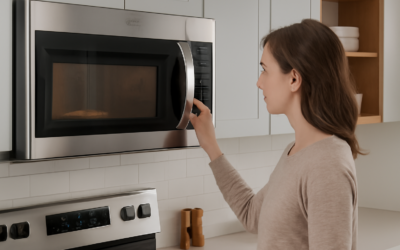
An LG microwave over the range does double duty — it heats your food and vents your cooktop — which makes it one of the more demanding appliance purchases in the kitchen. LG builds some of the better OTR microwaves on the market, with strong sensor cooking and a few genuinely useful venting tricks, but the model you pick has to match your ductwork, your cabinet opening, and how you cook. Here’s the full breakdown.
The over-the-range format saves counter space by mounting the microwave to the wall and underside of the upper cabinet above your range. That’s efficient, but it means the unit also has to handle steam and smoke from cooking below — so venting is the first thing to nail down.
Venting: The Part Most People Get Wrong
Every LG over-the-range microwave has a built-in exhaust fan, but how it vents depends on your kitchen. There are three configurations, and the unit can be set up for all three.
Ducted vertical sends air up through the cabinet and out the roof — the most effective option. Ducted horizontal pushes air out through the back wall to an exterior side vent. Recirculating (ductless) filters the air through a charcoal filter and blows it back into the kitchen — used when there’s no duct path. Recirculating removes some odor and grease but can’t handle heat and humidity the way ducted does, so duct it if you possibly can.
LG rates fan airflow in CFM, typically 300 to 400 CFM on standard models and up to 400-plus on higher-end units. For heavy cooking, higher CFM plus a true ducted setup makes a real difference. Match the CFM to your cooking style, not just the price.
ExtendaVent and LG’s Venting Edge
LG’s standout feature is ExtendaVent 2.0, a front-positioned vent grille that pulls steam and smoke from the front burners — the ones a standard OTR microwave struggles to capture because its intake sits at the back. Anyone who cooks on the front burners (most of us) notices the improvement. If venting performance matters to you, prioritize an LG model with ExtendaVent.
The filters are also worth knowing: aluminum mesh grease filters slide out for dishwasher cleaning (do it monthly), and if you run recirculating, a charcoal filter behind the grille needs replacing every 6–12 months.
Sizes and Capacity
OTR microwaves come in a standard 30-inch width to match typical range and cabinet openings, and most LG models run 1.7 to 2.0 cubic feet of interior capacity. Larger capacity means you can fit bigger dishes and casserole pans, useful for families. Wattage typically lands around 1,000 watts on standard units — enough for fast, even heating — with higher-wattage models cooking quicker.
Interior height matters if you reheat tall items; check that a standard dinner plate and your usual containers fit on the turntable. Some LG models offer a larger turntable diameter that accommodates oversized plates.
Features Worth Having
LG loads its OTR microwaves with features, and a few are genuinely useful day to day:
- Sensor Cook — humidity sensors detect when food is done and adjust time automatically, so popcorn and leftovers stop guessing games.
- EasyClean interior — a smooth coating that wipes down without scrubbing.
- Convection (on select models) — adds true baking and roasting, effectively a second oven overhead. Great for small kitchens.
- Cooktop LED lighting — brighter, longer-lasting task light over the range than the old incandescent bulbs.
- Smart/WiFi (ThinQ) — remote controls and scan-to-cook. Nice, not essential.
Sensor Cook and, if you cook a lot, convection are the ones that change how you actually use the appliance.
Installation Specs and Clearances
OTR microwaves have strict clearance requirements for fire safety. The standard is a minimum of 30 inches between the cooktop surface and the bottom of the microwave (measured from the cooking surface, not the burner grates), though LG’s install manual is the authority for your specific model. Too low and you risk heat damage and code violations; too high and you can’t reach the controls or turntable comfortably.
The cabinet opening is a standard 30 inches wide, and the microwave mounts to a wall plate anchored into studs plus bolts through the cabinet above. You’ll need a grounded 120-volt outlet inside the upper cabinet, and if you’re ducting, the duct path (vertical or horizontal) and correct blower orientation set during install. This is a two-person job — these units weigh 60-plus pounds and you’re lifting overhead. If you’re replacing a like-for-like unit, it’s a doable DIY; a new duct run is a job for a pro.
Recommended LG Models
LG’s lineup spans budget to premium. Entry models around $300–$400 cover the basics — 1.7–2.0 cubic feet, 300 CFM, sensor cook. Mid-range units near $400–$550 add ExtendaVent 2.0, EasyClean, and higher CFM. Premium models $600 and up bring convection cooking, ThinQ smart features, and the largest capacities.
Also weigh capacity against your cabinets: if you frequently reheat large casserole dishes, prioritize a 2.0-cubic-foot interior with a larger turntable, and confirm a full dinner plate clears the roof of the cavity. Wattage matters for speed — a 1,000-watt unit heats noticeably faster and more evenly than an 800-watt one, worth the small premium if you use the microwave heavily.
For most households, a mid-range LG with ExtendaVent 2.0 and Sensor Cook hits the sweet spot — you get LG’s best venting feature and the automation that matters without paying for convection you may not use. If your kitchen is short on oven space, though, a convection OTR model earns its premium.
Common LG OTR Problems and Fixes
A few issues come up often enough to know before you buy. If the microwave runs but doesn’t heat food, the magnetron or a high-voltage component may have failed — that’s a repair, not a DIY fix, because OTR microwaves store a lethal charge in the capacitor even when unplugged. Never open the cabinet; call a technician. A more common and harmless complaint is a weak-seeming exhaust fan, which usually just means a grease-clogged aluminum filter. Pull it and run it through the dishwasher monthly and airflow returns.
Touchpad or display glitches often clear with a simple reset — unplug the unit for a minute, or flip its breaker. If the turntable stops rotating, the drive motor or coupler is the cheap culprit. And if the cooktop light or interior bulb dies, most LG models use accessible LED or standard bulbs you can swap yourself. Knowing which problems are DIY and which demand a pro (anything inside the high-voltage cabinet) keeps you safe and saves needless service calls.
Cleaning and Filter Maintenance
Two filters keep an LG over-the-range microwave working well, and neglecting them is the top reason venting degrades. The grease filters — aluminum mesh panels on the underside — slide out and go straight in the dishwasher; clean them monthly, more if you fry often. Caked filters choke airflow and force the fan to work harder, and grease-laden filters near a hot cooktop are a fire risk.
If your unit runs in recirculating (ductless) mode, there’s also a charcoal filter behind the vent grille that absorbs odors. It can’t be washed — replace it every 6 to 12 months, or sooner with heavy cooking, since a saturated charcoal filter stops removing odor entirely. Inside, LG’s EasyClean coating wipes down with a damp cloth and a little mild cleaner; skip abrasive pads that scratch the interior. Ten minutes of filter maintenance a month keeps both the cooking and the venting performing like new.
The Bottom Line
An LG microwave over the range is a smart pick when you want to reclaim counter space and get solid cooktop venting in one appliance. Sort out your venting configuration first — ducted beats recirculating every time — and lean toward a model with ExtendaVent 2.0 if you cook on the front burners. Match the 30-inch width and 30-inch clearance to your setup, prioritize Sensor Cook, and consider convection if you’re tight on oven capacity. Do that, and you’ll get an OTR microwave that heats fast and keeps your kitchen air clear for years.