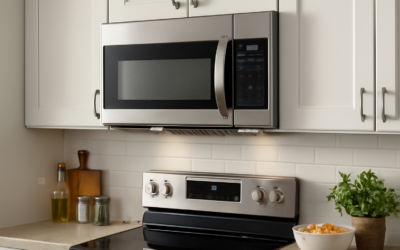
A Whirlpool over the range microwave does two jobs at once: it heats your food and it vents your cooktop, all while freeing up counter space. That combo is why it is one of the most common upgrades in American kitchens.
Before you buy or attempt a swap, there are real specifics you need to know about sizing, venting, wiring, and the weight of the unit. Here is what a tech looks at before touching one.
Why Over-the-Range Instead of Countertop
The obvious win is space. Mounting the microwave above the range clears the counter and puts the appliance right where you already stand to cook. The second win is ventilation. An over-the-range unit includes a built-in fan and light, so it replaces a separate range hood and handles steam, smoke, and grease from the burners below.
The tradeoff is height. The bottom of the microwave should sit 66 inches above the finished floor, or roughly 13 to 18 inches above the cooktop, which puts the controls up near eye level and the cavity higher than a countertop model. Shorter cooks sometimes find reaching a hot dish awkward.
Standard Sizes and Fit
Whirlpool builds these to industry-standard widths so they drop into typical cabinet openings.
- Width: 29 7/8 inches, sized for a 30-inch cabinet opening. This is the near-universal standard.
- Height: roughly 16 to 17 inches.
- Depth: 15 to 16 inches for the body, plus the handle.
- Capacity: most models run 1.7 to 1.9 cubic feet, enough for a large dinner plate or a 9-by-13 dish turned sideways.
Because the width is standardized, a Whirlpool unit usually replaces another brand’s over-the-range microwave without cabinet modification. Measure your opening anyway, since older kitchens occasionally used odd framing.
Wattage and Cooking Power
Most Whirlpool over-the-range models deliver 1,000 watts of cooking power, with some stepping up to 1,100 watts. That is enough to reheat, defrost, and cook packaged foods at full speed. Higher wattage means faster and more even heating, so if you cook from frozen often, look for the 1,000-watt-and-up models rather than a budget unit in the 700 to 900 range.
Convenience features vary by model and include sensor cooking that measures steam and shuts off automatically, steam and dinner-plate presets, and a “keep warm” setting. Some units add convection or air-fry-style modes, which raise the price.
Venting: Recirculating vs. Ducted
The fan can move air two ways, and this is the decision most people get wrong.
- Ducted (vented outside): the fan pushes air through ductwork to the exterior. This is the better option because it removes heat, moisture, and grease from the house entirely. Whirlpool over-the-range units typically move 300 to 400 CFM, and the discharge can be routed vertically through the cabinet or horizontally through the back wall.
- Recirculating (ductless): air passes through a charcoal filter and blows back into the kitchen. Use this only when running a duct is impossible. It captures some odor and grease but does nothing about heat or humidity.
Most units ship configured to recirculate, so if you have existing ductwork you will need to reposition the internal blower and add a charcoal-filter or vent kit as appropriate. Check which duct direction your kitchen uses, 3 1/4-by-10-inch rectangular or round, before ordering adapters.
Electrical Requirements
A Whirlpool over-the-range microwave needs a dedicated 120-volt, 20-amp circuit serving only the microwave, with a properly grounded three-prong outlet located in the cabinet directly above the unit. Do not share this circuit with the refrigerator, disposal, or countertop outlets. A microwave drawing 12 or more amps on a shared circuit will trip the breaker or, worse, run a chronically overloaded line.
If your kitchen only has a shared circuit above the range, plan on an electrician running a new home run to the panel. That work typically costs $200 to $600 depending on the panel distance and wall access. Never hardwire or use an extension cord for this appliance.
Installation: Weight and the Two-Person Rule
This is the part homeowners underestimate. A Whirlpool over-the-range microwave weighs roughly 55 to 70 pounds, and you have to lift that weight to shoulder height and hold it in place while starting mounting bolts. This is a genuine two-person job. One person supports the unit while the other threads the top-cabinet bolts through the microwave’s keyhole bracket. Attempting it solo is how people drop a $400 appliance and strain their back.
The basic sequence looks like this:
- Turn off power at the breaker before removing the old unit.
- Mount the wall plate that ships with the microwave to the studs behind the range, using a level and locating at least two studs.
- Set the grease filters and confirm the blower is oriented for your venting choice, ducted or recirculating.
- With a helper, lift the unit, hook it onto the wall plate’s bottom tabs, tilt it up, and start the two bolts that go up through the cabinet floor.
- Plug into the dedicated outlet, restore power, and run the fan and a cup of water to confirm operation.
Professional installation runs $100 to $250 if the circuit and duct already exist. Given the weight and the overhead work, many homeowners find that money well spent.
Measuring Before You Buy
A five-minute measuring session prevents the most common return. Check the cabinet opening width, which should be right around 30 inches, and the height of the gap between the top of your range and the bottom of the upper cabinet. Building code and Whirlpool both call for a minimum of 13 inches of clearance above an electric cooktop and typically 18 inches above gas, measured from the cooktop to the bottom of the microwave.
Also confirm three things behind the wall: that a duct opening exists if you plan to vent outside, that the electrical outlet sits in the cabinet above, and that the wall framing gives the mounting plate at least two studs to bite into. Locate the studs with a magnetic or electronic finder and mark them before you lift anything. Getting these numbers on paper first turns install day into a smooth swap instead of a scramble to the hardware store.
What It Costs
Whirlpool over-the-range microwaves generally run $250 to $650. Entry models around $250 to $350 give you 1.7 cubic feet, 1,000 watts, and basic venting. Mid-range units at $400 to $500 add sensor cooking, brighter LED cooktop lighting, and better fans. Premium models near $600 and up bring convection, larger capacity, and fingerprint-resistant stainless finishes.
Maintenance and Common Fixes
Two maintenance items keep the vent working. Wash the aluminum mesh grease filters every month in hot soapy water or the dishwasher, and replace the charcoal filter every 6 to 12 months if you run recirculating mode. A clogged grease filter is the most common reason the fan seems weak.
If the turntable stops spinning, the drive coupler or motor is usually the culprit and both are inexpensive parts. A microwave that runs but does not heat points to a failed magnetron or high-voltage diode, which is a repair to leave to a qualified tech because the capacitor holds a dangerous charge even when unplugged. When you weigh a magnetron repair against a $300 replacement on an older unit, replacement often wins.
Getting the Most From the Vent
The venting side of an over-the-range microwave is the part homeowners forget about, and it is the part that protects your cabinets and paint from grease film. Get in the habit of switching the fan on before you start searing or boiling, not after the smoke alarm goes off. Running it a couple of minutes past the end of cooking clears the last of the steam and heat.
If you find the fan underwhelming compared to a dedicated range hood, remember the tradeoff you accepted: an over-the-range microwave prioritizes the microwave cavity, so its blower and CFM sit below what a standalone hood delivers. For most home cooking that is plenty, but a serious gas range that puts out heavy smoke may be better served by a true range hood plus a countertop or built-in microwave elsewhere. Match the appliance to how hard you actually cook, and confirm the ducted configuration is set up correctly, and a Whirlpool over-the-range microwave earns its spot above the stove.