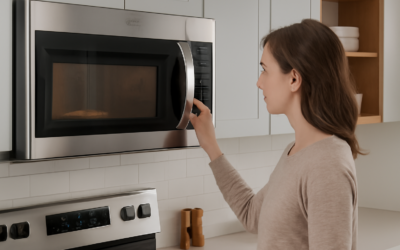
A low profile over the range microwave solves one nagging problem: the standard over-the-range unit is roughly 16 to 17 inches tall and eats the clearance you need over the burners. Drop in a low profile over the range microwave and you get a slim box around 10 inches tall that tucks under a standard 30-inch or 36-inch upper cabinet without leaving you crouching to see your front burners.
What “Low Profile” Actually Means
Manufacturers use the term loosely, so measure. A conventional OTR microwave stands about 16.4 inches tall. Low profile models come in around 10.2 to 10.25 inches. That saved six inches goes straight into clearance between the cooktop and the bottom of the microwave.
Building codes and manufacturer specs typically require a minimum of 13 inches from the cooktop to the bottom of the microwave, with 24 inches being the comfortable target on a standard install. Because a low profile unit is shorter, you can mount it higher on the wall while keeping the top flush with your 30-inch-high upper cabinets. The result: more headroom over a tall stockpot and a clearer sightline to the burners.
The Trade-Off: Ventilation
Here is the honest part no showroom sign tells you. Nearly every low profile OTR microwave vents by recirculation only, pushing air through a charcoal filter and back into the room. Blower ratings land around 300 to 400 CFM, which is respectable on paper, but recirculating air does not remove heat, grease, or moisture from the kitchen the way ducted exhaust does.
Standard-height OTR units can often be ducted vertically through the cabinet or horizontally through the back wall to the outside. Low profile models generally cannot. The slim body simply does not have room for a top damper and duct transition. If you cook with heavy grease, sear steaks, or run a gas range that dumps combustion byproducts and humidity into the room, a recirculating microwave is a real compromise.
When Recirculation Is Fine
- Apartments and condos where running a new duct to an exterior wall is impossible.
- Interior kitchen walls with no practical path outside.
- Light-to-moderate cooking: reheating, boiling, occasional sauté.
When You Should Reconsider
- Serious gas cooking above 15,000 BTU per burner.
- Frequent frying, wok work, or high-smoke searing.
- Any situation where you can duct to the outdoors and want to actually remove heat and moisture.
The Main Models Worth Knowing
Two brands dominate this niche, and their spec sheets tell the story.
GE JVM6172 and GE Profile PVM9005
The GE JVM6172 is the value pick, usually $310 to $400. It runs about 1.6 cubic feet of interior space, a 1,000-watt cooking element, and a 300 CFM recirculating vent with a two-speed fan. It measures roughly 10.2 inches tall by 29.9 inches wide. The GE Profile PVM9005 steps up to sensor cooking, a 400 CFM blower, and a cleaner control panel for around $500 to $650. Both are recirculating only.
Whirlpool Low Profile WML55011H and WML75011H
Whirlpool’s low profile line runs about 1.1 cubic feet, which is noticeably smaller inside, so a large dinner plate can be tight. The WML55011H lists a 300 CFM recirculating fan and 1,000 watts, priced near $350 to $450. The WML75011H adds a scan-to-cook feature and steam functions. Both stand around 10.25 inches tall and 29.9 inches wide.
Measure Before You Buy
A low profile microwave only earns its keep if it fits your opening cleanly. Grab a tape measure and confirm four numbers:
- Width: Standard OTR cutouts are 30 inches. The microwave body is about 29.9 inches, so you have almost no play. Verify the cabinet opening is a true 30 inches.
- Height of the opening: The gap between the cooktop and the bottom of your upper cabinet must accommodate the roughly 10-inch body plus your required clearance above the range.
- Depth: These units project 14 to 15 inches from the wall and typically sit around 12.5 inches deep with the door closed. Make sure it does not crowd your back burners.
- Cabinet depth above: The mounting hardware and vent path use the cavity behind and above. Confirm your 12- or 13-inch-deep upper cabinet clears the top of the unit.
Installation Realities
Swapping a standard OTR unit for a low profile model is a two-person job that runs about two hours if the electrical and mounting plate cooperate. You need a dedicated 120-volt, 20-amp circuit with a grounded outlet, almost always located inside the cabinet directly above the microwave. If your old unit was ducted to the outside, you will cap or leave that duct unused, since the low profile replacement recirculates.
The mounting plate bolts to wall studs, and at least one lag screw must hit solid framing because the unit weighs 45 to 55 pounds and carries a hot cooktop below it. Do not shortcut the anchoring. The top of the unit also secures with screws driven down through the cabinet bottom into the microwave’s mounting tabs.
Vent Direction Setup
Even on recirculating models, you set the blower orientation during install so air routes up through the top grille and back into the room. Follow the included template; getting the charcoal filter seated correctly is what keeps the recirculated air from smelling like last night’s fish.
Filters and Maintenance
A recirculating unit lives and dies by two filters. The metal grease filters on the underside slide out and go in the dishwasher; clean them monthly if you cook often. The charcoal filter behind the top grille handles odor and should be replaced every 6 to 12 months, sooner with heavy cooking. Charcoal filters run $15 to $30. Skip this and the microwave stops doing the one ventilation job it has.
Alternatives to Consider
If ventilation matters more than the microwave, a shallow under-cabinet range hood ducted outside plus a countertop microwave often beats a recirculating OTR unit. You get real exhaust, typically 300 to 600 CFM ducted, and you free up the wall for a proper hood. The downside is losing counter space and the tidy built-in look.
Another route is a microwave drawer mounted below the counter paired with a dedicated hood above the range. It costs more, $800 to $1,500 for the drawer alone, but it separates the two functions so neither is a compromise.
Power, Wattage, and Cooking Performance
Do not confuse the blower CFM with cooking wattage; they are separate systems. Most low profile OTR microwaves deliver 1,000 watts of cooking power, which is standard for the category and enough to reheat, defrost, and cook packaged meals at full speed. The smaller-cavity Whirlpool models at 1.1 cubic feet fit a standard dinner plate but struggle with an oversized casserole dish, so measure your favorite baking dish before assuming it will spin freely on the turntable.
Sensor cooking, found on the GE Profile and higher Whirlpool trims, uses a humidity sensor to judge doneness and shut off automatically, which beats guessing at times. If you reheat leftovers constantly, that feature alone justifies the step-up model. Watch the interior height too: a slim exterior sometimes means a shallower cavity, so a tall travel mug may not clear the ceiling.
Cost Breakdown
- GE JVM6172: $310 to $400, 1.6 cu ft, 300 CFM, best value.
- GE Profile PVM9005: $500 to $650, sensor cooking, 400 CFM.
- Whirlpool WML55011H: $350 to $450, 1.1 cu ft, 300 CFM.
- Charcoal filter replacement: $15 to $30 every 6 to 12 months.
- Professional install: $100 to $200 if you are not doing it yourself.
The Bottom Line
A low profile over the range microwave is the right call when you want more clearance over the cooktop, a clean built-in look, and you either cannot duct outside or do not cook heavily. Expect around 10 inches of height, 300 to 400 CFM of recirculating airflow, and prices from $310 to $650. Just go in clear-eyed: you are trading real outdoor exhaust for headroom and convenience. Measure your 30-inch opening twice, confirm the circuit, and keep those filters clean, and one of these slim units will serve a normal kitchen well for years.