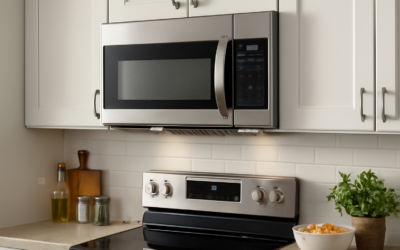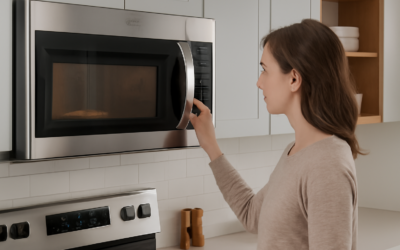
A ge over the range microwave does double duty: it reheats your leftovers and it vents your cooktop, all while freeing up the counter space a countertop unit would eat. GE is one of the two or three brands I install most in this category, and their over-the-range (OTR) lineup is deep. Here is how to pick the right one and keep it working.
- What an Over-the-Range Unit Actually Does
- Venting: CFM and Configuration
- Wattage and Cooking Power
- GE Model Tiers
- Sizing and Fit
- Installation Realities
- Common Failures
- Features Compared Across the Line
- Ducting Details That Make or Break Performance
- Maintenance That Extends Life
- Recirculating Setup Done Right
- Bottom Line
What an Over-the-Range Unit Actually Does
An OTR microwave mounts to the wall studs and the cabinet above your range, replacing a separate range hood. That means it has to handle two jobs: microwaving, and pulling smoke, steam, and grease off the cooktop. The venting side is where most people under-shop, so let’s start there.
Venting: CFM and Configuration
The exhaust rating is measured in CFM — cubic feet per minute of air moved. GE OTR microwaves range from about 300 CFM on base models to 400 CFM on better units. For reference:
- 300 CFM: Adequate for light cooking and electric cooktops.
- 350–400 CFM: What you want if you sear, fry, or run a gas cooktop that throws real heat and smoke.
Just as important is how it vents. You have three configurations:
- Vented outside (ducted): The best option. Ducts up through the cabinet and out the roof, or back through the wall. Actually removes smoke and moisture from the house.
- Recirculating (ductless): Pulls air through a charcoal filter and blows it back into the room. Use only when outside venting is impossible — it removes odor but not heat or moisture.
- GE models are convertible: most can be set up for top, rear, or recirculating exhaust, and you buy a charcoal filter kit for the recirculating mode.
Match the blower’s rotation and damper to your duct direction during install, or the vent will not draw properly.
Wattage and Cooking Power
Cooking power is rated in watts. GE OTR units run roughly 900 to 1,100 watts. Anything at 1,000 watts or above heats fast and evenly; below 900 you will notice slower reheats. Capacity ranges from about 1.6 to 2.1 cubic feet — the 2.1 cubic foot models fit a large dinner plate or a casserole dish comfortably, while 1.6 cubic foot units are tighter. If your household cooks big, spend for the larger cavity.
GE Model Tiers
- GE (base line): Around $270 to $400. Solid 1.6 to 1.9 cubic feet, 300 to 400 CFM, 1,000 watts, sensor cooking on better trims.
- GE Profile: $400 to $650. Larger cavities, 400 CFM venting, chrome or slate finishes, better sensor cooking, and often a scan-to-cook or Wi-Fi feature.
- GE Café: $600 to $900. Customizable hardware, premium finishes, the quietest blowers, and the most cooking presets.
The features I actually value: sensor cooking (measures humidity to stop reheating at the right point rather than guessing time), a bright and quiet blower, and a cavity light that is actually useful. Wi-Fi and voice control are nice-to-haves, not deciders.
Sizing and Fit
Standard OTR microwaves are 30 inches wide to match a standard range and the cabinet above it. Confirm three measurements before buying:
- Width of the cabinet opening — almost always 30 inches, but verify.
- Height clearance between the cooktop and the bottom of the microwave. Code and manufacturer specs call for a minimum clearance (typically around 30 inches from the cooktop to the microwave bottom, but follow GE’s install sheet). Too low and you risk heat damage and code violations, especially over gas.
- Duct location — top, rear, or recirculating — so you buy the right transition kit.
Installation Realities
An OTR microwave is a two-person job. It hangs on a wall mounting plate screwed into studs, with bolts coming down through the upper cabinet to carry the weight — these units run 60-plus pounds. It needs a dedicated 120-volt grounded outlet, usually located inside the cabinet above. If you are replacing a range hood, you will likely need to add that outlet and possibly reroute or add ductwork. This is doable for a confident DIYer, but the electrical outlet should be handled correctly, and over a gas range I lean toward professional installation for the clearance and gas considerations.
Common Failures
- Door switch failures: The most common fault by far. Three interlock switches confirm the door is shut; when one fails, the microwave will not start or blows a fuse. A repairable, moderately priced fix — but the internal high-voltage capacitor can hold a lethal charge even unplugged, so this repair is not for the untrained.
- Blown line fuse: Often triggered by a failing door switch or a power surge.
- Magnetron failure: The tube that makes the microwaves. Symptom is a unit that runs, lights, and turns the plate but does not heat. Replacement runs $100 to $200 installed; on a base unit, often not worth it versus replacement.
- Blower or grease filter: The aluminum mesh grease filters slide out and go in the dishwasher — clean them monthly or the blower loses draw and grease bakes onto the fan.
- Charcoal filter (recirculating mode): Replace every 6 to 12 months, or the ductless venting stops absorbing odor.
Warning worth repeating: microwave ovens store high voltage in a capacitor that can injure or kill even when unplugged. Door-switch and magnetron repairs are pro-level work unless you know how to safely discharge that capacitor.
Features Compared Across the Line
Beyond wattage and CFM, a few GE features separate the tiers and are worth knowing before you shop:
- Sensor cooking: Measures the steam a food gives off and stops when it is done rather than running a guessed time. Present on Profile and better base models. The single most useful upgrade.
- Two- or three-speed fan: A high boost speed for heavy searing versus a quiet low speed for light steam. Better units add a boost mode.
- LED cooktop lighting: Brighter, cooler, and longer-lived than the old incandescent bulbs. Profile and Café use LEDs that actually light the whole cooktop.
- Convection (on select models): A few premium GE OTR units add a convection element and fan, turning the microwave into a small second oven for baking and crisping.
- Scan-to-cook and Wi-Fi: Scan a package barcode and the microwave sets time and power. Neat, rarely essential.
Ducting Details That Make or Break Performance
The best microwave in the world vents poorly through bad ductwork. Keep the duct run short and straight, use smooth rigid metal duct rather than flexible foil, and minimize elbows — every 90-degree bend costs you meaningful airflow. Standard OTR venting uses a 3-1/4 by 10-inch rectangular duct or a round transition; match the size the install sheet specifies and seal the joints with foil tape, not screws that snag lint. If you are converting a top vent to rear or vice versa, you must reposition the internal blower to match the airflow direction, a step people skip that leaves the fan fighting itself. Get the ducting right and a 400 CFM unit performs to its rating; get it wrong and it wheezes.
Maintenance That Extends Life
Clean the mesh grease filters monthly, wipe the cavity after messy reheats, run the vent whenever you cook to keep grease off the internals, and replace the charcoal filter on schedule if you recirculate. A GE OTR microwave treated this way easily runs 8 to 10 years.
Recirculating Setup Done Right
If you genuinely cannot duct outside — an interior wall with no chase to the exterior — set up recirculating mode correctly so it does the most it can. Install the charcoal filter kit specified for your model, confirm the blower is oriented for recirculating airflow, and make sure the top grille vents are unobstructed so filtered air actually returns to the room. Replace that charcoal filter every 6 to 12 months; a saturated one stops absorbing odor entirely. Understand the limits: recirculating removes some smoke and cooking smell but does nothing for heat and moisture, so pair it with a cracked window when you cook heavy. It is a compromise for a hard layout, not a preference — duct outside whenever the structure allows.
Bottom Line
Buy a ge over the range microwave for the CFM and wattage your cooking actually demands — 400 CFM and 1,000-plus watts if you cook seriously — and duct it outside if you possibly can. Confirm the 30-inch width, the cooktop clearance, and the duct direction before you buy. Keep the grease filters clean, and it will vent your cooktop and reheat your dinners reliably for the better part of a decade.