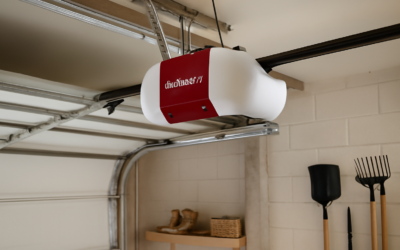
If your bedroom sits directly above the garage, the type of opener you choose matters more than the horsepower rating on the box. A LiftMaster belt drive garage door opener runs the door up and down on a reinforced rubber belt instead of a metal chain, and the difference in noise is dramatic: expect roughly 40 percent quieter operation than a comparable chain unit. That single change is why belt drives dominate new-construction homes with living space over the garage. This guide walks through the models, the specs that actually matter, real installation considerations, and what you should budget.
Part of our Garage Doors guide — explore the full guide →
- Why a Belt Drive Instead of a Chain
- LiftMaster Belt Drive Models Worth Knowing
- Understanding Horsepower and Motor Type
- What You Get in the Box
- Installation: DIY or Hire a Pro
- Pricing and Where to Buy
- Maintenance to Keep It Quiet
- Smart Features and myQ Integration
- Accessories Worth Adding
- Is It the Right Choice for You
Why a Belt Drive Instead of a Chain
Every automatic opener needs something to pull the trolley along the rail. Chain drives use a bicycle-style metal chain, which is durable and cheap but rattles and vibrates through the ceiling joists. Belt drives swap that chain for a steel-reinforced polyurethane or fiberglass belt. There are no metal-on-metal contact points, so you lose the grinding hum that defines older openers.
Homeowners consistently report the same thing after switching: they can no longer hear the door from upstairs. Beyond noise, belts require less maintenance because there is no chain to lubricate or re-tension every year. The tradeoff is a slightly higher purchase price, usually $40 to $80 more than the equivalent chain model. For a garage under a bedroom, nursery, or home office, that premium pays for itself in comfort.
LiftMaster Belt Drive Models Worth Knowing
LiftMaster organizes its lineup by a three-digit model number, and the belt drive workhorses are easy to identify once you know the pattern. Here are the units most homeowners will encounter:
- LiftMaster 8550W / 8550WLB: A DC belt drive with a built-in battery backup and a 24-volt motor. The battery backup lets the door open during a power outage, which is required by law in California and increasingly popular everywhere.
- LiftMaster 8557 / 8587W: Higher-lift and heavy-duty variants aimed at larger or insulated doors that weigh more.
- LiftMaster 87504-267 (Secure View): A newer smart model with an integrated camera and LED corner-to-corner lighting.
- LiftMaster 84501: A myQ smart belt drive with battery backup, one of the current flagship residential units.
Nearly all current belt drives ship with myQ connectivity, meaning you control and monitor the door from your phone. That app also lets you receive alerts if the door is left open and integrate with smart-home platforms.
Understanding Horsepower and Motor Type
Opener strength is marketed in horsepower or “HPS” (horsepower-similar) ratings, but the number you want to focus on is whether the motor is AC or DC. A DC motor allows soft-start and soft-stop, so the door eases into motion and slows before it lands rather than slamming. DC motors are also what make battery backup possible, since they run on lower voltage.
For a standard single door, a 1/2 HP or 3/4 HPS belt drive is plenty. Move up to 3/4 HP or higher if you have a heavy insulated door, a solid-wood carriage door, or an oversized two-car door on a single opener. Oversizing slightly extends the life of the unit because the motor never strains at the top of its range.
What You Get in the Box
A retail LiftMaster belt drive kit is fairly complete, but knowing the parts helps you judge whether you have everything before you climb the ladder. A typical kit includes:
- The motor unit (powerhead) with the belt already partially assembled
- A multi-piece rail, usually three sections that bolt together
- The trolley and belt
- Two remote controls and one wall-mounted control panel
- A pair of safety-reversing photo-eye sensors
- Mounting brackets, lag screws, and the door arm
The photo-eye sensors are federally mandated on all openers sold since 1993. They mount about six inches off the floor on each side of the door and stop the door from closing on a pet, a child, or a car bumper. If your door reverses for no reason, misaligned sensors are the number one culprit.
Installation: DIY or Hire a Pro
A confident DIYer can install a belt drive opener in three to four hours. The job is mostly overhead work, so a helper and a sturdy stepladder make it far safer. The rough sequence is: assemble the rail, attach the rail to the powerhead, mount the header bracket above the door, hang the powerhead from the ceiling with the supplied angle iron, run the belt tension, wire the sensors and wall panel, then program the travel limits and force settings.
The step people underestimate is setting the travel and force limits correctly. If the force is too high, the safety reverse won’t engage properly; too low and the door stops halfway. LiftMaster walks you through this with the up and down buttons on the powerhead. Always test the reverse by placing a 2×4 flat on the floor under the door — the door should hit it and reverse. If you are uncomfortable working overhead or your garage has finished drywall ceilings, a professional install runs $150 to $300 in labor.
Pricing and Where to Buy
Expect to pay $230 to $400 for a LiftMaster belt drive opener depending on features. The plain belt-drive myQ models sit near the bottom of that range, while units with battery backup, cameras, or extra-bright LED lighting land at the top. LiftMaster’s residential line overlaps heavily with Chamberlain, its sister brand under the same parent company, so the internal mechanics are often identical while LiftMaster leans toward the professional-installer channel and carries slightly longer warranties.
Speaking of warranties, LiftMaster belt drives typically carry a lifetime motor and belt warranty, five years on parts, and one to five years on the battery and accessories. Keep your receipt and register the unit through myQ to make any future claim painless.
Maintenance to Keep It Quiet
The whole point of a belt drive is quiet, and a little upkeep preserves that. Twice a year, wipe the rail and apply a thin coat of white lithium grease or a garage-door-specific silicone lubricant to the trolley and rail — never grease the belt itself. Inspect the belt for fraying and check that it hasn’t stretched enough to sag. Lubricate the door’s own rollers, hinges, and springs too, because a noisy door will make even the quietest opener seem loud.
If you start hearing new sounds, check the belt tension first. A belt that is too loose slaps the rail; too tight and it strains the motor. LiftMaster provides a tension adjustment nut at the door end of the rail. Turn it in small increments until the belt runs smoothly without slack.
Smart Features and myQ Integration
The connectivity built into modern LiftMaster belt drives is more than a gimmick. Through the myQ app you can confirm the door is closed from the office, open it remotely for a delivery, and set schedules that auto-close the door at a certain hour if you tend to forget. Notifications alert you the moment the door opens or closes, which is genuinely useful for keeping tabs on teenagers and packages alike.
LiftMaster has also built out integrations that go beyond the app. Certain models tie into home-security systems and smart-home platforms, and select units support in-garage delivery services that let a courier drop a package inside your garage and relock it. If you plan to lean on these features, verify the specific model supports them before you buy, since the exact capabilities vary from the base 8550W up to the camera-equipped Secure View units.
Accessories Worth Adding
A few add-ons round out a belt-drive install and are worth budgeting for up front:
- Wireless keypad: Mounts outside the door so family members can enter without a remote — handy for kids and for letting in a contractor.
- Extra remotes and a car visor clip: Program one for each vehicle so nobody is hunting for a shared remote.
- Backup battery (if not included): Essential if you want outage operation on a model that doesn’t ship with one.
- Smart light or camera accessory: Extends the opener’s usefulness into security and lighting.
Most of these program to the opener in under a minute using the same learn-button routine as the main remotes, so you can add them any time down the road.
Is It the Right Choice for You
A LiftMaster belt drive garage door opener is the sensible pick any time noise matters — attached garages, homes with rooms above the bays, or households where someone comes and goes at odd hours. If your garage is detached and noise is irrelevant, a chain drive saves you money with no real downside. But for the majority of modern homes, the quiet operation, low maintenance, smart features, and available battery backup make the belt drive the model most homeowners are happiest with a year down the road.