If you bought a house built or updated in the late 1990s or early 2000s, there is a fair chance a workhorse is bolted to your garage ceiling that still runs fine decades later. The Liftmaster Formula 1 garage door opener earned a reputation as a durable, no-nonsense chain-drive unit, and plenty of them are still lifting doors every day. Whether you just inherited one, need a replacement remote, or you are chasing a stubborn fault, understanding how this classic opener works makes it far easier to keep running or decide when to retire it.
Part of our Garage Doors guide — explore the full guide →
- What the Formula 1 Actually Is
- Identifying Your Exact Unit
- Programming a Remote or Keypad
- Common Problems and How to Fix Them
- Lubrication and Routine Care
- Replacement Parts and Remote Options
- Adding Modern Accessories
- Resetting Travel and Force Limits
- Safety Checks Every Owner Should Run
- When to Repair Versus Replace
What the Formula 1 Actually Is
The Formula 1 was a value-tier model in Liftmaster’s residential lineup, built around a reliable chain-drive system and typically a 1/2 horsepower motor. Chain drive means a metal chain, much like a bicycle chain, pulls the trolley along the rail to raise and lower the door. It is not the quietest configuration, but it is mechanically simple and forgiving, which is exactly why so many are still in service.
Most Formula 1 units shipped with the now-standard safety photo-eye sensors near the floor, an overhead light, and a wall control button. Depending on the exact production year, they used either the older billion-code or the Security+ rolling-code remote technology, a distinction that matters a great deal when you go to buy a replacement remote.
Identifying Your Exact Unit
Before you order any accessory, read the label on the side or back of the motor housing. You are looking for two things: the model number and the “learn” button color. Liftmaster color-coded the learn button to signal which frequency and coding the opener uses:
- Green or purple learn button generally indicates 390 MHz Security+ rolling code.
- Orange or red learn button generally indicates 315 MHz Security+.
- Yellow learn button indicates the newer Security+ 2.0 system, which appeared after the Formula 1 era.
Match a replacement remote to that button color and frequency, and programming becomes trivial. Guess wrong and the remote will simply never learn.
Programming a Remote or Keypad
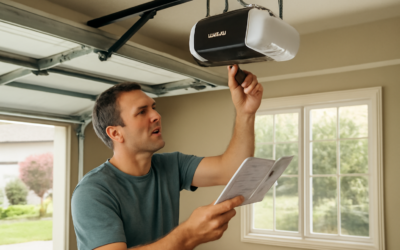
Pairing a remote to a Formula 1 follows Liftmaster’s classic learn-button routine. Set up a ladder so you can reach the motor unit safely, then:
- Press and release the learn button on the back of the opener. An indicator light will glow for about 30 seconds.
- Within that window, press and hold the button on your remote you want to use.
- Watch the opener light blink or the motor click once to confirm the code was accepted.
- Release the remote button and test the door.
For a wireless keypad, enter your chosen four-digit PIN and press enter first, then press the learn button and press enter again on the keypad within 30 seconds. If nothing pairs, the frequency almost certainly does not match; re-check the learn-button color.
Common Problems and How to Fix Them
The single most frequent complaint is a door that reverses immediately or refuses to close while the opener light flashes ten times. That flashing is the safety sensors telling you they are misaligned or blocked. Wipe the photo-eye lenses, confirm both are pointed at each other, and look for a steady (not blinking) LED on each sensor. A stray box, a spider web, or a bumped bracket is usually the whole story.
Grinding or slipping usually points to a loose or over-stretched chain. There is a threaded adjustment on the trolley that takes up slack; the chain should have only about a half-inch of sag at the midpoint of the rail. If the door hesitates or struggles, the travel and force limits may need adjustment using the dials on the motor housing. Turn them in small increments and test after each change, because setting the force too high defeats the safety auto-reverse.
Lubrication and Routine Care
A chain-drive opener rewards a little maintenance with years of quiet service. Twice a year, wipe the chain and apply a garage-door-rated lubricant, either a white lithium grease or a silicone spray made for openers. Do not use WD-40, which is a solvent and degreaser, not a long-term lubricant. While you are up there, spray the door’s hinges, rollers, and springs so the opener is not fighting a stiff door.
Check the mounting hardware once a year. Vibration slowly loosens the lag bolts that hold the motor to the ceiling bracket and the rail to the header. A wobbling unit is noisy and wears the chain unevenly.
Replacement Parts and Remote Options
Because the Formula 1 uses Liftmaster’s standard Security+ platform, you are not limited to a discontinued original remote. Any current Liftmaster or Chamberlain remote that matches your learn-button color will pair, and universal remotes from brands like Genie or Clicker list the Formula 1 in their compatibility charts. A basic replacement remote runs $20 to $40, and a wireless keypad is about $30 to $50.
If the logic board itself fails, a repair is often possible but rarely economical. A replacement circuit board can cost $80 to $150 plus labor, which starts to approach the price of a brand-new opener with a warranty, a battery backup, and smartphone control.
Adding Modern Accessories
Because the Formula 1 rides on Liftmaster’s standard Security+ platform, you can bolt on conveniences it never shipped with. A wireless keypad mounted outside the garage lets you or the kids get in with a PIN, no remote required, and pairs the same way a remote does. A second or third remote for extra vehicles is a cheap add, and a compatible universal remote from another brand will work as long as it matches your learn-button frequency.
What you generally cannot add is native smartphone control, since the Formula 1 predates built-in Wi-Fi. If app control matters, a separate retrofit smart-garage controller can bridge the gap, wiring into the opener’s terminals and adding phone control and open-or-closed status alerts. It is an affordable way to modernize an old but working opener without replacing the whole unit, letting you check from anywhere whether you left the door up.
Resetting Travel and Force Limits
Two adjustments quietly control how well a Formula 1 behaves: travel limits and force limits. Travel limits tell the opener how far to move the door to reach fully open and fully closed. If the door stops short of the floor, reverses before closing, or slams down too hard, the travel setting is off. On these units you adjust it with the up and down travel dials on the motor housing, turning them in small increments and running the door after each change until it seats correctly.
Force limits govern how much push the motor applies before it decides something is in the way and reverses. Set too low, the door reverses for no reason on a cold morning when the door is stiff. Set too high, the safety reverse becomes dangerous. Adjust force gradually, and always test the auto-reverse afterward by laying a 2×4 flat under the door; the door should touch the wood and immediately back off. If it does not, the force is too high and needs to come down.
Safety Checks Every Owner Should Run
Because this opener predates some modern safety features, it is worth confirming the basics work. Beyond the 2×4 reversal test, check the photo-eye reversal by waving a broom through the beam as the door closes; the door should stop and reverse instantly. Test the emergency release cord, the red handle, so you know how to disconnect the door and open it by hand during a power outage.
Also inspect the door’s springs and cables while you are at it. A struggling opener is often fighting a door with a weak or broken spring, and that puts strain on the motor that no adjustment can fix. Spring work is dangerous and best left to a professional, but simply noticing a gap in a coil or a frayed cable tells you the real problem lies with the door, not the opener.
When to Repair Versus Replace
A Formula 1 that only needs sensors aligned, a chain tightened, or a fresh remote is absolutely worth keeping; these units were built to last and parts are cheap. But if the motor is straining, the gears are stripped, or the board is dead, weigh the repair against a modern opener. Newer models add rolling-code security you can trust, ultra-quiet belt drives, and app control for well under $300 installed.
For most homeowners, the Liftmaster Formula 1 garage door opener is a reliable old friend that just needs occasional attention. Learn to read its learn button, keep the chain lubricated, and respect the safety sensors, and it will keep opening your door long after you expected it to quit.