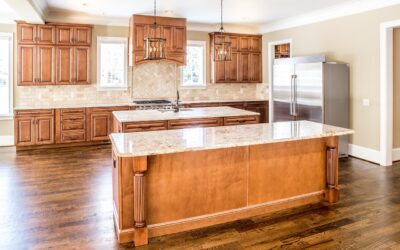
Most kitchen islands end up under-lit because the homeowner hangs three pendants where a single 48 inch linear fixture would have done the job better and cleaner. A long kitchen light — whether it is a linear chandelier, a continuous LED strip, or a row of low-profile panels — solves the dim-spot problem on long counters and reads as more architectural than a string of pendants. The trick is sizing it right and matching the color temperature to the rest of the kitchen lighting.
Part of our Kitchen Remodeling guide — explore the full guide →
This guide covers sizing rules, fixture types, lumen targets, and the brands worth shortlisting for islands, peninsulas, and galley counters.
How Long Should the Fixture Actually Be
The two-thirds rule is the working starting point: the linear fixture should be roughly two-thirds the length of the surface it lights. A 9 foot island wants a 60 to 72 inch fixture. A 6 foot peninsula calls for 36 to 48 inches. Anything shorter and you get dark zones at the ends of the counter; anything longer crowds the cabinets and looks oversized.
Hang height matters as much as length. For islands with seating, the bottom of the fixture should sit 30 to 36 inches above the countertop. Drop it lower and tall guests will hit their head; raise it higher and the fixture loses its visual connection to the counter. Use a laser distance measure like the Bosch GLM 20 to set this precisely before drilling.
Linear Chandeliers and Pendants
Linear chandeliers — fixtures that look like horizontal chandeliers with multiple bulbs along a beam — are the dressiest option. Brands like Visual Comfort, Hinkley, and Hudson Valley price these between $400 and $2,200 depending on size and finish. The Visual Comfort Bryant linear in aged brass with five 60 watt equivalent bulbs has become a designer default for modern farmhouse kitchens.
For a more transitional look, Pottery Barn’s PB Linear and Rejuvenation’s Caplin work at $500 to $1,400 range. Always confirm the canopy mounts to a single ceiling box or to two boxes with a remote driver — older homes with single boxes need a fixture rated for one connection point or you will be patching drywall.
Linear LED Fixtures and Channel Lighting
For modern kitchens, sealed linear LED fixtures give clean, uniform light without bulbs to swap. WAC Lighting Stik and Tech Lighting Tellus run $300 to $900 for 48 to 72 inch lengths and put out 3,000 to 6,000 lumens. They are dimmable on a forward-phase or 0-10V dimmer depending on the model.
For an even cleaner look, recessed LED channels mounted into a soffit or beam disappear into the ceiling and wash the counter below. Diode LED Chromapath and Klus channels paired with LED tape run about $40 per linear foot installed. This works particularly well over peninsulas where a hanging fixture would cut sightlines into the dining area.
Matching Color Temperature Across the Kitchen
Color temperature is where most kitchen lighting falls apart. The long fixture, the recessed cans, the under-cabinet strips, and the range hood light all need to match — within 100 Kelvin of each other. Pick 2700K for traditional kitchens with warm wood tones, 3000K for transitional spaces, and 3500K for white or gray modern kitchens.
Skip 4000K and cooler unless the kitchen is purely task-driven and never used for dinner parties. Cool light makes warm wood look orange and white quartz look gray. Verify the CRI rating too — anything below 90 makes food and skin look washed out. WAC, Tech, and Hudson Valley all spec 90+ CRI on their LED products.
Lumen Targets for the Surface Below
An island used primarily for food prep needs 50 to 70 lumens per square foot at the counter surface. A 4 by 8 foot island is 32 square feet, so target 1,600 to 2,240 lumens delivered to the counter. After accounting for fixture losses and hang height, you want a fixture rated for 3,000 to 4,500 total lumens.
If the island is purely decorative — a bar setup or display surface — drop the target to 20 to 30 lumens per square foot. The fixture still has to read as substantial, but it does not need to support knife work.
Wiring and Switching
The long fixture should be on its own dimmer separate from the recessed cans. Use a Lutron Caseta or Diva CL dimmer rated for LED loads — a standard dimmer can flicker LED drivers below 30 percent. For multi-location control on a kitchen with two entrances, Caseta gives wireless three-way switching without running new wire to a second box.
If the existing ceiling box is in the wrong spot, plan to fish new 14/2 Romex from a nearby junction and patch the original location. A licensed electrician will quote $200 to $500 for the move including drywall patching.
Top Picks by Budget
- Under $400: Globe Electric Bayonne 48 inch linear in matte black — surprisingly substantial for the money
- $400 to $800: Hinkley Calder 60 inch linear in heritage brass — handles 9 foot islands cleanly
- $800 to $1,500: Hudson Valley Bari linear in aged brass with white shades — designer staple
- $1,500 plus: Visual Comfort Bryant linear in any finish — the benchmark
Installation Notes from a Contractor
Use a swivel-jaw fish stick to fish the new wire through the joist bay rather than cutting open the ceiling. Add a fan-rated brace box even if the fixture is light — it gives a solid mount and lets a future homeowner swap the fixture without re-framing. Pre-assemble the fixture body on the floor and lift it with a second person; trying to assemble a 60 inch chandelier overhead alone is how shades get cracked.
Set the hang height with the fixture temporarily hung from a length of paracord and adjust before cutting the chain or cable. Take five minutes to step back from every angle of the kitchen before committing.
Choosing the right long kitchen light ties the room together architecturally and solves a lighting problem that string pendants only mask. Size to two-thirds the counter, match the rest of the kitchen’s color temperature, and put it on its own dimmer.