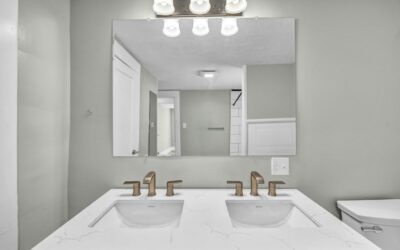
Two quartz slabs can share almost identical ingredients and still differ in price by a factor of two or three. The gap is not marketing alone. Luxury quartz countertops earn their price through realistic veining that runs through the slab, careful pattern matching, thicker and larger slabs, refined finishes and the fabrication skill to show all of that off. Basic quartz is a durable, practical surface; premium quartz is designed to pass for natural marble or quartzite at arm’s length.
Part of our Countertops guide — explore the full guide →
The short version: if you want a plain white or speckled counter, entry-level quartz performs just as well as the expensive stuff. The upcharge makes sense when you want a dramatic marble look, a large island without a seam, mitered or waterfall edges, or veins that wrap convincingly over edges and continue across seams. Knowing the quality signals lets you spot real value and avoid paying premium prices for basic slabs.
- What Makes Luxury Quartz Countertops Different
- Finishes and Edge Work
- Quality Signals to Check in Person
- When the Upcharge Is Worth It
- Cost Ranges
- Pairing With Sinks and Fixtures
- Questions to Ask Before You Sign
- Design Choices That Show Off Premium Slabs
- Care and Maintenance
- Troubleshooting
- When to Call a Licensed Professional
- Frequently Asked Questions
What Makes Luxury Quartz Countertops Different
All engineered quartz is made by blending ground natural quartz with resin and pigments, then pressing and curing the mix into slabs. The differences come from how the pattern is created, how carefully the slab is produced and how big and thick it is.
Through-body veining
Entry quartz often has a uniform speckle or a printed surface pattern. In premium slabs, veins are layered into the mix so they run partly or fully through the thickness. When an edge is profiled or a sink is cut, the vein continues into the cut face instead of stopping at a plain band. That matters most for mitered edges, waterfall ends and undermount sink cutouts, where cut faces are visible.
Realistic, varied patterns
High-end marble-look quartz features veins with soft edges, varying widths, subtle secondary veins and translucent depth. Cheaper patterns can look painted on, with repeating motifs or veins that start and stop abruptly. Look at the full slab, not a 4-inch sample, to judge pattern quality.
Book-matching and sequential slabs
Some premium designs are produced as matched pairs so two slabs mirror each other at a seam or across a waterfall. That level of control is rare in basic lines.
Jumbo slab size
Standard slabs are about 120 by 55 inches. Jumbo slabs reach roughly 130 by 65 inches or more, allowing big islands with no seam. Premium collections are more often offered in jumbo format.
Thickness options
Luxury lines usually come in 3 centimeter thickness, and some offer thicker slabs, which feel more substantial and reduce the need for built-up edges.
Finishes and Edge Work
Premium quartz often offers more than one surface finish:
- Polished: glossy, deepens veins, easiest to clean.
- Honed or matte: soft and stone-like, but shows fingerprints and metal marks more.
- Textured or leathered: tactile and natural-looking, good at hiding smudges.
Edges are where craftsmanship shows. A mitered edge with veins flowing over the corner, a crisp waterfall with matched veining down the side, or a perfectly flat, tight seam signals a skilled fabricator. Even the best slab looks ordinary with a sloppy seam or misaligned vein. Ask fabricators for photos of their mitered and waterfall work in marble-look patterns.
Quality Signals to Check in Person
- View the full slab in the yard, under good light, and from several feet away as well as up close.
- Check cut edges on remnants. Does the vein continue into the body?
- Look for consistency in color and resin distribution; blotchy patches or pooled resin are signs of lower quality control.
- Ask about warranty length and what it covers, including heat damage and outdoor use.
- Ask about UV stability. Most quartz is indoor-only; sun can yellow the resin.
- Request a seam plan showing where seams fall and how veins will be matched.
Shoppers searching for high end quartz countertops sometimes assume price guarantees quality. Ask the same questions at every price point, and compare slabs side by side.
When the Upcharge Is Worth It
Worth paying for
- A large island where a seam would interrupt a dramatic pattern.
- Mitered, waterfall or full-height backsplash designs that expose cut faces.
- A marble look in a busy family kitchen where real marble would etch.
- Homes in a price range where buyers expect high-end finishes.
Probably not worth it
- Laundry rooms, secondary baths or rental units.
- Solid or lightly speckled colors, where basic quartz looks virtually the same.
- Small runs with simple eased edges and no visible cut faces.
Cost Ranges
Installed costs for quartz span a wide range. As general figures, entry quartz often runs roughly $50 to $80 per square foot, mid-range about $70 to $110, and luxury quartz countertops $100 to $200 or more per square foot. Jumbo slabs, mitered edges, waterfall ends and complex vein matching each add cost. Get quotes that break out material, fabrication, edges, cutouts and installation.
Compare that with natural marble and quartzite, which often fall in a similar or higher range. Premium quartz trades some natural depth for consistency, low maintenance and resistance to stains and etching.
Pairing With Sinks and Fixtures
An undermount kitchen sink shows off the polished cut edge of a premium slab and makes cleanup easy, since crumbs sweep straight in. Ask the fabricator to polish the sink cutout to the same sheen as the top. Stainless, granite composite and fireclay undermount sinks all work. Faucet holes are drilled on site or in the shop, depending on your fixture.
Questions to Ask Before You Sign
A quote for premium quartz should tell you exactly what you are paying for. Before you approve it, ask the fabricator these questions:
- Which slabs, by lot or batch number, will be used, and can I see and tag them?
- Where will seams fall, and how will veins be matched across them?
- Is the sink cutout polished to match the top, and is the faucet hole drilling included?
- What edge profile is included, and what does a mitered or waterfall edge add?
- Does the price include removal of old countertops, plumbing disconnection and reconnection, and backsplash pieces?
- What is the warranty on fabrication and installation, separate from the material warranty?
- How do you control silica dust in the shop and on site?
Fabricators who answer clearly and show photos of finished seams and mitered corners are more likely to do justice to an expensive slab. Vague answers or a refusal to show slab layouts are warning signs, whatever the price.
Design Choices That Show Off Premium Slabs
The more cut faces and continuous surfaces a design has, the more a premium slab pays off. A waterfall island with matched veining down both ends is the classic example. A full-height backsplash cut from the same slab, running from counter to ceiling behind the range, turns the stone into a feature wall. Floating shelves or window sills in matching quartz tie the room together.
Keep surrounding finishes calm so the stone can lead. Flat-panel or simple shaker cabinets, plain hardware and quiet flooring let dramatic veining take center stage. Lighting matters too: warm 2700K to 3000K bulbs flatter cream backgrounds and gold veins, while 3500K to 4000K suits bright white and gray patterns. Under-cabinet strip lighting highlights texture and depth on polished surfaces.
Finally, think about how long you will stay. Luxury quartz countertops make the most financial sense in a kitchen you plan to enjoy for many years, or in a home where buyers expect high-end finishes. For a short-term stay, a mid-range slab with a simple layout often delivers most of the look for far less.
Care and Maintenance
Quartz is nonporous, so it never needs sealing. Clean with warm water and mild soap or a pH-neutral cleaner. Avoid harsh chemicals like oven cleaner and strong solvents, which can damage resin. Use trivets under hot pans, because sudden heat can scorch or crack quartz. Cutting boards protect the polish, especially on matte finishes that show metal marks.
Troubleshooting
Faint gray marks on a honed finish
Usually metal transfer from pots or utensils. A soft cloth and a mild cream cleaner removes them.
Visible seam
Ask the fabricator to re-fill and level it with color-matched adhesive. Prevention starts with a good seam plan.
Discoloration near a window
UV exposure may be yellowing the resin. Window film or shades slow it down.
When to Call a Licensed Professional
Premium quartz deserves a premium installer. Cutting quartz releases high levels of crystalline silica dust, which can cause serious lung disease, so fabrication requires wet cutting, dust extraction and fitted respirators, never dry cutting at home. Slabs are heavy and can crack if mishandled, so installation is a crew job. Hire a licensed plumber to connect sinks, disposals and dishwashers, and a licensed electrician for any new or moved outlets, which must be GFCI protected near counters. Check local permit requirements for kitchen remodels.
Frequently Asked Questions
What makes quartz countertops high end?
Realistic through-body veining, book-matched or jumbo slabs, thicker material, refined finishes and skilled fabrication with tight seams and matched veins.
Is luxury quartz more durable than basic quartz?
Not necessarily. Both are similarly hard and stain resistant. The premium is mostly about appearance, slab size and pattern quality.
How much do luxury quartz countertops cost?
Roughly $100 to $200 or more per square foot installed, depending on slab, edges and region.
Does luxury quartz look like real marble?
The best patterns are very convincing, with varied, soft-edged veins and depth. Viewing the full slab helps you judge realism.
Do luxury quartz countertops need sealing?
No. Quartz is nonporous and never needs sealing. Just clean with mild soap and use trivets for hot pans.